
Ball Mastery for 7–9 Year Olds: The Dribbling Foundation That Actually Transfers to Games
At ages 7–9, your child or player is sitting at one of the most important windows in their entire soccer development. Motor skill learning is rapid, attention is capturable, and the sport-specific patterns a kid burns in now will be the instincts they call on at 14. The problem? Most…
Ball Mastery for 7–9 Year Olds: The Dribbling Foundation That Actually Transfers to Games
At ages 7–9, your child or player is sitting at one of the most important windows in their entire soccer development. Motor skill learning is rapid, attention is capturable, and the sport-specific patterns a kid burns in now will be the instincts they call on at 14. The problem? Most U8–U10 sessions waste this window on cone slaloms that go nowhere and drills where half the group is standing in line. Here’s how to do it right.
Why this matters at this age
The US Youth Soccer Player Development Model describes ages 4–9 as the biological “Childhood” stage — a period where technical development is mostly exploratory and where volume and variety matter more than perfection. That sounds like permission to keep things loose, and in one sense it is. But “exploratory” doesn’t mean unstructured. It means kids need lots of reps of simple patterns across both feet and all surfaces before complex combinations are meaningful.
The US Youth Soccer Coaching Manual is direct about the physical side: growth plates near the ankle and knee are still forming at this age. Drills with rapid, repetitive direction changes — done at full speed before the pattern is learned — put real stress on those structures. The fix isn’t to avoid direction changes; it’s to start every new skill at low speed and add competition only after the movement is comfortable.
Cognitively, 7–9-year-olds are making a transition. According to TeachMe.To’s Soccer Skills for Kids development guide, a 7–8-year-old can dribble while glancing up occasionally; by 8–9, they can receive a ball and redirect it with intent. That progression tells you how to layer your instruction: don’t demand heads-up dribbling in traffic until the feet can manage the ball without conscious attention.
Perhaps most importantly, the US Youth Soccer Player Development Model notes that players the same calendar age can be at very different developmental stages. A 7-year-old and a 9-year-old in the same group may technically belong in different stages of the progression below. Differentiate your tasks. Don’t average the group.
Core concepts
Ball mastery — comfort with the ball using all surfaces of both feet, so that controlling, stopping, and changing direction become automatic. Coerver Coaching identifies ball mastery as the base layer of every dribbling pyramid: you cannot build moves on top of uncertainty with the ball.
Close control — keeping the ball within one touch’s reach at all times during technical work. In open space you can push the ball further ahead; in tight situations, short touches and body shielding take over. Close Control Dribbling
Coerver Ball Mastery Pyramid — a framework that sequences learning from ball familiarity → dribbling moves → feints and fakes → 1v1 attacking. Each layer depends on the one below it. Coerver Ball Mastery Pyramid
Change of pace — the deliberate shift from slow to fast (or the reverse) as a dribbling weapon. This is a decision, not just athleticism. Slow-fast transitions should be coached explicitly, not left to instinct.
Approach pace — a slower, controlled speed of approach toward a defender that leaves room to accelerate explosively after the move lands. Running full speed into a defender is the single most common 1v1 error at this age.
Non-dominant foot equity — equal reps, equal surfaces, both feet, every session. The US Youth Soccer Coaching Manual treats individual ball work as essential throughout this age range. Passive “you can use your left foot if you want” doesn’t count. The drill design has to force it.
1V1 Attacking Principles Dribbling In Tight Space
Progression
Stage 1 — Foot Familiarity (entry, ~age 7)
What to do: One ball per player, every session. Toe-taps, sole rolls, inside-outside touch sequences. Alternate feet on every rep. Sharks and Minnows variants (everyone dribbles, two players try to knock balls out) give you movement and control in a game wrapper without standing in line. Key cue: “Soft feet — the ball is staying close.” Duration: 2–3 weeks of consistent practice. How to advance: Player can perform toe-taps, sole rolls, and inside-outside touches with both feet without looking down at the ball.
Stage 2 — Directional Control (~age 7–8)
What to do: Cone slalom with a specified surface assignment — inside foot only on the right cones, outside foot only on the left. Add the V-turn (drag the ball back with the sole, then push it away at an angle with the inside foot) and the L-turn (inside cut followed immediately by a forward push). No time pressure yet. Key cue: “Check the ball with your sole, then go.” Duration: 3–4 weeks. How to advance: Player executes V-turns and L-turns consistently in both directions without losing the ball.
Stage 3 — Change of Direction with Purpose (~age 8)
What to do:
 ▶ Watch on YouTube
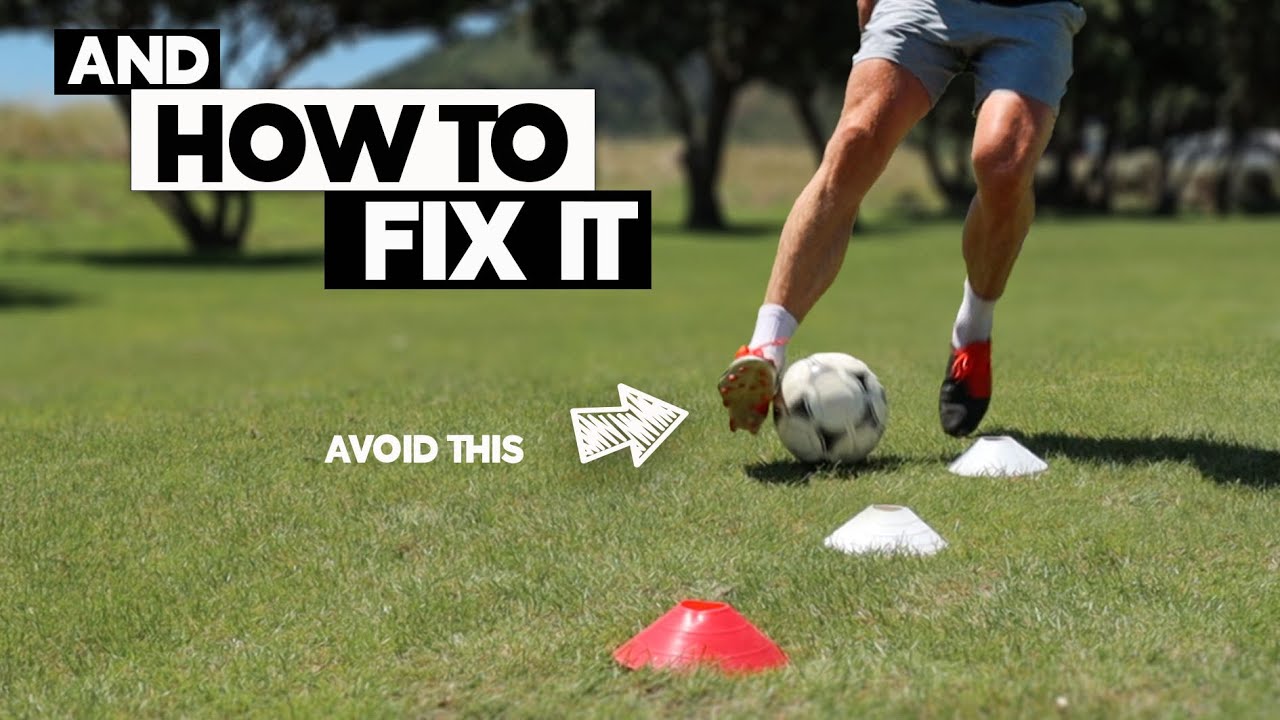
Why MOST Players Can’t Dribble around Cones — by The Football Folk on YouTube.
— dribble at a cone as if it’s a defender, execute a named move (inside cut, drag-back) to change direction before reaching it. The cone is a decision trigger. Also add pull-back combinations: sole roll backward, cut inside with the non-dominant foot. Key cue: “Slow to the cone, fast away from it.” Duration: 2–3 weeks. How to advance: Player consistently uses approach pace (slow) + explosive exit (fast) on 4 out of 5 reps.
Stage 4 — First Feints and Fakes (~age 8–9)
What to do: Introduce the basic step-over (scissors) and the shoulder drop / body feint — one or two moves only, drilled to comfort, not a catalogue. The US Youth Soccer Skills School Manual explicitly introduces feints at this age with defined coaching points. Key cue: “Sell it — make your body say you’re going left before you go right.” The mental concept of deception gets named here for the first time. Duration: 3–4 weeks on each feint before adding the next. How to advance: Player can consistently fool a stationary partner using one feint on both the left and right side.
Stage 5 — 1v1 vs. a Passive/Semi-Active Defender (~age 9)
What to do: The cone from Stage 3 becomes a standing coach or parent, then a slow-moving peer.
 ▶ Watch on YouTube
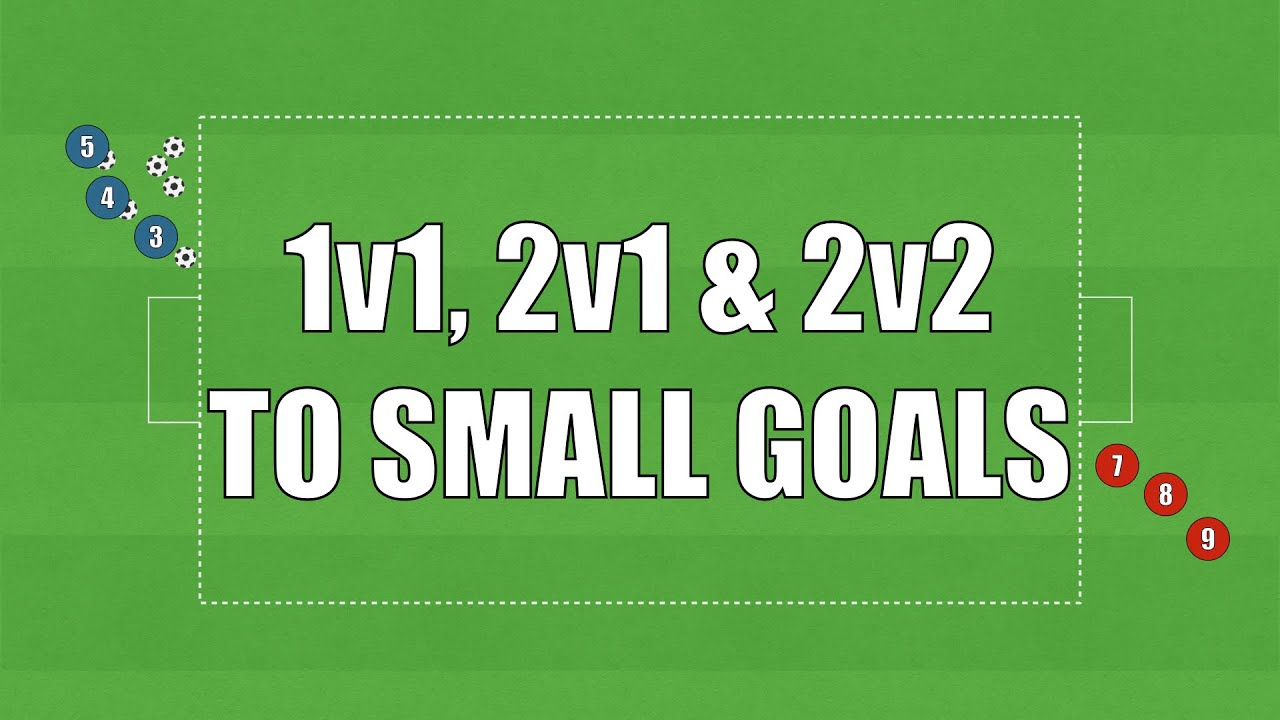
1v1, 2v1 & 2v2 To Small Goals Drills | Football/Soccer — by Onside - Training on YouTube.
— short 1v1 games to small goals, two-minute rounds, frequent rotation. Teach players to read the defender’s weight: “Which foot is the defender’s weight on? Attack the other side.” Key cue: “Don’t run at them — pick your shoulder.” No tackling; defenders use body positioning only. How to advance: Player beats a semi-active defender using a named move 3+ times in a two-minute session.
Stage 6 — Game-Context Dribbling (~age 9)
What to do:
 ▶ Watch on YouTube
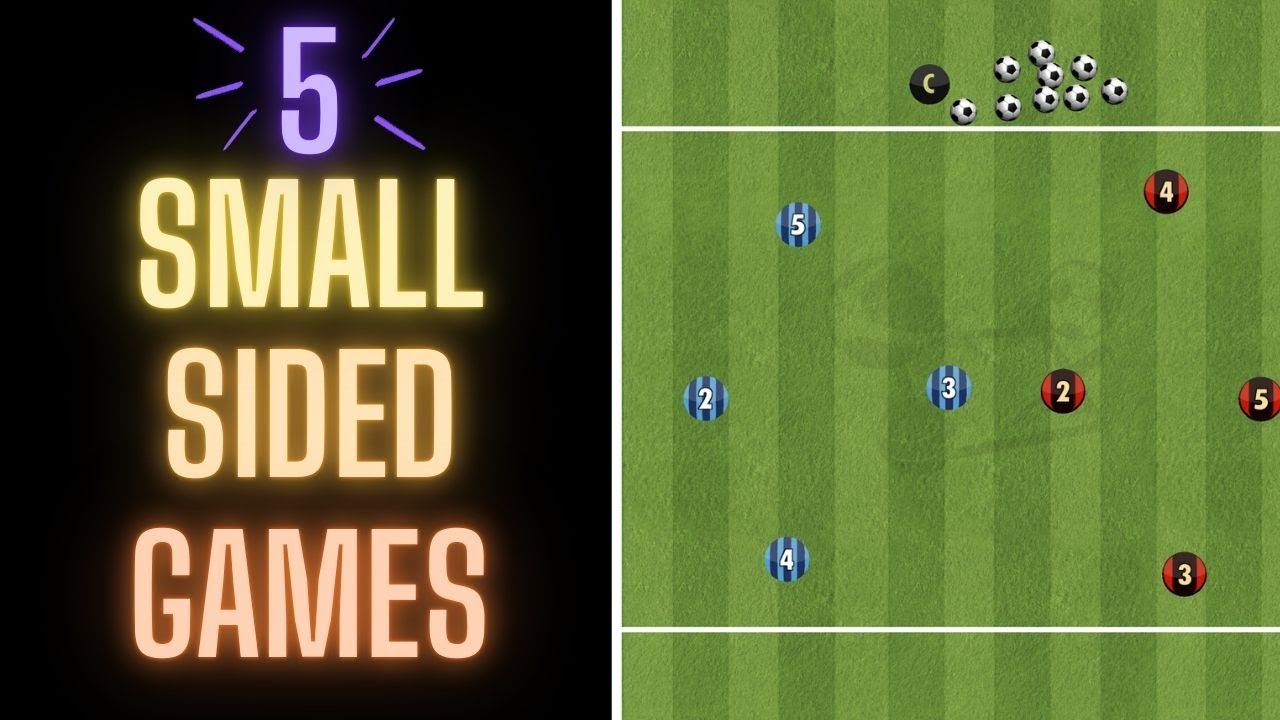
Small Sided Games | 5 Variations | Football/Soccer — by KS Performance on YouTube.
with dribbling rules built in — for example, must dribble past the halfway line before shooting, or gets a bonus point for executing a named move. “Coach holds up a number, dribbler calls it out” games train eyes-up awareness. Change-of-pace dribbling in open space gets specific practice here:
 ▶ Watch on YouTube
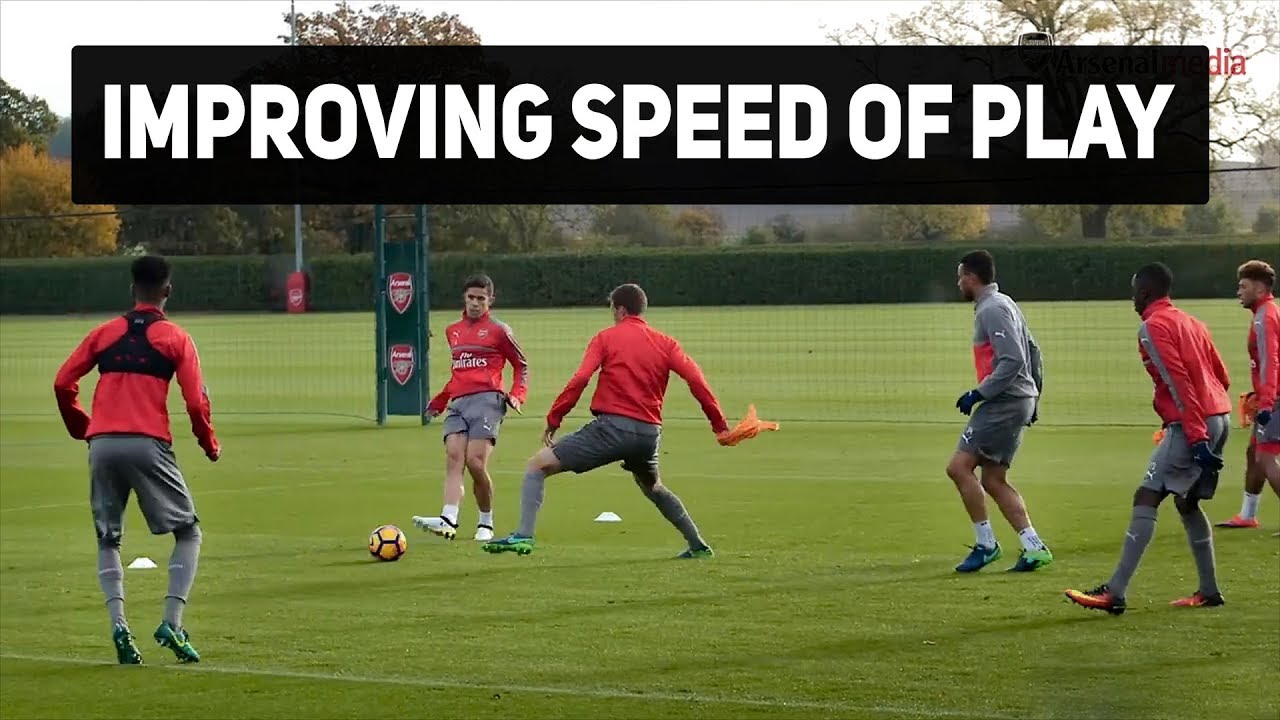
Speed of Play | Learn to Play Quicker — by Become Elite on YouTube.
— dribble at 50% for four touches, then full acceleration for three steps, repeat. Key cue: “Eyes up, touch further, then burst.”
Suggested program / schedule
This assumes two team sessions per week plus short daily solo work at home. Adjust for your actual schedule.
| Day | Activity | Details |
|---|---|---|
| Team Session 1 | Ball mastery warm-up | 8 min of toe-taps, sole rolls, inside-outside (both feet), one ball per player |
| Team Session 1 | Stage drill (current stage) | 10–12 min; named drill with surface or foot constraint |
| Team Session 1 | Small-sided game | 10–12 min 1v1 or 2v2 with a dribbling constraint; mini goals |
| Team Session 2 | Ball mastery warm-up | Same as above, different sequence |
| Team Session 2 | Feint/1v1 focus | 10–12 min Beat-the-Cone or 1v1 to mini goal |
| Team Session 2 | Free small-sided game | 4v4 per US Soccer PDI format; let the skills surface |
| Home (daily, 10 min) | Solo ball mastery | 3 min toe-taps/sole rolls both feet; 3 min V-turns + L-turns; 4 min pull-back + inside-cut combo; no shoes on carpet works fine for foot familiarity |
Change activities every 8–12 minutes. Anytime Soccer Training’s development guide recommends roughly an 80% technique / 20% games split for this age range, with 10–15 minutes of daily home ball work encouraged.
Mistakes to avoid
- Letting players default to their dominant foot. Passive permission isn’t enough — the drill design has to force the weaker foot. If you’re not counting reps by foot, you’re probably not getting equity.
- Long cone lines. Every session, every player should have a ball in their feet. Standing in a line of six kids waiting for one turn is six kids not developing.
- Treating slaloms as the whole dribbling curriculum. Cone slaloms with no decision component don’t transfer to the game. A cone doesn’t shift its weight or pressure you — a defender does. Get players to Stage 5 and 6 quickly.
- Introducing too many moves at once. At ages 7–9, depth on one or two reliable moves beats a wide catalogue of half-learned tricks. TeachMe.To’s development guide warns that players missing solid foundations will plateau around age 12.
- Letting fast kids dribble past everyone at full speed. A player who beats defenders with raw pace isn’t learning dribbling skills. Constrain activities to reward the move, not just the outcome — bonus points for a named feint, for example.
- Skipping the game and fun element. Static rep drills lose 7–9-year-olds quickly. Sharks and Minnows, 1v1 mini-tournaments, and tag games with a ball serve the same technical function with far better engagement and attendance at training.
- Adding speed or competition before the pattern is stable. The US Youth Soccer Coaching Manual is specific: growth plates near the ankle and knee are vulnerable at this age. Any drill with rapid direction change starts at low speed. Competition comes after the movement is automatic, not before.
When to advance
Use these as real checkpoints, not approximate feelings:
- Stage 1 → Stage 2: Player performs toe-taps, sole rolls, and inside-outside touches with both feet for 30 seconds each without looking down at the ball.
- Stage 2 → Stage 3: Player executes V-turn and L-turn in both directions on 4 of 5 attempts without losing the ball at low speed.
- Stage 3 → Stage 4: Player consistently uses slow approach + explosive exit past a cone or stationary target on 4 of 5 reps.
- Stage 4 → Stage 5: Player can deceive a stationary partner using one feint (step-over or shoulder drop) on both left and right sides.
- Stage 5 → Stage 6: Player beats a semi-active defender with a named move 3 or more times in a two-minute 1v1 session.
- Stage 6 — ready for more complexity: Player dribbles with eyes up reliably in small-sided games, uses at least two distinct moves, and varies pace without prompting. Anytime Soccer Training puts a useful age-8 benchmark here: 5+ ball mastery moves performed comfortably, and the ability to beat a defender with at least one reliable move using a fake, feint, or change of speed.
Further reading
- Coerver Ball Mastery Pyramid — How the five layers build on each other, with session examples
- Long Term Athletic Development Soccer — Where U8–U10 sits in the FUNdamentals/Learning to Train transition
 ▶ Watch on YouTube
Sharks and Minnows — by TidewaterSharks on YouTube.
— Full game rules and constraint variations for foot familiarity
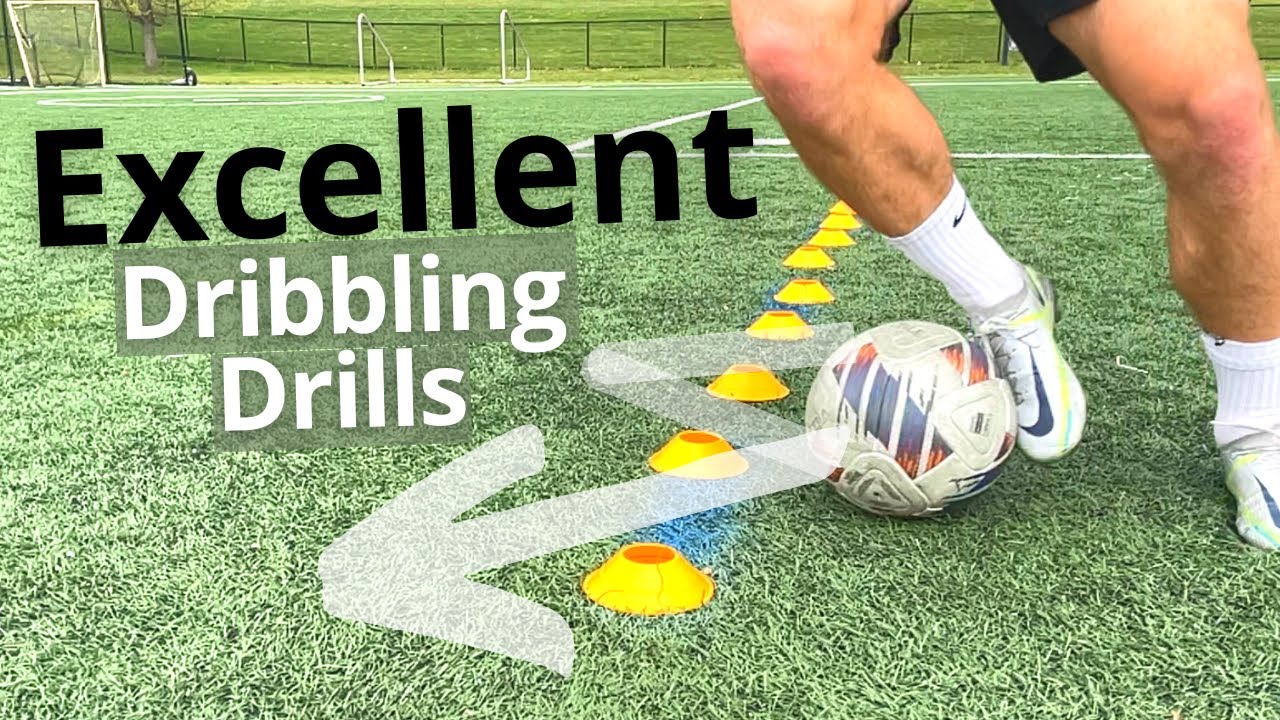 ▶ Watch on YouTube
6 Simple Cone Weave Dribbling Drills for Beginners — by Kreider Academy on YouTube.
— Three-stage escalation from cone to passive defender to live 1v1 - Constraints Led Approach Soccer — How shaping the game environment teaches decisions, not just moves
Sources
- The Official US Youth Soccer Coaching Manual — governing-body — https://www.usyouthsoccer.org/wp-content/uploads/sites/160/2023/09/Official-US-Youth-Soccer-Coaching-Manual-1.pdf
- US Youth Soccer Player Development Model — governing-body — https://cdn2.sportngin.com/attachments/document/0090/7006/US_Youth_Soccer_Player_Development_Model.pdf
- US Youth Soccer Skills School Manual (2017) — governing-body — https://www.usyouthsoccer.org/wp-content/uploads/sites/160/2023/09/2017-Skills-School-Manual.pdf
- Soccer Ball Mastery — Coerver Coaching — practitioner — https://www.coerver.com/blog/soccer-ball-mastery/
- Soccer Skills for Kids by Age: Development Guide — practitioner — https://teachme.to/blog/soccer-skills-for-kids-by-age-development-guide
- Soccer Development Milestones by Age — practitioner — https://anytime-soccer.com/soccer-development-milestones-by-age-what-your-child-should-know-at-every-stage/