
Shooting and Finishing for Ages 12+: Build the Decision, Not Just the Strike
At 12 and older, most young players have been kicking a soccer ball for years. The gap between a good finisher and an average one at this age is rarely raw talent — it's whether they've been trained to make the right decision quickly and execute it cleanly under pressure. This is the…
Shooting and Finishing for Ages 12+: Build the Decision, Not Just the Strike
At 12 and older, most young players have been kicking a soccer ball for years. The gap between a good finisher and an average one at this age is rarely raw talent — it’s whether they’ve been trained to make the right decision quickly and execute it cleanly under pressure. This is the age window where finishing starts to mean something beyond technical repetition, and where coaches who structure practice thoughtfully will see real payoffs in game performance.
Why this matters at this age
Finishing is the highest-stakes technical skill in the game. The US Soccer Coaching Curriculum rates shooting at maximum workload (5/5) from U6 through U18 — it is never deprioritized. But at 12 and older, the nature of finishing work has to evolve. Players are now competing in 11v11 formats. They’re encountering real goalkeepers, real defenders, and real tactical shape. Isolated shooting lines can still build contact quality, but they can’t build the game.
The US Youth Soccer Player Development Model identifies the dominant developmental pillars at this age as Technical (consolidating), Tactical (rising), and Physical (emerging). By 15–18, the Mental pillar takes over — composure, pressure-handling, and decision quality under stress become as important as the underlying technique. In other words, finishing is a mental skill as much as a physical one, and coaches can develop it deliberately.
There’s also a biological wrinkle that coaches at this level must understand. Players aged 12–15 are somewhere in early-to-mid puberty, and the spread of physical maturity within any squad can be enormous. During peak height velocity (PHV) — the rapid growth phase that typically arrives around 12–14 for females and 13–15 for males — temporary drops in coordination and motor fluency are common. If a player who used to strike the ball cleanly suddenly looks disjointed, that may be growth, not laziness. Patience during these windows is not softness — it’s developmental literacy.
One more reality check worth sharing with any coach or parent tracking stats: the FA’s coaching resources note that roughly 60–70% of goals at senior level come from inside the 18-yard box. Training sessions that spend most of their time on long-range drives are, statistically, training for the rarest outcomes. Composure in close-range situations — the curled placement, the calm side-foot, the 1v1 decision — is where finishing is actually won and lost.
Core concepts that apply across the 12+ age range
Instep (laces) drive Instep Drive Mechanics: The primary power strike, executed with the planted foot beside the ball, knee over the ball at contact, and a full follow-through. “Knee over” is the single most important cue — it’s what keeps the shot low.
Side-foot finish (placement) Side Foot Placement: Striking with the inside of the foot for accuracy. Often described as “passing it into the corner,” this is the most reliable finish at any level and should anchor early finishing work.
Instep with curl: Striking the inside-outer part of the laces to bend the ball away from the keeper. Technically a step up from the flat laces drive — introduced once the basic instep is consistent.
Volleys and half-volleys Volley Timing: Striking a dropping or bouncing ball. Timing, body position, and a stable plant foot are the keys. Appropriate to introduce at 12+, starting with half-volleys before full struck volleys from crosses.
Chip finish: Undercutting the ball to lift it over a rushing goalkeeper. Demands composure as much as technique — players must resist the instinct to blast the ball when the keeper closes.
First-time finishing: Striking without a controlling touch. Early sighting of the ball, body shape arriving into the shot, and timing are the cues. England Football Learning’s coaching resources emphasize that less experienced players need more touches before finishing — first-time finishing should be layered in progressively.
Placement over power: The governing principle at this age. Most missed shots come from poor contact quality, not lack of force. This reframe should shape how you give feedback.
Both feet: The motor pattern window for weaker-foot finishing is narrowing through this age band. The US Youth Soccer Player Development Model and broader curriculum guidance make clear that bilateral finishing reps are not optional — they need to be built into session design explicitly, every session.
Progression
Stage 1 — Technical consolidation (Ages 12–13)
Reinforce instep drive and side-foot placement from served passes. Work both feet on every repetition — not as an afterthought at the end of session, but woven into the core activity. Drill example:
 ▶ Watch on YouTube
Soccer Warm Up For Youth Athletes — by Kbands Training on YouTube.
— player receives a ground pass at the edge of the box and finishes side-foot to a designated corner, alternating left and right foot on each rep. Volume cue: keep reps clean; stop and correct if contact quality drops rather than accumulating sloppy reps. Players can advance to Stage 2 when contact is consistent (low and on target) with both feet on ground balls.
Stage 2 — Finishing with movement (Ages 12–13)
Introduce near-post and far-post timed runs to a served cross or pass. The goal is arriving onto the ball in stride rather than standing and waiting. Drill example:
 ▶ Watch on YouTube
Jockey Jose Ortiz makes 'a dream come true' with Kentucky Derby 2026 win | NBC Sports — by NBC Sports on YouTube.
— wide player serves to the near post, central player times a run to arrive as the ball lands. Key cue: “hit your stride at the six-yard box.” Advance when players consistently time three consecutive runs without overrunning or stalling.
Stage 3 — 1v1 with goalkeeper (Ages 13–14)
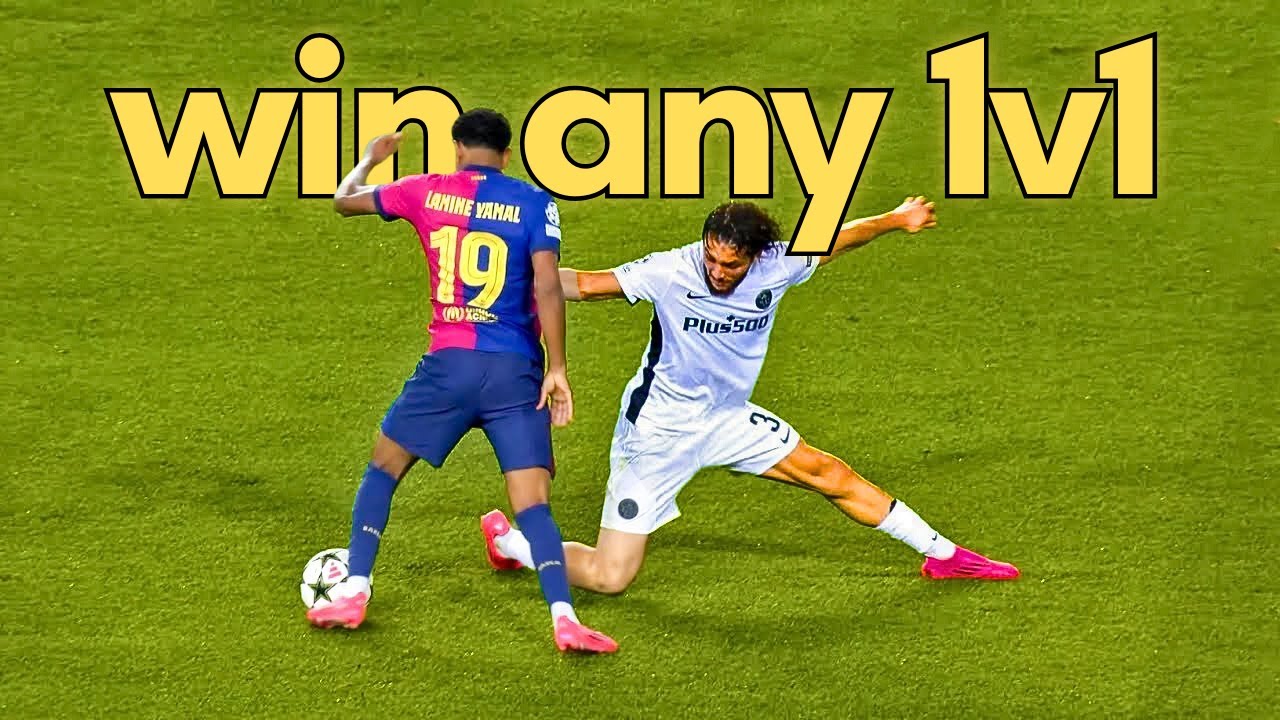
Finishing in live 1v1 situations against a real goalkeeper. The decision — side-foot far post, drive near post, chip, or dribble around — must come from reading the keeper’s behavior, not from a pre-planned script. Drill example:
 ▶ Watch on YouTube
How to Win Any 1v1 (complete guide) — by Football Protocol on YouTube.
— ball played into space behind a midfield line; player runs onto it against a live GK with no prescribed outcome. Cue: “survey the keeper before you commit.” Safety note: explicit rules about goalkeeper safety must be in place — attackers must not follow through dangerously at close range; near-post dinks and chips reduce collision risk significantly.
Stage 4 — Volleys and half-volleys (Ages 13–14+)
Begin with self-drop half-volleys: player drops the ball, lets it bounce once, and strikes instep on the rise. Progress to a partner-served bouncing ball, then to struck volleys meeting a cross from a wide area. Cue: “get your plant foot level with the ball’s bounce point.” Power is not the goal — clean, timed contact is. Advance when contact is reliably low and on frame before increasing delivery variety.
Stage 5 — Finishing under defensive pressure (Ages 14–15)
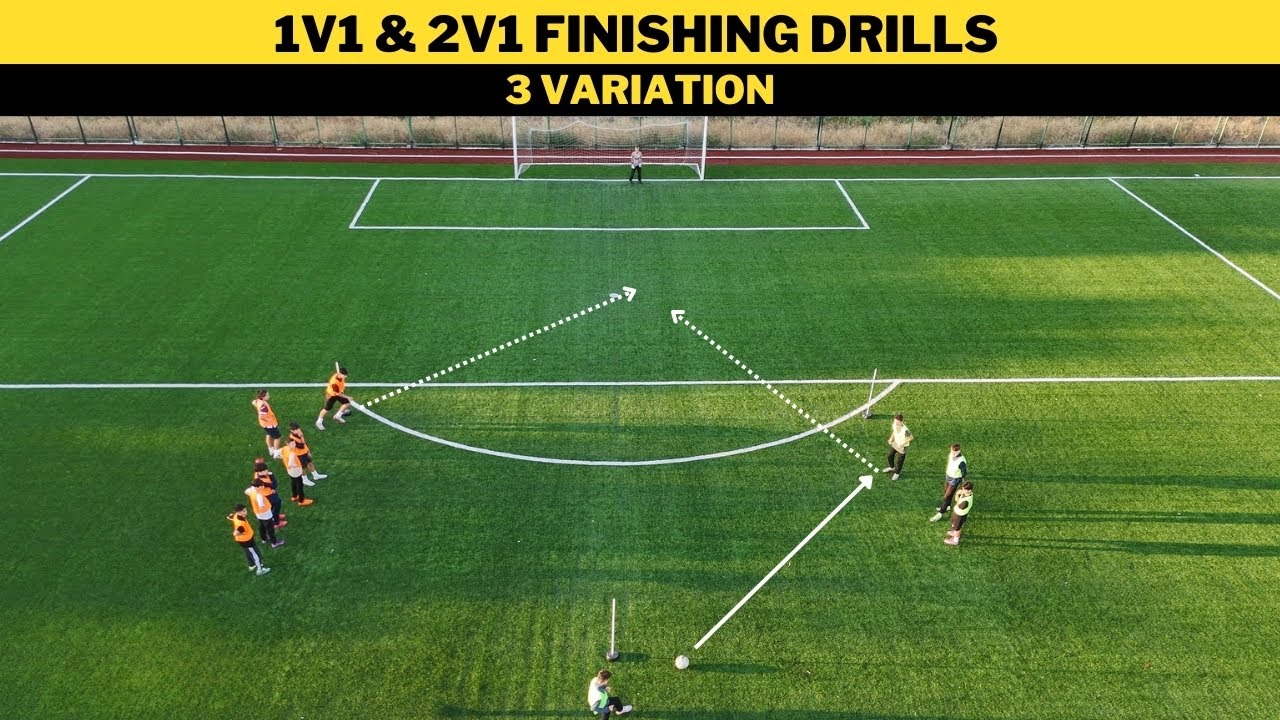
A defender closes from behind or blocks a shooting lane; the player must shield, shift body shape, and still execute the finish. Critically, the decision to shoot versus hold versus lay off is part of the rep. Drill example:
 ▶ Watch on YouTube
1v1 & 2v1 Finishing Drills | 3 Variations | Football/Soccer Training — by AD Football Training Videos on YouTube.
— attacker receives with back to goal against a passive-to-active defender; must create the angle and shoot within four seconds. Cue: “feel where they are, then commit.”
Stage 6 — Combination play to finish (Ages 14–16)
Wall pass to finish, overlap with cut-back finish, third-man run arriving late to shoot. The combination is the practice; the shot is the outcome. Soccer Attack’s drill framework demonstrates how chaining full back → wide player → central midfielder → striker replicates actual game patterns rather than isolating individual shots. The shot should feel like a reward for the movement, not the starting point of the drill.
Stage 7 — Finishing in transition (Ages 15+)
High-intensity small-sided games where finishing must happen immediately off a turnover. Players cannot reset and build — they must read the counter and shoot or drive before the defense recovers. Speed of thought is the variable being trained here, not speed of foot.
Stage 8 — Full game integration (Ages 16+)
Near-post and far-post movement patterns, crossing sequences, and pressing-to-finish transitions rehearsed within 9v9 or 11v11 tactical sessions. The US Soccer Curriculum identifies Finishing in the Final Third as a collective tactical concept that peaks at U17–U18 — this stage is where the individual technique and the team attacking shape start to work as one system.
Suggested weekly program
This template assumes two to three training sessions per week, consistent with the US Soccer PDI’s recommended training-to-game ratio. Adjust volume if players are in peak growth (PHV) — reduce high-repetition kicking loads during rapid growth periods.
| Session | Focus | Activities | Load notes |
|---|---|---|---|
| Session 1 | Technical consolidation + weak foot | Dynamic warm-up (FIFA 11+ or equivalent); instep drives and side-foot to corners, both feet; Stage 1/2 drills | 20–25 min finishing; cap reps per player |
| Session 2 | Game-realistic finishing | 1v1 vs. GK (Stage 3); combination-to-finish sequences (Stage 6); crossing-and-finishing runs | 25–30 min; embed in team shape where possible |
| Session 3 or Match prep | Transition finishing + small-sided | High-intensity SSGs with counter-finish rule; volley/half-volley introduction (Stage 4) if appropriate | Short, sharp; 15–20 min |
Mistakes to avoid
Prioritizing power over placement. Most missed shots in this age group are poor-contact misses, not power deficits. Reframe the instep drive as a contact quality exercise first — the power follows.
Standing flat-footed before shooting. A static approach kills hip rotation and momentum. Players must approach at an angle and arrive into the strike, not into it standing still.
Leaning back at contact. When the upper body leans back, the shot goes over. Cue “knee over the ball” on every instep rep until it becomes automatic.
Plant foot too far from the ball. Planting wide forces the player to reach, which collapses hip rotation and direction. The plant foot should be beside the ball, pointing toward the target.
Static queue-based shooting lines. These build contact quality in isolation but develop no decision-making. England Football Learning’s guidance recommends starting there and moving off it quickly — not staying there all session.
Skipping weaker-foot reps. Players will always default to their dominant foot unless the coach builds bilateral reps into the structure. By 14–16, the motor pattern window is narrowing — treat this as urgent.
Rushing in 1v1 against the goalkeeper. Shooting too early or without composure is the most common 1v1 mistake. Cue players to commit the keeper first — draw them out, then decide.
Not scanning before receiving. A player who doesn’t know where the keeper is before the ball arrives will produce aimless shots. Scanning cues (“head up on your last touch before the pass comes”) belong in finishing practice, not just possession work.
Treating crossing and finishing as the same skill as central shooting. Meeting a ball from a wide area while running across goal is a distinct technical and timing skill. It needs dedicated repetition, not just occasional inclusion.
Over-coaching during live reps. Interrupting a game-realistic finishing rep to correct technique breaks the decision-making loop. Pause, demonstrate, then restart — don’t narrate through live action.
When to advance
Concrete markers by stage:
- Stage 1 → 2: Player completes 8 of 10 ground-ball finishes on target using both feet, with knee-over contact and a clean follow-through.
- Stage 2 → 3: Player times three consecutive near-post or far-post runs correctly (arriving in stride) without overrunning on three separate training days.
- Stage 3 → 4: Player demonstrates at least two distinct 1v1 decisions (e.g., drives one rep, chips another) based on keeper position rather than habit, over multiple sessions.
- Stage 4 → 5: Player contacts half-volleys cleanly (low and on frame) from a served bouncing ball on both feet across two sessions.
- Stage 5 → 6: Player executes a clean finish under passive-to-moderate defensive pressure with correct body shape — not just the result, but the movement quality.
- Stage 6 → 7: Player consistently produces the finishing touch as the end product of a combination sequence in training rather than breaking off to shoot individually.
If a player shows coordination regression during what appears to be a growth phase, pause stage advancement and reduce technical load — do not interpret normal PHV effects as a skills gap that needs to be drilled harder.
Further reading
- Peak Height Velocity And Skill Development
- Placement Vs Power In Youth Finishing
- Bilateral Motor Development Weaker Foot
- Breakaway 1V1 Decision
- Crossing And Finishing Timing Mechanics
Sources
- How to Coach Players on Finishing in Football — governing body (England Football / The FA) — https://learn.englandfootball.com/articles-and-resources/coaching/resources/2022/How-to-coach-shooting-in-football
- US Soccer Coaching Curriculum (Guide to Coaching) — governing body (US Soccer Federation) — https://www.ossca.org/documents/ossca/coachingeducation/US_Soccer_Guide_to_Coaching.pdf
- US Youth Soccer Player Development Model — governing body (US Youth Soccer) — https://www.usyouthsoccer.org/wp-content/uploads/sites/160/2023/09/Player-Development-Model.pdf
- US Soccer Player Development Initiatives (PDI) — governing body (US Soccer Federation) — https://static.ussdcc.com/users/148963/897090_eng-october2017pdi.pdf
- Soccer Attack! 80 Shooting & Finishing Drills — practitioner resource — https://cloud.rampinteractive.com/westsideyouthsoccer/files/SoccerattackHR.pdf
- 4 Soccer Shooting Drills for Youth Players — practitioner resource — https://soccer-coaches.com/4-soccer-shooting-drills-youth-players