
Ball Mastery for Ages 4–6: What Your Little Soccer Player Actually Needs
Your 5-year-old doesn't need to learn the Cruyff turn. What they need is a ball at their feet, an imagination, and a coach who knows when to stop talking. At the Discovery Stage — roughly ages 4 through 6 — the entire job of soccer practice is to make kids fall in love with the ball.…
Ball Mastery for Ages 4–6: What Your Little Soccer Player Actually Needs
Your 5-year-old doesn’t need to learn the Cruyff turn. What they need is a ball at their feet, an imagination, and a coach who knows when to stop talking. At the Discovery Stage — roughly ages 4 through 6 — the entire job of soccer practice is to make kids fall in love with the ball. Get that right, and everything else follows. Get it wrong, and you’ve spent a season teaching techniques to kids whose brains and bodies aren’t ready for them.
Why this matters at this age
The 4–6 window is when foundational movement habits form. According to peer-reviewed research cited in a meta-analysis by Alonso-Martínez and colleagues, object control skills like kicking and dribbling are genuinely responsive to structured movement intervention at preschool age — the window is real and important. What you do now doesn’t just affect this season. It shapes how a child relates to a ball for years.
The US Youth Soccer Model for U-6 is explicit: body control comes before ball control. A 4-year-old is still figuring out how to run, stop, and change direction without a ball in the mix. Add a ball and you’ve just doubled the cognitive demand. The motor foundation — balance, coordination, basic agility — has to be built first.
Intrinsic motivation is also on the line. A research intervention study by Wilhite, Chui, Sacheck, and colleagues found that physical literacy-based, play-focused programs improve both movement skills and behavioral self-regulation in preschool children. The flip side: if kids don’t enjoy this stage, they quit. Fun isn’t optional — it’s the mechanism.
And perhaps the most practical stake for coaches: habits form here. The ICA Coaching Manual for 4–6 year olds structures its first eight weeks so that dribbling comfort — not passing, not shooting — is the entire focus for the opening three weeks. Passing comes later. That sequencing is intentional. Same goes for the non-dominant foot. Equal time on both feet is a habit you build at this age, not a correction you make at 12.
Core concepts
One ball per player — Every child has a ball for the entire session. The US Youth Soccer U-6 model is unambiguous on this: every minute of practice should have every child touching a ball. Lines eliminate ball contact. Lines are the enemy.
Play-based guided discovery Guided Discovery Coaching — The coach sets up engaging games and environments, then steps back. The US Youth Soccer U-6 model explicitly flags over-coaching as a problem. Visual demonstrations and imaginative cues replace technical corrections.
Ball familiarity (“Me and My Ball”) — The goal for this age is comfort with the three surfaces of the foot: inside, outside, and sole. This isn’t about moves — it’s about the ball feeling like a natural extension of the body.
Both feet from day one Non Dominant Foot Development — Equal left and right foot exposure should be woven into every activity. This is a consensus-backed coaching principle, and the habit is easiest to build before a dominant foot is entrenched.
Close control — The ball should stay near the player’s feet at all times. The Parker Recreation drill guide uses the phrase “keep the ball your friend” — that’s exactly the right level of instruction for this age.
Coerver ball mastery — entry level only Coerver Ball Mastery Pyramid — The Coerver ball mastery pyramid has many layers, but at ages 4–6, only the base applies: repetitive individual touches to build feel. Step-overs, feints, and signature moves are for older athletes with more developed motor patterns.
Small-sided format — US Soccer’s Player Development Initiative specifies 3v3 or 4v4 on small fields with no goalkeeper. Every player is close to the ball most of the time. Full-size fields and big goals actively work against development at this age.
Progression
Stage 1 — Body Exploration (no ball)
Jumping, hopping, skipping, stopping on command, changing direction. No ball yet. Build the balance and coordination base that dribbling will need. Keep it to 5 minutes max, make it a game — “freeze!” works fine.
Stage 2 — Ball Familiarization (stationary)
Rolling the ball with hands. Sole-of-foot exploration while standing still. Alternate toe-taps on top of the ball — this is the
 ▶ Watch on YouTube
Soccer Drill - How to do Toe Taps - Online Soccer Academy — by Online Soccer Academy on YouTube.
the Parker Recreation guide calls “petting the dog.” Cue: “Pet the dog with BOTH feet, left then right.” One minute per side. No movement yet.
Stage 3 — Walking Dribble
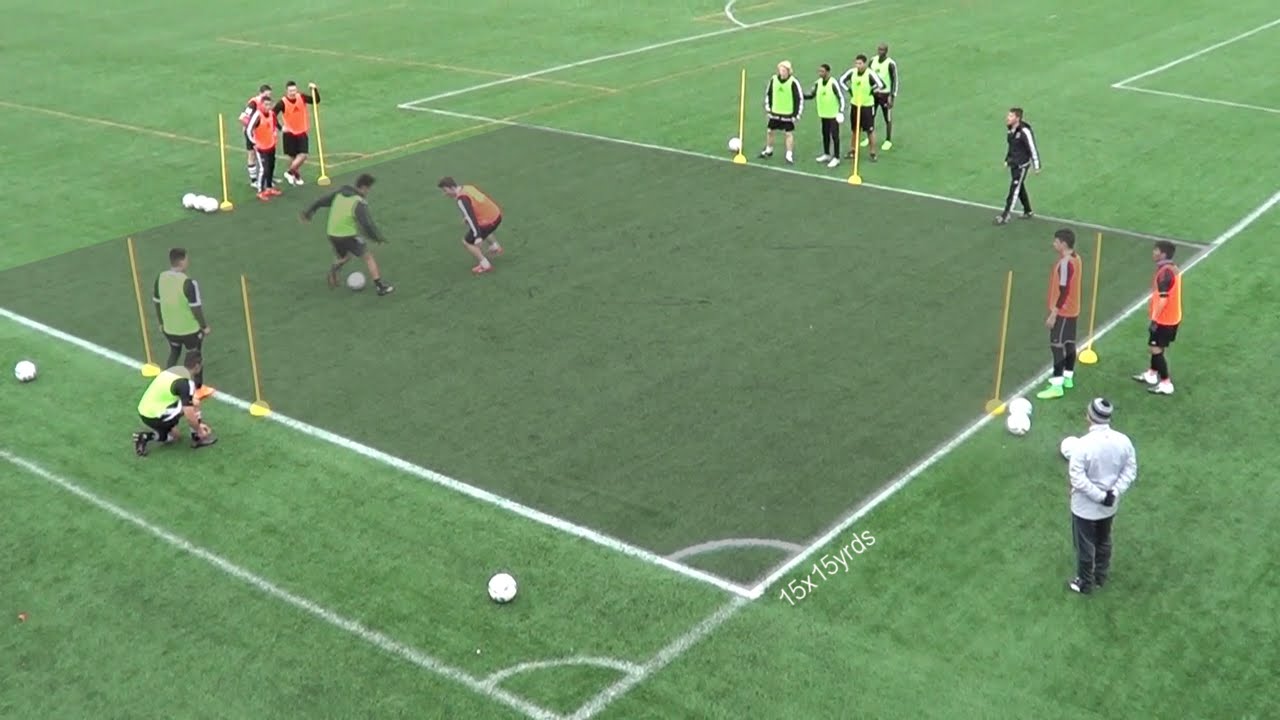
Move with the ball at a walk, using inside foot, outside foot, and sole. Inside a 20x20 yard grid (“your house”). No speed pressure whatsoever. Cue: “Keep the ball close — don’t let it run away from you.”
 ▶ Watch on YouTube
1vs1 Dribbling Soccer Drill | Attacking & Defending Exercises — by Professional Soccer Coaching on YouTube.
Three to four minutes, then rotate.
Stage 4 — Dribble with Simple Direction Change
Reach the end line and stop with the sole of the foot. Then go another direction. This is the
 ▶ Watch on YouTube
Red Light/Green Light Soccer Drill — by Rockford Park District on YouTube.
— coach calls “Red light!” and players freeze the ball under their foot. “Green light!” and they’re off again. Cue: “Stomp it!” for the stop. No formal drag-back move — just stop, look, and choose a new direction. Four to five minutes.
Stage 5 — Dribble in a Crowd
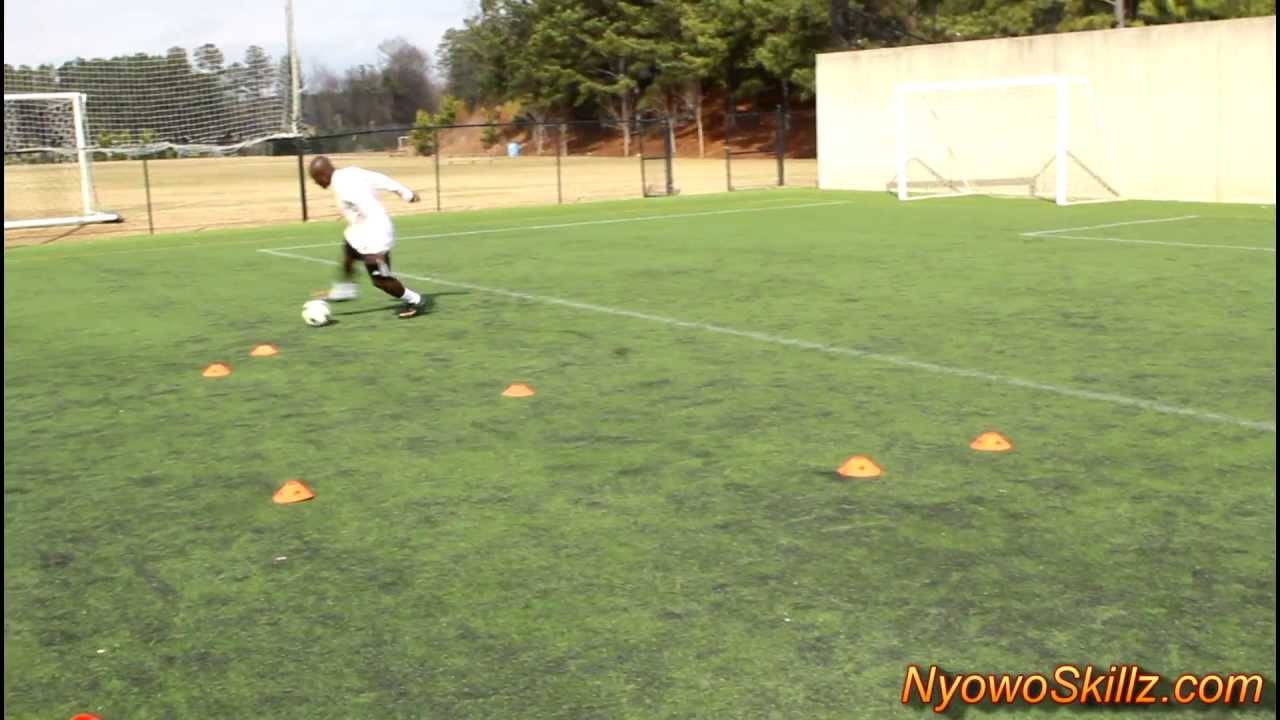
All players, all with balls, in the same 20x20 grid. Navigate each other without collisions. No defenders — just traffic. This is the
 ▶ Watch on YouTube
How to Play Striker Position in Soccer -- Dribbling in Traffic — by NyowoSkillz on YouTube.
and it quietly builds vision and touch at the same time. Cue: “Eyes up, ball close.” Four to five minutes.
Stage 6 — Soft Tag Games (ball plus body awareness)
 ▶ Watch on YouTube
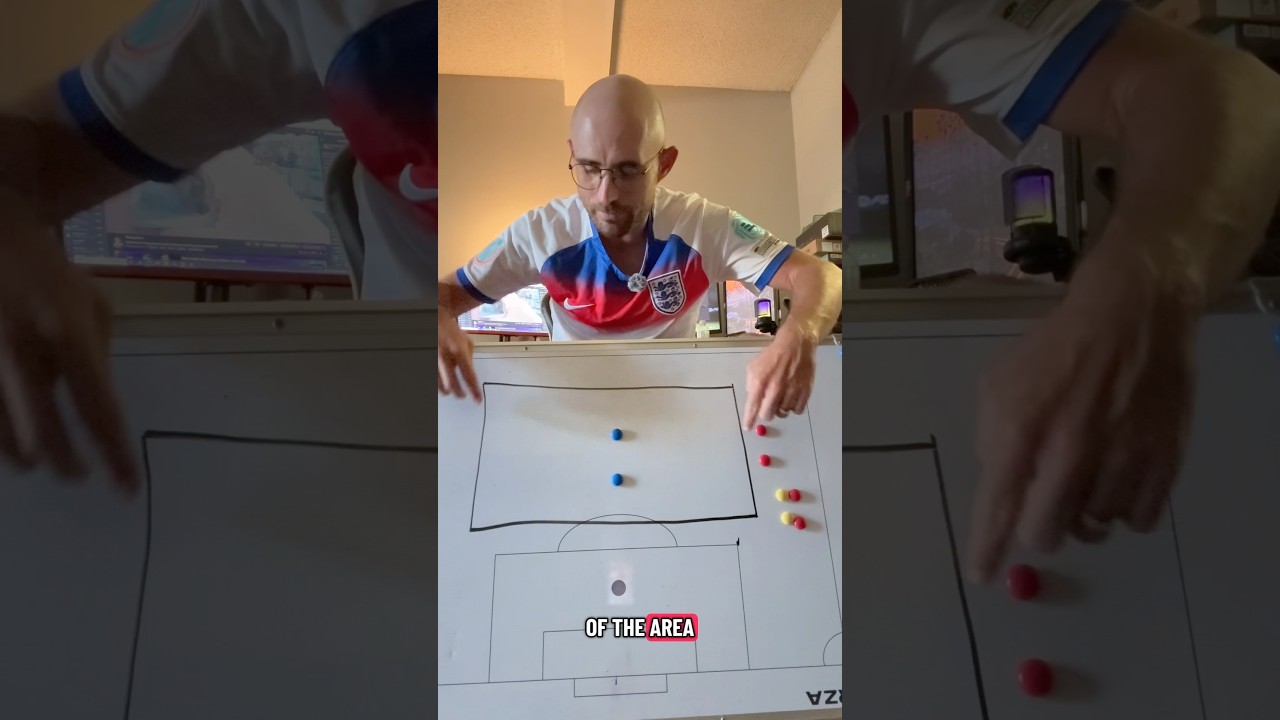
Day 19 - 100 Drills in 100 Days - Sharks and Minnows #soccer #football #coaching — by The Gaffer Jay on YouTube.
and are the workhorses here. In Transformer, every player has a ball and tries to kick others’ balls out of the grid while keeping their own in. This introduces protective dribbling entirely through instinct — no technique instruction needed. Physical contact is not appropriate; this is soft tag only. Rounds of one to two minutes, high energy.
Stage 7 — Simple Direction Games
“Dribble to the red cone, then the blue cone.” “Follow the leader.” Mirroring a partner’s movement with the ball. Builds responsiveness and decision-making without any defender pressure.
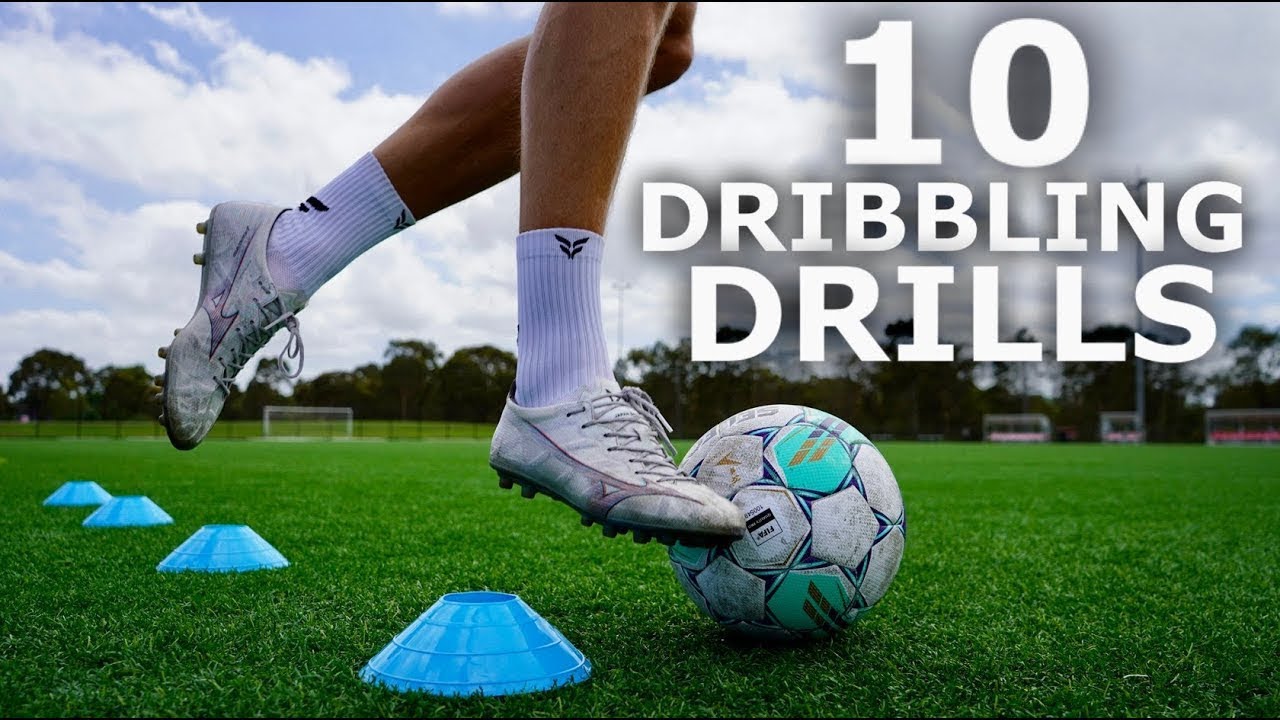 ▶ Watch on YouTube
Master Dribbling Technique | 10 Close Control Dribbling Exercises For Footballers — by 7mlc on YouTube.
Two to three minutes per variation.
Stage 8 — Small-Sided Free Play (3v3 or 4v4)
This is the culminating context for everything above. Let them play. Coach facilitates from the outside; does not narrate or correct during the game. The ICA Coaching Manual structures every weekly session to end here. The US Youth Soccer U-6 model notes that in a 3v3 game, the player with the ball is essentially in a 1v5 situation — reinforcing that individual ball work and small-sided play are the same thing at this age.
Suggested program / schedule
Sessions should not exceed 45 minutes. The following is one practice session, not a weekly split — at this age, one or two sessions per week is appropriate.
| Segment | Activity | Time |
|---|---|---|
| Warm-up | Stage 1: Body exploration — freeze tag, hopping, direction changes (no ball) | 5 min |
| Ball intro | Stage 2: Stationary toe-taps (“Pet the dog, both feet”) | 4 min |
| Dribble 1 | Stage 3: Walking dribble in grid — inside, outside, sole | 5 min |
| Dribble 2 | Stage 4: Red Light / Green Light — sole-of-foot stops | 5 min |
| Dribble 3 | Stage 5: Dribble in a crowd — all players, all balls, same grid | 5 min |
| Game 1 | Stage 6: Transformer (knock balls out, protect yours) — 2-minute rounds × 2 | 6 min |
| Game 2 | Stage 7: Dribble to color cones / follow the leader | 5 min |
| Free play | Stage 8: 3v3 or 4v4 small-sided game — coach facilitates, doesn’t interrupt | 10 min |
| Total | ~45 min |
Water breaks every 10–15 minutes, regardless of weather.
Mistakes to avoid
Putting kids in lines. Every minute in a line is a minute without a ball. Ball-contact volume is the only currency at this age — spend it wisely.
Over-coaching with technical language. Telling a 5-year-old to “lock the ankle” mid-activity shuts down learning. Use visual demonstrations and imaginative cues (“the ball is your puppy — don’t let anyone steal it”) instead.
Introducing formal dribbling moves too early. Step-overs, scissors, and Cruyff turns require motor patterns and decision-making that 4–6 year olds don’t yet have. The ICA Coaching Manual delays even basic move instruction for weeks.
Running formal 1v1 defending drills. Too intimidating, physically risky given size mismatches, and cognitively complex. Tag games accomplish the same protective-dribbling goal safely.
Ignoring the non-dominant foot. Coaches default to cueing the “good foot.” Make both-feet cues part of every single activity from day one.
Sessions longer than 45 minutes. Cognitive and physical fatigue causes regression in skill and behavior. Shorter, high-energy sessions are more productive, not a compromise.
Treating the small-sided game as an afterthought. The game is the main learning environment at this age. Cutting game time to add more drills works directly against development.
Using full-size goals and big fields. Distances overwhelm 4–6 year olds and break the close-control habits you’re trying to build. Scale everything to the child’s body.
Using a size 4 or 5 ball. US Soccer recommends a size 3 ball for U-8 and below. A larger ball raises injury risk and actively slows skill learning.
When to advance
A child is ready to move toward U-7/U-8 content when they can:
- Dribble at a comfortable walk through a crowd of moving players for 3–4 minutes without losing the ball more than twice
- Stop the ball cleanly with the sole of the foot on command, three out of five attempts
- Attempt a touch with both feet in a given activity when prompted (not yet autonomous, but responsive to the cue)
- Stay engaged for a full 45-minute session without significant behavioral difficulty
- Play 3v3 and make at least one unprompted decision to change direction to avoid a teammate or opponent
These are behavioral and functional markers, not age thresholds. A mature 5-year-old may be there; some 6-year-olds will not be. The developmental range within the 4–6 band is wide, and the ICA Coaching Manual notes this explicitly — coaches working with true U-5 groups should assume even less ball-control capacity and plan for more body-exploration time.
Further reading
- Guided Discovery Coaching — How the facilitator model works in youth soccer practice design
- Coerver Ball Mastery Pyramid — The full progression from first touches to advanced moves, age-mapped
- Non Dominant Foot Development — Building two-footed ability from the ground up
- Transformer Game — Full setup, variations, and coaching notes for this protective-dribbling game
- Red Light Green Light Dribble — Setup, progressions, and how to layer in direction changes
Sources
- US Youth Soccer Model for U-6 — The Fundamental Stage — governing body — https://www.msjsl.com/Default.aspx?tabid=1182086
- US Youth Soccer Skills School Manual (2017) — governing body — https://www.usyouthsoccer.org/wp-content/uploads/sites/160/2023/09/2017-Skills-School-Manual.pdf
- Training for 4 to 6 Year Olds — ICA Coaching Manual — practitioner — https://dt5602vnjxv0c.cloudfront.net/portals/80647/docs/coaches%20corner/training%20for%204%20to%206%20year%20olds.pdf
- Soccer Coaching 3 to 5 Year Olds — Parker Recreation Drill Guide — practitioner — http://parkerrec.com/DocumentCenter/View/10742/Drills-for-3_5yr?bidId=
- Getting an Active Start: Assessing the Impact of a Physical Literacy-Based Intervention on Preschool-Aged Children’s Fundamental Movement Skills, Motor Competency and Behavioral Self-Regulation — peer-reviewed — https://pubmed.ncbi.nlm.nih.gov/41464494/
- Improving Preschool Fundamental Motor Skills Through Interventions Targeting 24-Hour Movement Behaviors and Socioecological Factors: A Meta-Analysis — peer-reviewed — https://pubmed.ncbi.nlm.nih.gov/40675559/