
Building a Better U10–U12 Soccer Practice: Team Concepts, Game Formats, and How to Actually Develop Players
If your players are between 10 and 12 years old, you're coaching in one of the most important developmental windows in a soccer career. These are the "skill-hungry years" — a phase where basic motor patterns are laid down efficiently and technical habits stick. What you do (and don't…
Building a Better U10–U12 Soccer Practice: Team Concepts, Game Formats, and How to Actually Develop Players
If your players are between 10 and 12 years old, you’re coaching in one of the most important developmental windows in a soccer career. These are the “skill-hungry years” — a phase where basic motor patterns are laid down efficiently and technical habits stick. What you do (and don’t do) in practice right now shapes how these kids play for years. The jump from 7v7 to 9v9 also introduces the first real team shape concepts, which means the way you structure sessions has to evolve too.
Why this matters
The U10–U12 age range isn’t just a step up in field size. It’s the window that long-term athlete development frameworks identify as most sensitive to building foundational soccer skills. The US Soccer Grassroots Player Development Framework describes this as the phase where players begin to “play their role within the team” while still developing individual technique — a balance that requires deliberate practice design.
At the same time, the transition from 7v7 to 9v9 introduces new tactical layers: a second line of defense, wider attacking positions, build-up play from the back, and more complex transition decisions. These concepts can be taught at this age — but only if practice sessions mirror the game’s structure, not a parade of cone drills.
If you skip good practice design here, you get teams that kick it long and chase — not because kids are lazy, but because the practice environment never gave them a better option. The Small-Sided Games Developmental Coaching Resource summarizing Cologne/Abertay research is blunt about this: 11v11 and 7v7 on a full-sized field are described as “totally inappropriate” for players under 12, because they reward physical size and kick-and-run over skill.
How the picture shifts with age
Ages 10 (U10, 7v7): Players are transitioning out of pure individual skill work. They can begin understanding simple team shape — a defensive triangle, supporting angles, basic width in attack. Their working memory and focus have grown enough to hold one or two tactical ideas. Cognitively, they’re starting to grasp cause-and-effect in the game (“if I pass wide, the defender has to move”). Practice should still be dominated by 3v3 and 4v4 games, with 7v7 as the match format.
Ages 11–12 (U11/U12, 9v9): The jump to 9v9 on a 70–80 by 45–55 yard field opens up genuine team-shape concepts — two lines of defense, thirds of the field, goalkeeper distribution. Players this age can begin to understand a teammate’s perspective and problem-solve collaboratively in small groups. They can handle rondos (e.g., 4v2 or 5v2 possession exercises) as positional awareness tools. Stage 4 and 5 concepts like pressing triggers, third-man runs, and overlapping runs are now developmentally accessible — but only when introduced through games, not lectures.
The maturity variable: On any U12 team, one player might be two to three years ahead of another in biological development. The US Soccer Framework is explicit: coaches should not read physical dominance as greater soccer ability. Early maturers may look like better players right now but often lag technically later. Late developers need protection from being written off.
Age-specific guidance
Ages 10 (U10): Introducing Team Shape in 7v7
What to develop: Individual ball mastery remains the core, but team concepts enter — supporting angles, basic defensive goal-side positioning, and width in attack. Players should begin to understand what offside means in practice.
What practice looks like: 3v3 and 4v4 small-sided games dominate the session body. A typical 60-minute session runs: 8 minutes of arrival free play (players with balls, no coach instruction), 12 minutes of ball-active warm-up (every player with a ball — no lines), 15 minutes of 3v3 or 4v4 SSG with a simple constraint (e.g., a goal counts double if scored from a wide zone), 10 minutes of expanded 5v5 with goals and keepers, and 15 minutes of 7v7 match.
Key drill:
 ▶ Watch on YouTube
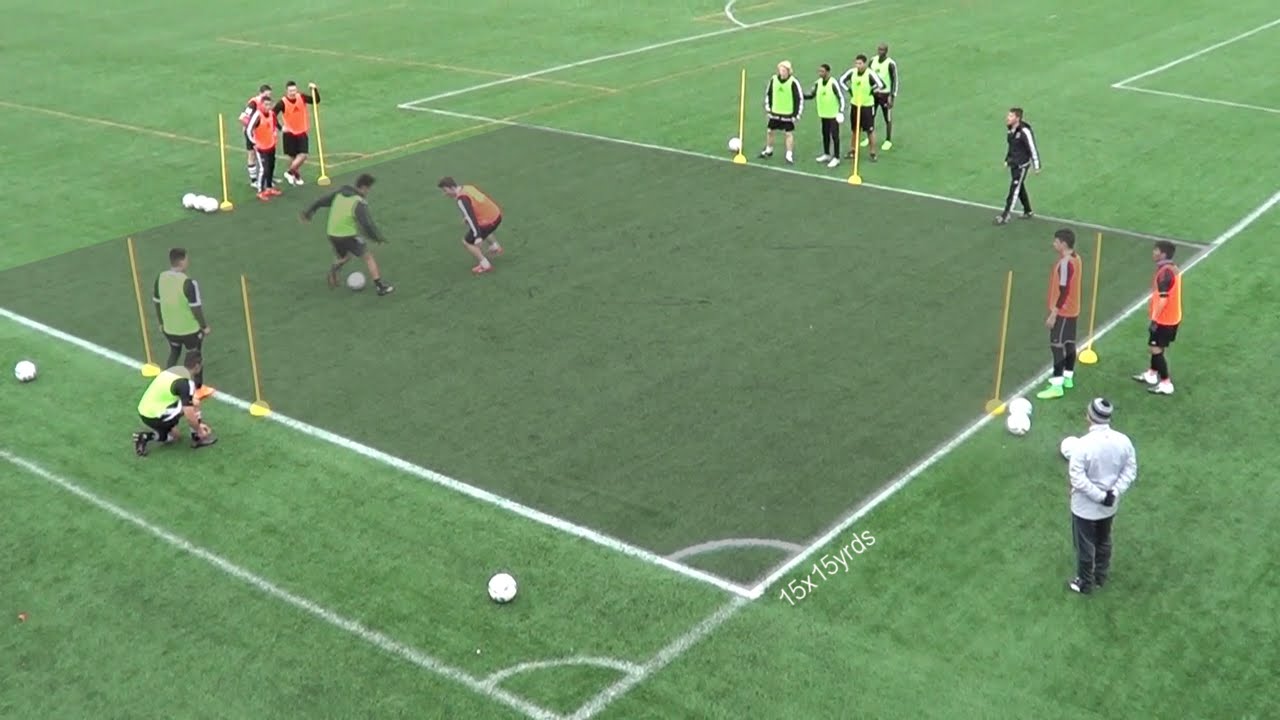
1vs1 Dribbling Soccer Drill | Attacking & Defending Exercises — by Professional Soccer Coaching on YouTube.
— set two small gates on each end line at the wide positions. Teams score by dribbling through a gate OR scoring in the main goal. This rewards width without a lecture about it.
Key cue to players: “Where’s your triangle? Can your teammate see two options?” Use questions, not narration.
What to avoid: Don’t introduce heading practice. US Soccer banned heading entirely at U10 and under in 2015. Don’t assign permanent positions — everyone rotates, including goalkeeper.
Ages 11–12 (U11/U12): Building 9v9 Shape and Transitions
What to develop: Two lines of defense (backs and midfielders holding shape), attacking width and depth, build-up from the goalkeeper, and basic transition decisions — what do we do the moment we win or lose the ball?
What practice looks like: A 75-minute session following the US Soccer Play-Practice-Play structure:
| Block | Time | Activity |
|---|---|---|
| Arrival / Free Play | 8 min | Players arrive with balls, unstructured play |
| Ball-Active Warm-Up | 12 min | Dribbling circuits and |
 ▶ Watch on YouTube
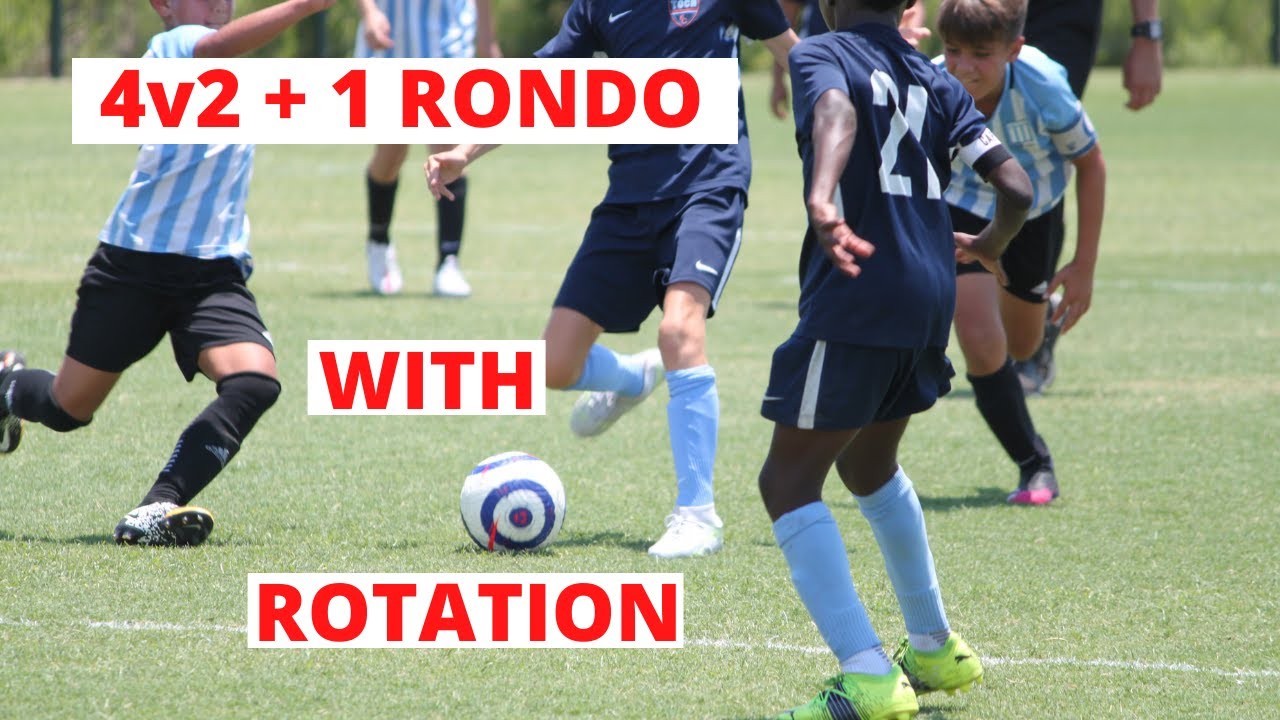
Soccer Coaching Drills | 4v2 + 1 Rondo with Rotation | Toca FC 2010 MLS — by Purpose Driven Futbol on YouTube.
— all players active, no lines | | SSA 1 | 18 min | 4v4 or 5v5 with directional goals and a constraint (bonus point for a wall pass before shooting) | | SSA 2 (Expanded) | 17 min | 6v6 or 6v6+GK with transition trigger (when team wins ball, must advance past halfway in 5 seconds) | | Match | 20 min | 9v9 on full PDI-spec field |
Key drills:
 ▶ Watch on YouTube
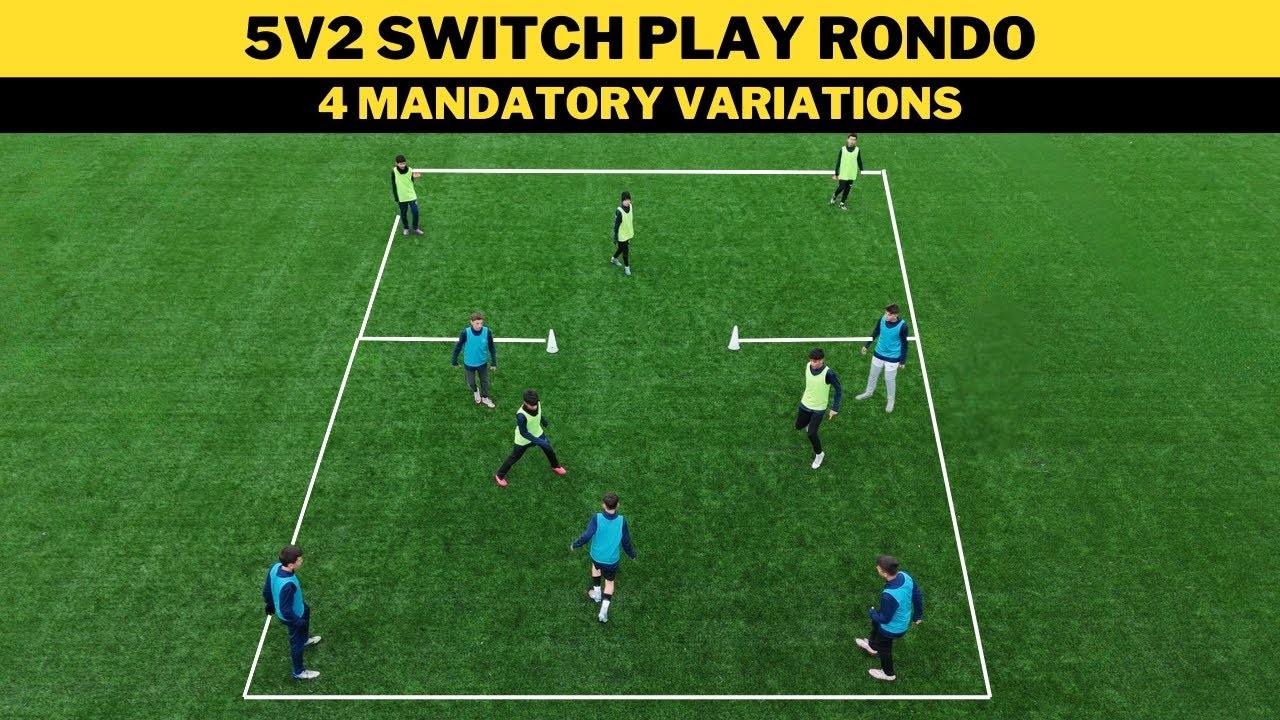
5v2 Switch Play Rondo | 4 Mandatory Variations | Football/Soccer Training — by AD Football Training Videos on YouTube.
— 5 players keep possession against 2 defenders in a square. Cue: “Check your shoulder before you receive. Where’s the pressure coming from?”
 ▶ Watch on YouTube
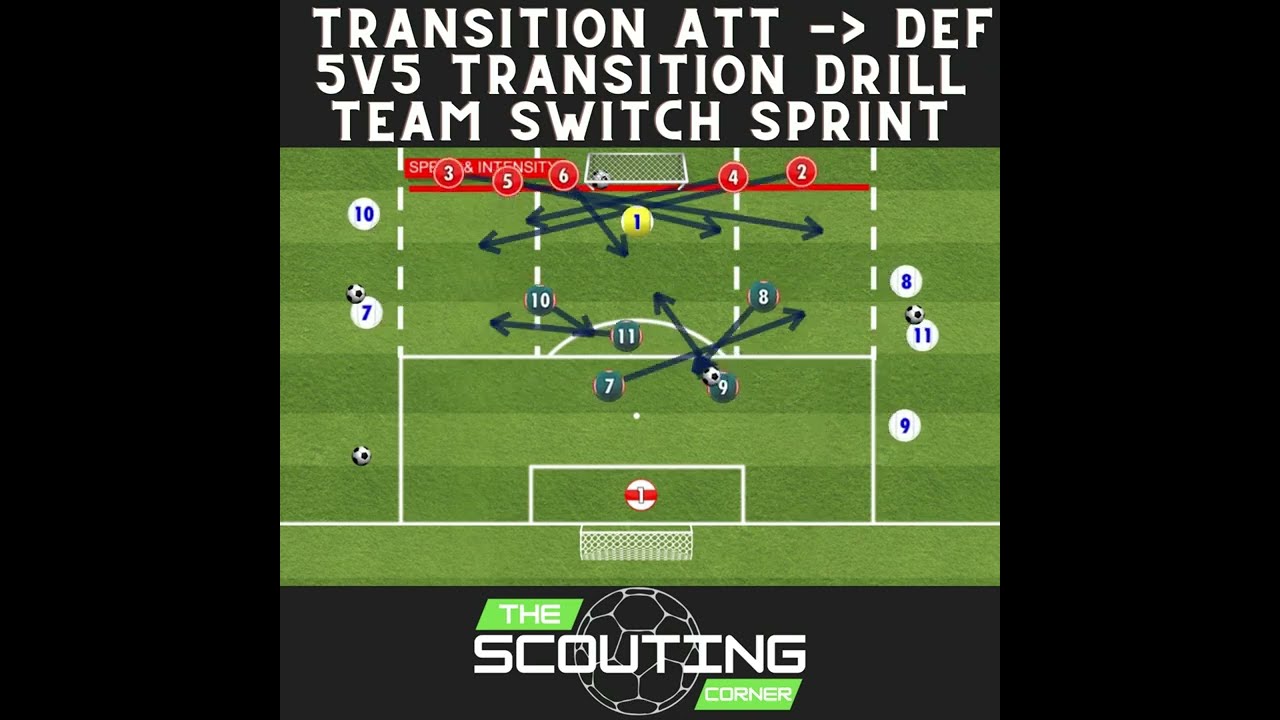
5v5 Transition Game Youth Soccer Coaching Drill How to improve your team defensive transition — by The Scouting Corner Pro Scouting and Player Videos on YouTube.
— When possession switches, the team that just won the ball has 5 seconds to get a player beyond the midfield line. This trains the D-to-A moment without stopping play to explain it.
 ▶ Watch on YouTube
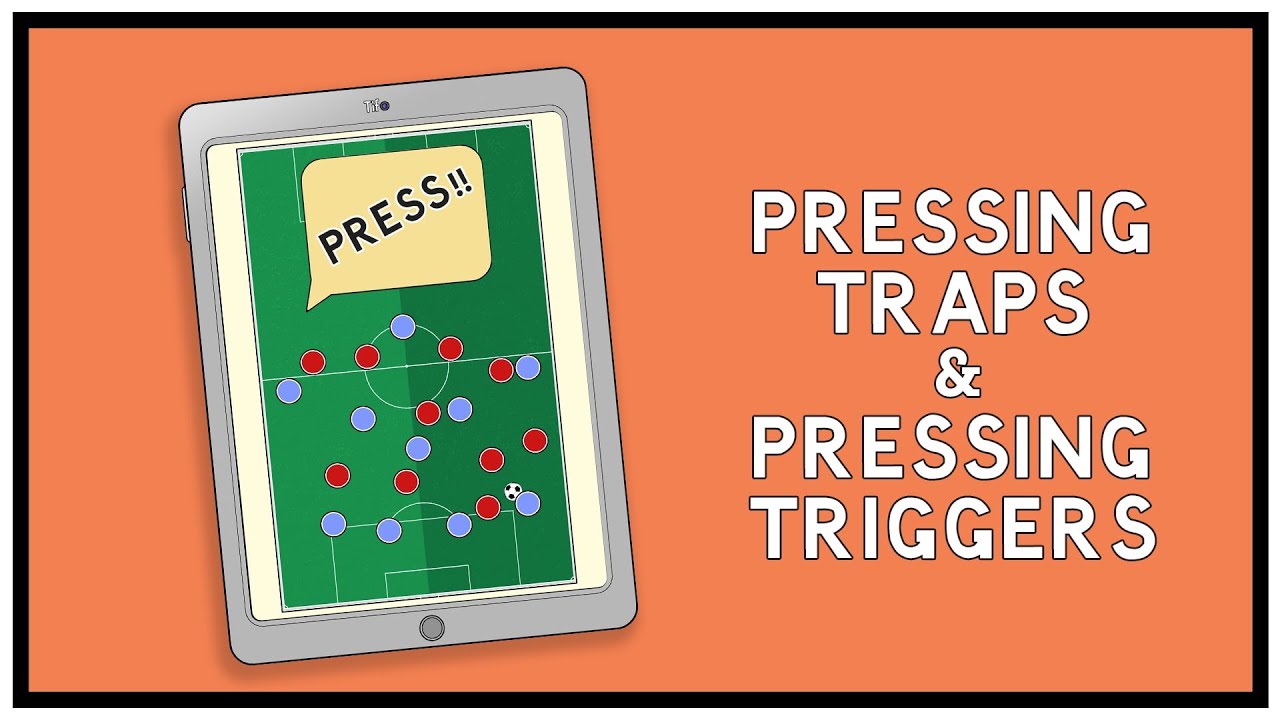
What are pressing traps and pressing triggers? — by Tifo Football by The Athletic on YouTube.
— Defense presses as a unit when the ball goes to a specific zone (e.g., the goalkeeper). Introduces pressing triggers through the game rather than a walkthrough.
Both feet: Activities should require or reward use of the weaker foot. A simple constraint: gates in warm-up can only be dribbled through with the left foot going right, right foot going left.
Scanning habits: The US Soccer Age Group Learning Plans list scanning as a top U11/U12 development goal. Reinforce it with one question per session: “What did you see before you got the ball?”
Core concepts that apply across ages
*Play Practice Play* — The US Soccer session structure where every block connects to a shared theme, and the match at the end is the culmination, not an afterthought.
*Constraints Led Approach* — Changing field size, numbers, or scoring rules to produce behaviors you want, without constant verbal instruction. Better than stopping play to explain.
*Four Moments Of The Game* — Attacking organization, defending organization, transition to attack, transition to defense. Every practice plan should touch all four, even briefly.
*Small Sided Games Touch Counts* — The Cologne/Abertay research documents approximately 14 ball contacts per player per 10 minutes in 4v4, versus roughly 4 in 11v11. This is why small-sided games aren’t just warm-ups — they’re the core development tool.
*Scanning Skills* — Checking shoulders and building awareness before receiving. A habit that can be trained at this age because players now have the cognitive capacity to sustain it.
*Psychological Safety In Training* — A practice environment where fear of mistakes dominates kills experimentation and risk-taking — both of which are required for skill development.
Common mistakes (any age)
Joystick coaching. Narrating every decision from the sideline during games and small-sided activities. This stops players from solving problems. Use guided questions instead — “What did you see?” not “Play it wide!”
Running players through lines. Dribble through cones, wait, next player goes. Low touches, zero decisions, no transfer to the game. Replace with competitive 1v1 or small possession games.
Jumping straight to the full match format. Going from a 3v3 activity directly to 9v9 without a bridge activity means players never get to apply the session idea before the game’s complexity overwhelms it. Always include the expanded SSA step.
Locking players into permanent positions. Assigning a U12 player as your permanent striker or centerback limits their technical and physical development. The US Soccer Framework explicitly recommends multi-position exposure through U12.
Too many coaching points at once. Research and practitioner consensus both point to one clear coaching point per activity. Multiple corrections at once overload working memory. Pick one thing, say it once, let the game do the teaching.
Skipping arrival free play. Starting structured coaching the moment players arrive removes player-initiated creative reps and tanks motivation. The US Soccer framework specifically values unstructured arrival play as part of every session.
Running repetitive heading drills. This carries documented concussion risk for developing brains. It is banned at U10 and under, and restricted at U11/U12. Check your state association’s rules — some are stricter than US Soccer’s baseline.
Excessive practice volume at club level. Scheduling five or more sessions per week at U12 is increasingly common in competitive clubs and runs past what long-term development guidance recommends for this age. It raises overuse injury risk and contributes to early dropout.
When and how to advance
Progression between stages isn’t about age — it’s about demonstrated readiness. Use these observable markers:
- Stage 1 → Stage 2: Players consistently maintain supporting angles in 3v3 without prompting. Ball mastery is solid enough to receive under light pressure without losing possession immediately.
- Stage 2 → Stage 3: Players understand and apply basic goal-side defending in 5v5. Switching the point of attack is attempted in games, not just when coached to do it.
- Stage 3 → Stage 4: Players can name and describe the two lines of defense. Rondos don’t collapse immediately — players are making scanning checks before receiving.
- Stage 4 → Stage 5: Players begin organizing themselves using the team’s style-of-play principles without coach prompting during the match block. Transition decisions (winning/losing the ball) are made quickly and consistently.
If a group isn’t meeting the readiness markers, stay at the current stage. The US Soccer framework allows a coach to spend multiple months in Stage 3 if that’s where the group is. Advancing the stage while mechanics remain shaky just buries the gaps under more complexity.
Further reading
- Play Practice Play Session Structure
- Constraints Led Approach In Youth Soccer
 ▶ Watch on YouTube
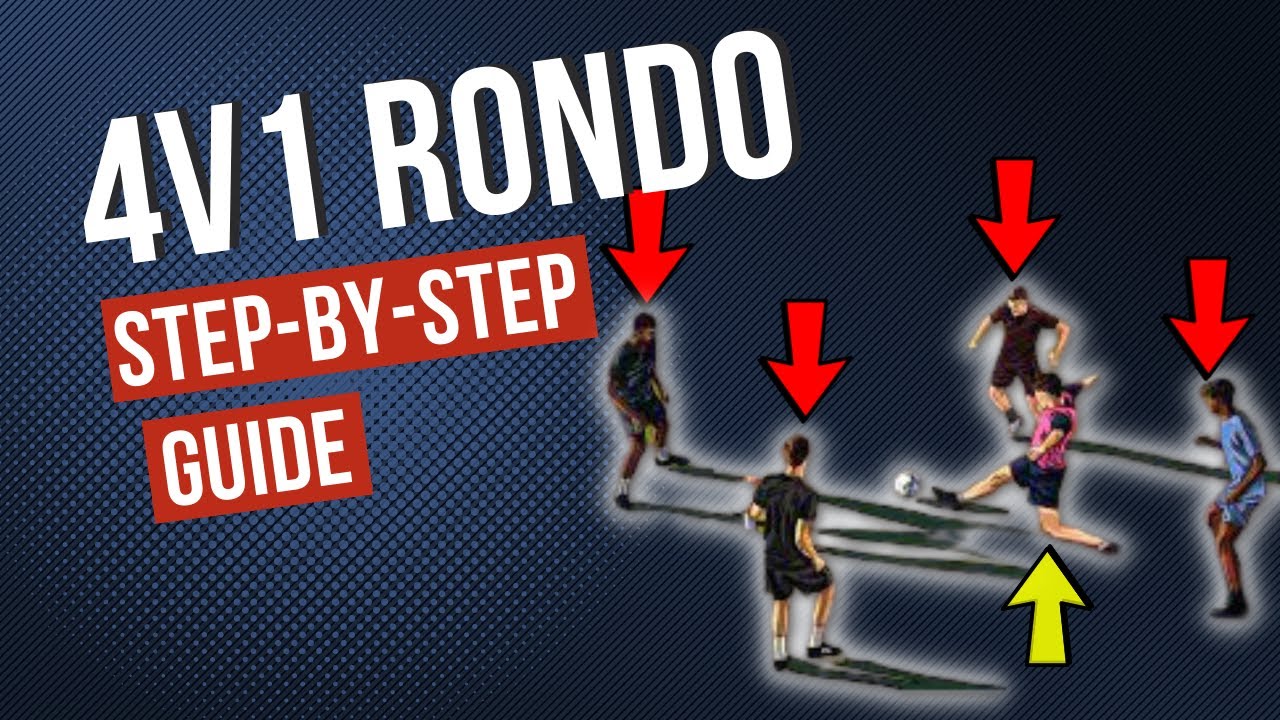
4v1 Soccer Rondo (Keepaway): How To Guide For Beginners — by Paul Spacey on YouTube.
- Long Term Athlete Development Learning To Train Phase
- Us Soccer Pdi Field Size Requirements
Sources
- US Soccer Grassroots Player Development Framework — All Age Groups (2020) — governing-body — https://cdn3.sportngin.com/attachments/document/2323-2425713/US_Soccer_Player_Development_Framework_All_Age_Groups.pdf
- US Youth Soccer / US Soccer Player Development Initiatives (2017) — governing-body — https://www.usyouthsoccer.org/wp-content/uploads/sites/160/2023/09/Player-Development-Initiatives-2017.pdf
- US Soccer Player Development Framework — Age Group Learning Plans (2023) — governing-body — https://bigwalnutsoccer.com/wp-content/uploads/2025/03/us-soccer-player-development-framework-age-group-learning-plans.pdf
- Small-Sided Games — Developmental Coaching Resource (Cologne/Abertay Study Summary) — academic — https://prod-assets.demosphere.com/_deimos/_public_files/2aee8zdicnnos/coaches/small-sided-games/06_SMALL_SIDED_GAMES.pdf
- Small Sided Games — US Youth Soccer Coaching Resource — academic — https://www.usyouthsoccer.org/wp-content/uploads/sites/160/2023/09/Small-Sided-Games.pdf
- Small-Sided Games in Youth Football (Sustainability, MDPI, 2025) — peer-reviewed — https://www.mdpi.com/2071-1050/17/21/9563
- How to Write a Training Session Plan — US Youth Soccer — governing-body — https://www.usyouthsoccer.org/wp-content/uploads/sites/160/2023/09/How-to-Write-a-Training-Session-Plan.pdf