
Building Better U13–U16 Soccer Practices: The US Soccer Player-Centered Model Explained
Your 13-year-old doesn't need another cone drill with three kids standing in line waiting their turn. She needs decisions, pressure, and the ball at her feet — repeatedly, every minute of practice. Here's how the US Soccer framework actually works at the performance phase, and what it…
Building Better U13–U16 Soccer Practices: The US Soccer Player-Centered Model Explained
Your 13-year-old doesn’t need another cone drill with three kids standing in line waiting their turn. She needs decisions, pressure, and the ball at her feet — repeatedly, every minute of practice. Here’s how the US Soccer framework actually works at the performance phase, and what it looks like in a real session plan.
Why this matters
The jump from 9v9 to 11v11 at U13 is more than just adding two players. It’s the beginning of what US Soccer’s 2023 Player Development Framework calls the Performance/Adolescence Phase — a window where technical ability starts fusing with real tactical understanding. Get this right and players develop soccer intelligence that carries them through high school and beyond. Get it wrong — by over-drilling, over-coaching, or playing too many games with too little training — and you produce players who are technically competent but tactically helpless the moment a game gets complicated.
The US Youth Soccer Player Development Model sets a 3:1 training-to-game ratio for U14. That standard exists for a reason. This is a developmental phase, not a results phase.
How the picture shifts with age
At U12–U13, players are arriving at the performance phase with uneven technical foundations and bodies going through puberty at wildly different rates. Early maturers can physically dominate. Late maturers may have higher long-term potential but get overlooked. Practice design must reward smart decisions and technical quality — not just whoever is currently bigger and faster.
By U13–U14, the cognitive hardware for abstract tactical thinking starts coming online. Players can genuinely understand why a center back holds a certain shape, not just that they should do it. But working memory under match pressure is still developing, so instructions need to stay brief and get tested in game-like activities immediately.
U14–U15 marks the shift toward team tactical structure: a defined formation, explicit positional responsibilities, set pieces, and deliberate weekly periodization. The US Youth Soccer Aspiring Towards “Elite” resource describes a weekly cycle — recovery/technical on Monday, tactical-defensive Tuesday, tactical-attacking Wednesday, transitions and set pieces Thursday, pre-activation Friday — that becomes realistic and useful at this stage.
U15–U16 players can handle positional specificity in training, more complex pressing schemes, and more direct tactical conversations. The coach’s role starts resembling what Aspiring Towards “Elite” calls the “Strategist” archetype — more deliberately directing the tactical framework while still centering the player’s decision-making.
Age-specific guidance
Ages 12–13: Technical skills applied under pressure
This is the entry point to the performance phase. Sessions should look like soccer, not preparation for soccer.
Session design: Keep formats small — 4v4 to 7v7 — to maximize ball contacts and decisions per player. Positional roles are loose at this stage. A player learns what a central midfielder does by playing in that space in a 5v5 with a constraint, not by listening to a ten-minute explanation. The US Soccer Best Practices document recommends every player with a ball in the warm-up, no lines, wait time near zero.
Key cues: “What did you see before you received it?” “Can you find a third player?” Use freeze-frame questioning (briefly stopping play to pose a question to the group) sparingly — the game itself should do most of the teaching.
Mistakes to avoid here: Locking players into positions. The US Soccer framework explicitly discourages position specialization before U14. Rotate players through different roles in training — they’ll understand the game better for it.
Advancement signal: Player can consistently receive and play forward under pressure in a 5v5 or 6v6. Begins identifying open teammates before receiving the ball.
Ages 13–14: Unit tactical understanding
Now the lines mean something. Sessions at this stage introduce the back four as a unit, the midfield as a unit, and how they relate to each other — compactness, width, depth, supporting distance. These are concepts that can be taught Positional Compactness because the cognitive capacity is there.
Session design: Expand SSA formats to 7v7 to 9v9. Introduce overload situations explicitly — both attacking (creating a 2v1 on the outside) and defending (compressing to create numerical superiority). The US Soccer 2023 Player Development Framework lists these as standard themes for U13–U14.
Sample session — “Building out of the back”: - Arrival free play (10 min): Players arrive, balls available, unstructured - Warm-up (15 min): Rondos
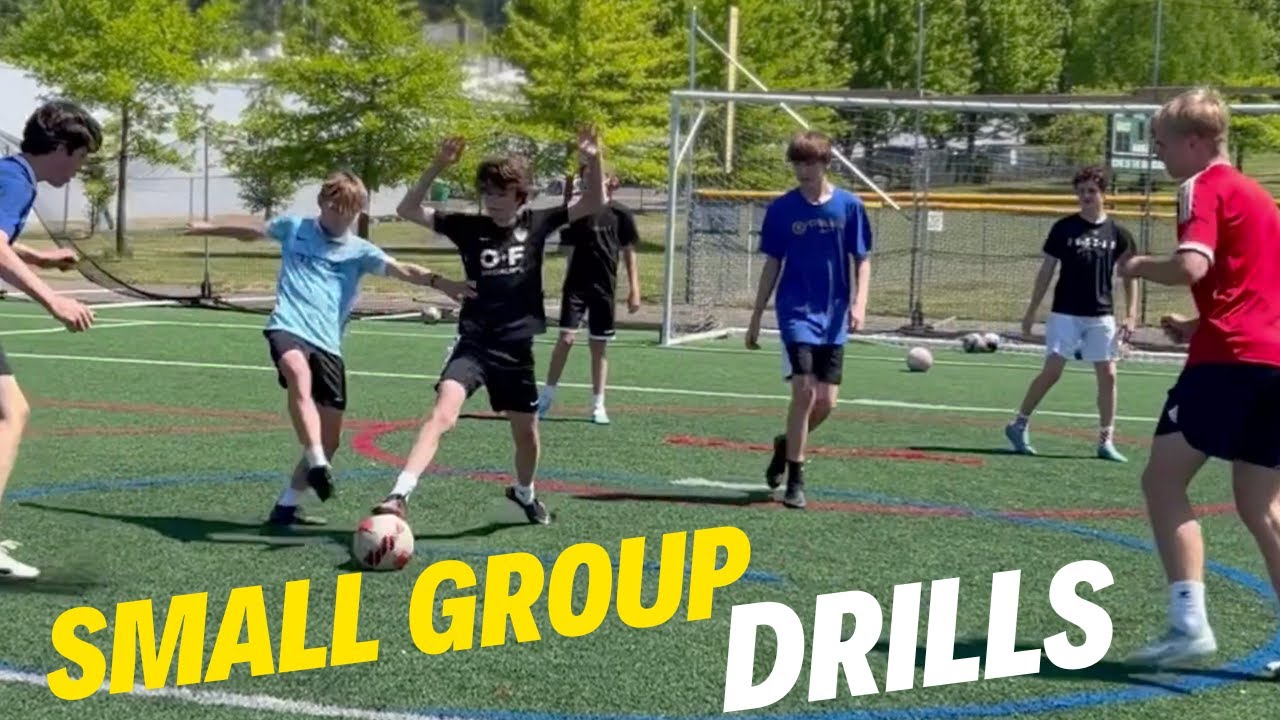 ▶ Watch on YouTube
Tight Space Decision Making | 4v1 Transitional Rondo Drill — by RAIN Soccer Training on YouTube.
and technical circuits — every player with a ball, directional passing combinations at pace - SSA 1 (15 min): 5v5 + goalkeepers on a narrow field — constraint: back line must complete two passes before crossing halfway; defending team wins by winning the ball in the defensive third - SSA 2 — expanded (20 min): 8v8 on a larger field with the same theme; coach observes, uses one freeze-frame question per 10-minute block maximum - Match (20 min): Full scrimmage with no constraints — let it run, let the theme reveal itself
Heading: At U13, heading is introduced gradually with proper technique. By U14, it’s fully allowed under standard rules but should be coached with emphasis on forehead contact and proper approach angle. Any ongoing neck or head discomfort warrants a referral to a medical professional — do not diagnose or make return-to-play decisions as a coach.
Ages 14–15: Team tactical structure
This is where a defined style of play — a formation plus a set of principles for how the team attacks, defends, and transitions — becomes the organizing framework. Players are ready for it, and without it, tactical development stalls.
Session design: Full 11v11 scrimmages now serve a genuine developmental purpose, testing whether session themes hold up in match conditions. Set pieces get introduced: corner kick runs
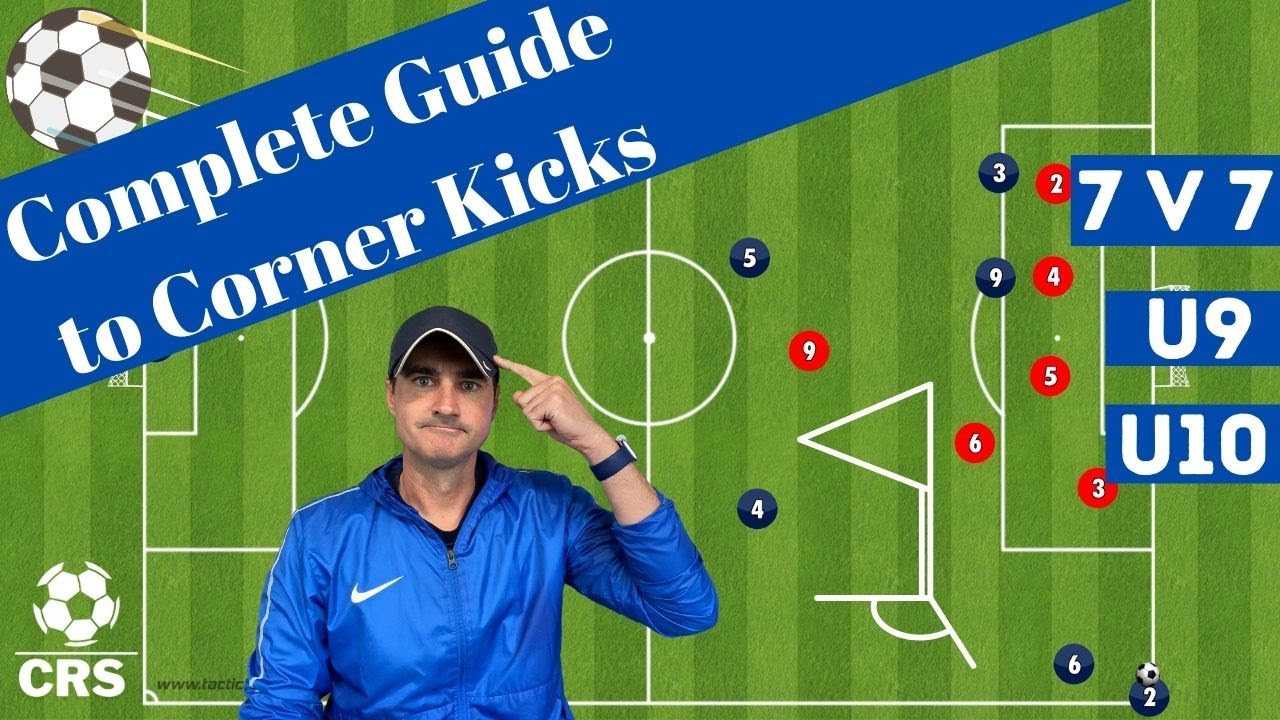 ▶ Watch on YouTube
Master Corner Kicks at U9/U10 (7v7)! — by Coach Rory Soccer on YouTube.
, free kick walls, throw-in patterns. These should grow from open-play themes, not consume session time independently.
Weekly periodization (sample structure):
| Day | Focus | Format | Duration |
|---|---|---|---|
| Monday | Recovery + technical | 1v1 circuits, individual ball mastery | 60 min |
| Tuesday | Tactical — defending | 7v7 defensive shape SSA | 75–90 min |
| Wednesday | Tactical — attacking | 8v8 combination play SSA | 75–90 min |
| Thursday | Transitions + set pieces | 9v9 + scripted transition triggers | 75–90 min |
| Friday | Pre-activation | Light technical, short-sided | 45–60 min |
Goalkeeper development: At 11v11, dedicated goalkeeper work becomes appropriate as a supplement. But goalkeepers should still be included in SSAs and arrival activities — a goalkeeper standing in a static net for 30 minutes gets fewer developmental touches than any field player in the same session. Locking a single player into the goalkeeper role before U14 is discouraged by the US Soccer framework.
Ages 15–16: Situational mastery and periodization
Sessions are now planned against an annual calendar — pre-season, in-season, and tournament micro-cycles. The Aspiring Towards “Elite” framework maps SSG formats to physiological intensity: extensive endurance formats (11v11 to 9v9), intensive endurance (7v7 to 6v6), and extensive interval (4v4 to 3v3) are cycled deliberately across the week and season.
Position-specific training supplements group work. Video review can be introduced. The coach can be more directive about tactical organization — but the principle of player-centered design doesn’t disappear. Guided questions, ownership of reflection, and free play time remain part of every session as recommended by US Soccer Best Practices.
Core concepts that apply across ages
*Constraints Led Approach — Adjusting field size, player numbers, touch limits, or scoring rules to produce specific tactical behaviors. González-Rodenas et al. (2021) in IJERPH* found that pitch configuration in small-sided games directly shapes tactical behavior and goal-scoring opportunities in youth players. Changing the environment changes the behavior — no verbal instruction required.
*Four Moments Of The Game* — Every match contains four moments: attacking (your team has the ball), defending (opponent has the ball), transition to attack (winning the ball), transition to defense (losing the ball). A well-designed weekly cycle touches all four. Don’t only train the exciting ones.
*Small Sided Games As Teaching Tool — Smaller formats create more ball contacts, more individual decisions, and more goal-scoring situations per player than 11v11. They’re not a warmup to real training. They are* real training.
*Training To Game Ratio* — The US Youth Soccer Player Development Model recommends a 3:1 ratio (training sessions to games) for U14. Tournament-heavy schedules often invert this. More games at the expense of training time delays development.
*Periodization Youth Soccer* — Planning training across the week and season with deliberate variation in intensity, tactical focus, and recovery. Introduced gradually in the early performance phase; more formalized at U15–U16.
Common mistakes (any age)
Joystick coaching. Calling out instructions continuously during game-like activities removes decision-making from players — which is the entire point of the activity. Keep sideline commentary during SSAs to a minimum. Design the game to teach. US Soccer coaching education has flagged this as among the most damaging and most common coaching habits.
Over-reliance on lines and isolated drills. Long passing lines where players wait their turn waste contact time and don’t replicate game decisions. Replace them with rondos, 1v1 circuits, or small-sided activities that keep everyone active.
Position-locking before U14. Assigning a 12- or 13-year-old permanently to center back or striker for the season limits their understanding of the full game and caps their development. Rotate in training.
Treating the group as physically equivalent. Early and late maturers in the same U13–U15 group can be at completely different developmental stages. Design activities that reward technical and tactical quality, not just the player who’s currently biggest.
Skipping the match phase. Practice should end in a real game, every session. Coaches who run over on drills and cut the scrimmage short lose the most important developmental moment of the day — where learning is tested and sticks.
Too many games, not enough training. The US Soccer PDI caps youth players at no more than 30 games per calendar year. Competitive club schedules frequently exceed this. Track total load across training, games, and camps.
Ignoring the goalkeeper in session design. The goalkeeper should be included in SSAs and arrival activities. Isolating them in a net during field-player drills gives them fewer touches and decisions than anyone else on the roster.
Over-coaching set pieces at the expense of open play. Spending significant session time on corner kick choreography in the early performance phase trades ball mastery and open-play tactical development for something that has limited payoff at U13–U14.
When and how to advance
Movement from one stage to the next isn’t strictly age-based — it’s behavior-based. A U13 group that still can’t find a free teammate in a 5v5 is not ready for a weekly periodization cycle built around defensive shape. Here are concrete signals:
- Stage 1 → Stage 2: Players consistently apply technical skills (first touch, passing accuracy) under game pressure in 5v5 to 6v6. Positional awareness is beginning to show — players recognize when they’re in a poor supporting position and adjust.
- Stage 2 → Stage 3: The back unit and midfield unit can maintain compact shape in 8v8 for most of a 15-minute SSA without constant reminders. Players understand what “losing the ball means we defend together” means — and show it.
- Stage 3 → Stage 4: Team holds defined shape in full 11v11 scrimmage under match pressure. Transition moments are mostly recognized and responded to correctly. Coach can begin annual periodization planning without it being wasted.
If growth plate pain (heel, knee) appears during high-volume kicking and jumping periods in the U12–U15 growth spurt window, refer to a qualified medical professional immediately. These decisions are medical, not coaching.
Further reading
- Constraints Led Approach — How changing rules and field size teaches tactics better than verbal instruction
- Four Moments Of The Game — A full breakdown of attacking, defending, and both transitions with SSG design examples
- Rondo 4V1 — Setup, progressions, and coaching cues for the foundational possession game
- Periodization Youth Soccer — Building a weekly and annual training calendar for club teams
- Corner Kick Near Far Post — When and how to introduce set pieces without losing open-play development time
Sources
- US Soccer Player Development Initiatives (PDI) — 2017 — governing-body — https://static.ussdcc.com/users/148963/897090_eng-october2017pdi.pdf
- US Soccer Player Development Framework — Age Group Learning Plans (2023) — governing-body — https://bigwalnutsoccer.com/wp-content/uploads/2025/03/us-soccer-player-development-framework-age-group-learning-plans.pdf
- Best Practices for Coaching Soccer in the United States — US Soccer — governing-body — https://www.americanfork.gov/DocumentCenter/View/5211/USA-soccer_Best_Practicespdf
- US Youth Soccer Player Development Model — governing-body — https://fcdulles.ottosport.ai/_files/csc-coaching-education/US_Youth_Soccer_Player_Development_Model.pdf
- Different Pitch Configurations Constrain the Playing Tactics and the Creation of Goal Scoring Opportunities during Small Sided Games in Youth Soccer Players — González-Rodenas et al. (2021) — peer-reviewed — https://pubmed.ncbi.nlm.nih.gov/34639800/
- Aspiring Towards “Elite” — US Youth Soccer — practitioner — https://www.usyouthsoccer.org/wp-content/uploads/sites/160/2023/09/Aspiring-Towards-22Elite22.pdf
- How to Coach U12 Soccer: Tips, Session Plans, and U12 Soccer Drills — Player Development Project — practitioner — https://playerdevelopmentproject.com/u12-soccer-drills/