
Dribbling in the Performance Phase: Ball Mastery and 1v1 Attacking for Players 12 and Up
You coached them through the basics. They can do a step-over, more or less. They can slalom a row of cones without much trouble. Now they're 13 or 15 or 17, the game is faster, defenders are smarter, and somehow the skills that looked sharp at 11 look less reliable under real pressure.…
Dribbling in the Performance Phase: Ball Mastery and 1v1 Attacking for Players 12 and Up
You coached them through the basics. They can do a step-over, more or less. They can slalom a row of cones without much trouble. Now they’re 13 or 15 or 17, the game is faster, defenders are smarter, and somehow the skills that looked sharp at 11 look less reliable under real pressure. This is exactly when dribbling development either gets serious or quietly gets abandoned — replaced by “just play your position.” Don’t let that happen.
Why this matters at this age
The adolescent years are the window in which technical skills either get consolidated into automatic, pressure-proof tools or stay permanently fragile. The US Soccer Player Development Framework describes the 12+ phase as one where players must execute under high pressure in tight spaces — not just demonstrate moves in open air. A step-over that only works in a cone drill isn’t a weapon; it’s a rehearsed habit that falls apart the moment a defender applies pressure.
The non-dominant foot problem also peaks here. Once players hit position-specific training at 15 and 16, coaches tend to accept one-footedness as a positional reality. But the US Soccer framework explicitly mandates both-feet development across all phases, and the practitioner evidence backs it up: a 1v1 player who can only go one way is a 1v1 player a defender can read from 10 yards out.
Adolescent growth spurts — roughly ages 12–15 for girls, 13–16 for boys — temporarily wreck the coordination players have spent years building. Coaches should expect technique regressions during peak height velocity (the period of fastest growth) and resist the urge to over-correct them. What looks like carelessness is often the nervous system catching up to a body that changed shape over the summer.
Finally, this is the age when the decision to dribble becomes as important as the execution. The US Soccer framework frames dribbling at this phase as “driving,” “protecting,” and “controlling” — actions embedded in tactical context. A winger 1v1 on the touchline in the attacking third has a completely different risk/reward profile than a central midfielder trying the same move under a high press. Players can now handle that complexity. Teaching it is part of the job.
Core concepts
*Ball Mastery* — Systematic close-control repetition with inside foot, outside foot, and sole of both feet, typically in an unopposed or lightly structured setting. This is the foundation layer of the Coerver Pyramid of Player Development (Ball Mastery → Receiving & Passing → 1v1 Moves → Speed → Finishing → Group Attack). Former Tottenham and Chelsea academy coach Saul Isaksson-Hurst argues that ball mastery work is not exclusively for younger players — the volume of quality touches needed for automaticity “can only come from daily individual work on top of team sessions,” and elite-level players continue it throughout their careers.
*Constraints Led Approach — A coaching methodology that develops skill by manipulating the conditions* around a task — space, number of defenders, time available — rather than prescribing fixed technique. A peer-reviewed study of 12-year-old footballers found that constraints-led training produced significantly better dribbling accuracy than a traditional prescriptive approach (effect size d = 0.77), with fewer execution errors. This is the research basis for why 1v1 reps and small-sided games need to progressively replace cone slaloms as the primary training mode.
*Slow Fast Slow Rhythm* — The approach cadence for attacking a defender: controlled entry, explosive execution, acceleration on the exit. Approaching at full speed the whole way removes the timing window needed to set up the move and eliminates the explosive exit. The move itself is the middle beat; the acceleration into space after is where the value is created.
*Signature Move — One or two individual moves a player has rehearsed to the point of automaticity under live pressure. The goal, as described in the Coerver method, is functional mastery*, not a broad trick repertoire. A reliable step-over is worth more in a match than five moves a player executes inconsistently.
*Reading The Defender — The perceptual skill of identifying where a defender’s weight is loaded before choosing a move. A player who executes a step-over on a fixed count regardless of the defender’s posture will get stopped. A player who executes it when the defender’s weight is on the wrong foot will get through. The SS360 U13 Coaching Manual describes the coaching sequence as: dribble forward, recognize* the confronting opponent, and execute when the opponent is roughly one yard away — timing first, technique second.
*Bio Banding* — Grouping players by biological maturity rather than chronological age for certain training tasks. Players the same age can be 4–5 years apart in biological development. A late-maturing 14-year-old needs the same ball mastery work as an early-maturing peer, and should not be grouped with physically dominant older-maturity players for contact-based dribbling scenarios.
Progression
Stage 1 — Refresh and Solidify Fundamentals (U13)
Open every training session with a 5–8 minute Coerver ball mastery circuit:
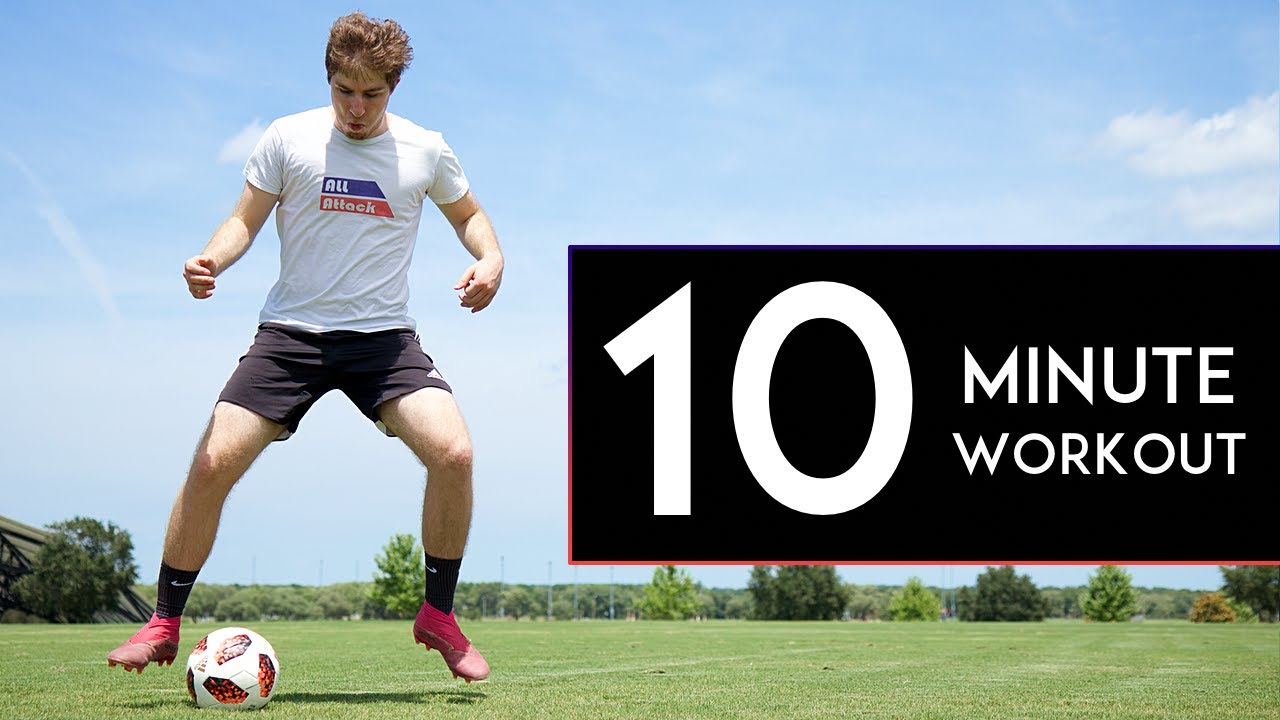 ▶ Watch on YouTube
Get Faster Feet in 10 MINUTES! 10 Min Footwork Workout — by AllAttack on YouTube.
,
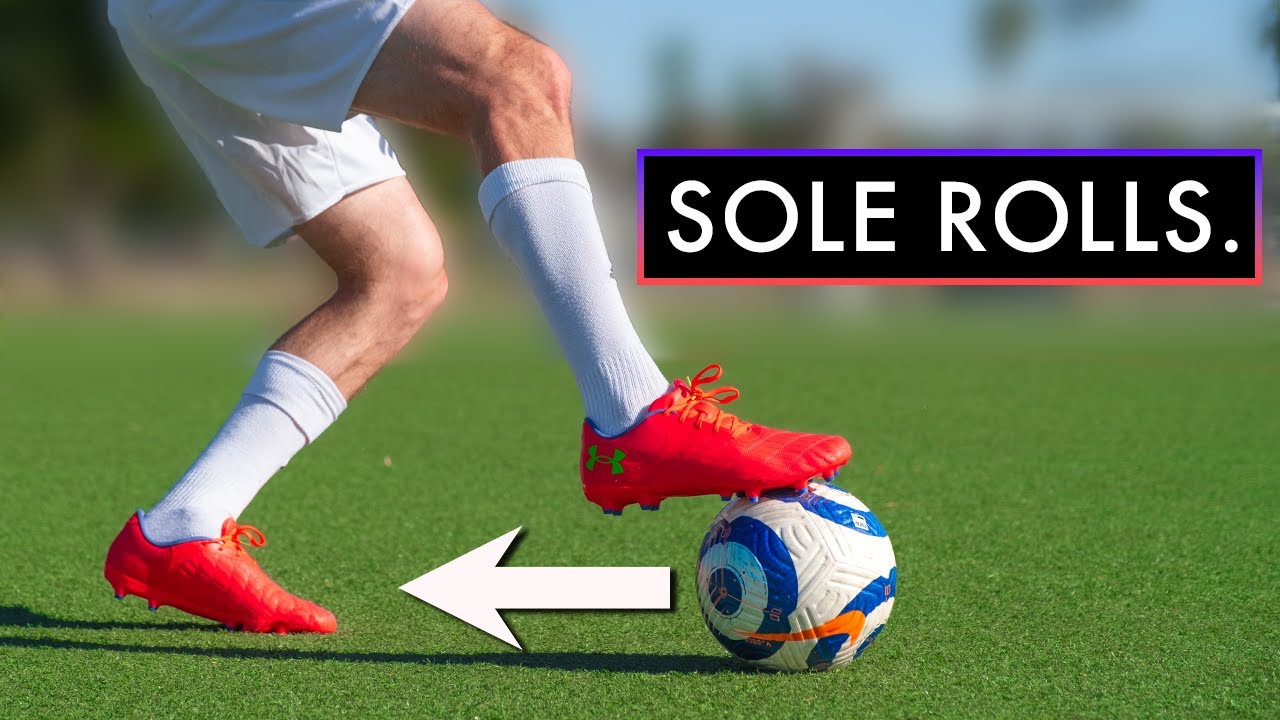 ▶ Watch on YouTube
10 SOLE ROLL SKILLS that Defenders Can’t Stop — by AllAttack on YouTube.
, . Equal reps with both feet, no exceptions. This is not a beginner warm-up — it is the highest-volume technical window in the session. Advance when players can sustain clean, rhythmic execution at pace for the full circuit without hesitation or dominant-foot drift.
Stage 2 — Signature Move Acquisition Under Low Pressure (U13–U14)
Each player selects one or two moves from a menu:
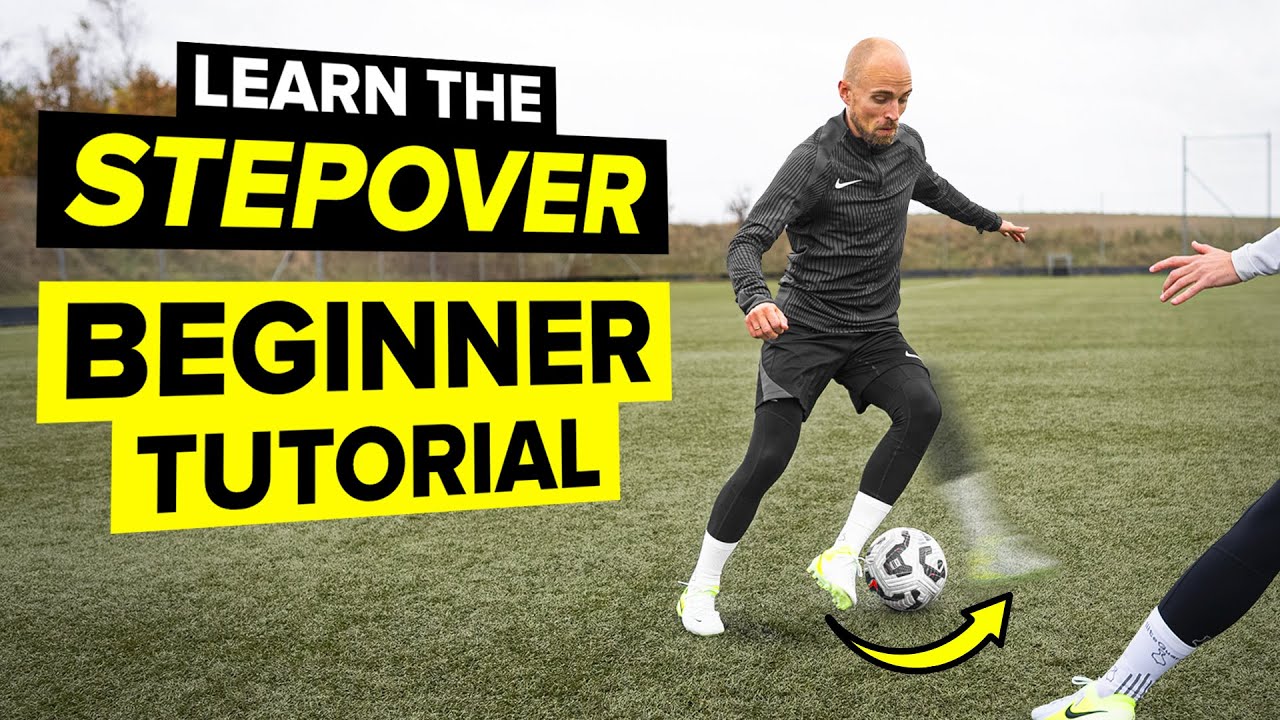 ▶ Watch on YouTube
STEPOVER beginner tutorial - learn it STEP by STEP! — by Unisport on YouTube.
,
 ▶ Watch on YouTube
The Cruyff Turn | Tutorial — by AllAttack on YouTube.
,
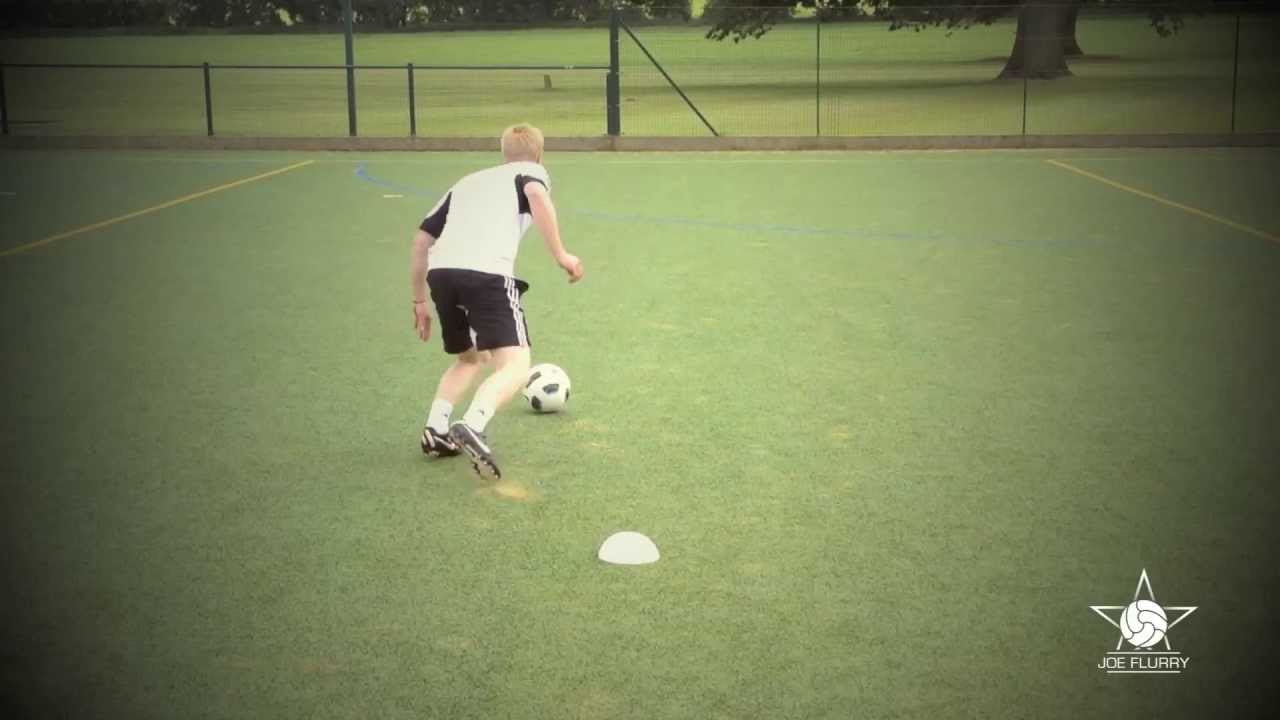 ▶ Watch on YouTube
How to do the Inside & Outside Cut Turn - Football Soccer Move Tutorial — by Football Skills Coach on YouTube.
, ,
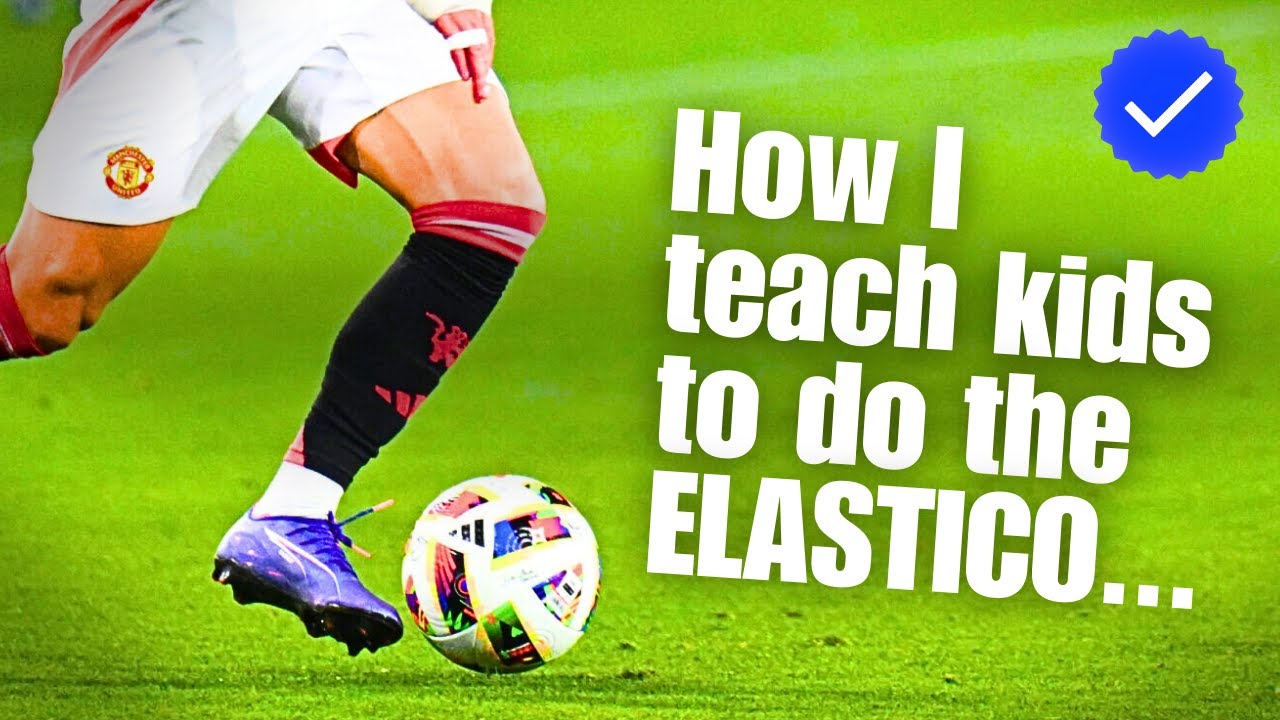 ▶ Watch on YouTube
How I teach kids to do the Elastico Soccer Trick (and you can too) — by Progressive Soccer on YouTube.
. Drill these in paired shadow format — the defender is present but lets the move happen. The defender gradually introduces passive resistance over several sessions. Cue: “Slow into the move, explode out.” Advance when the player can execute without hesitation against passive resistance in both directions.
Stage 3 — Signature Moves Under Live Pressure (U14–U15)
Run 1v1 scenarios from realistic starting positions: receiving a pass and turning; receiving with a defender tight behind; wide 1v1 on the flank. Each rep goes both directions. Cue: “Read the weight before you go — attack the open shoulder.” Advance when the player successfully executes their signature move 3 out of 5 reps against a live but cooperative defender, both directions, from each starting position.
Stage 4 — Combination Moves (U14–U16)
Introduce
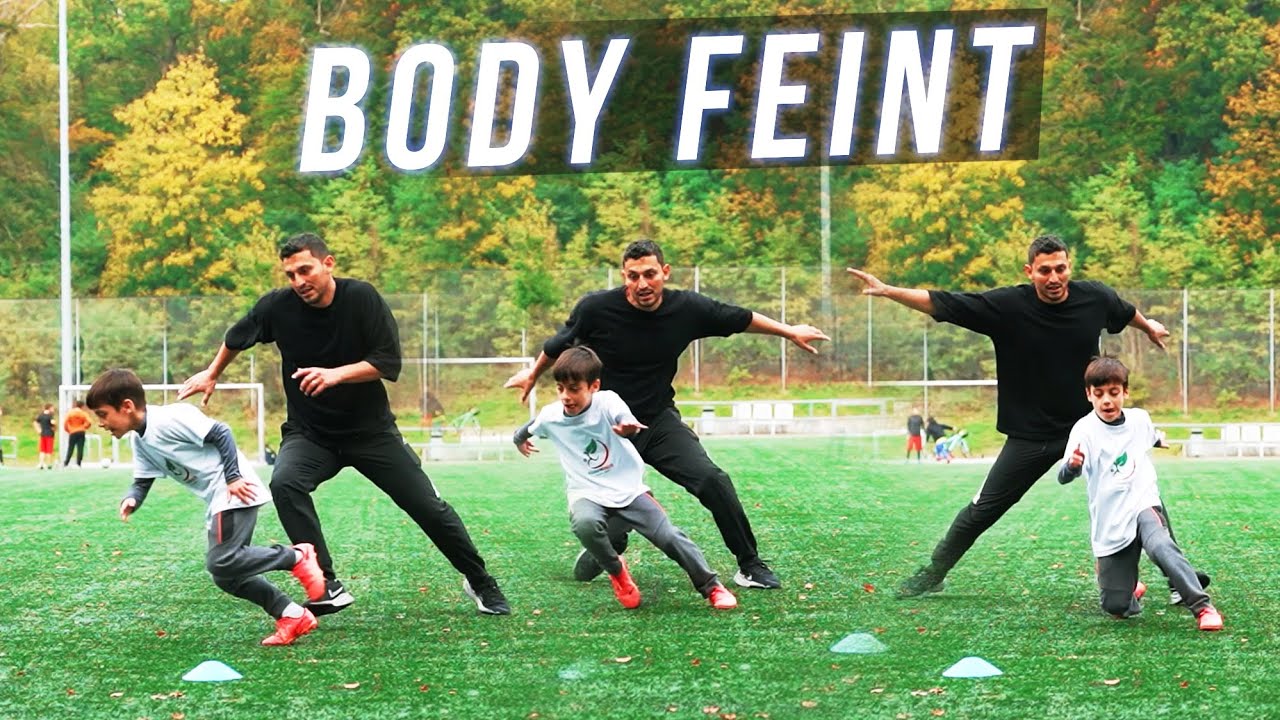 ▶ Watch on YouTube
Master the Body Feint: Watch a 9-Year-Old's Skills Soar with This Proven Method — by PersianBall Drills on YouTube.
,
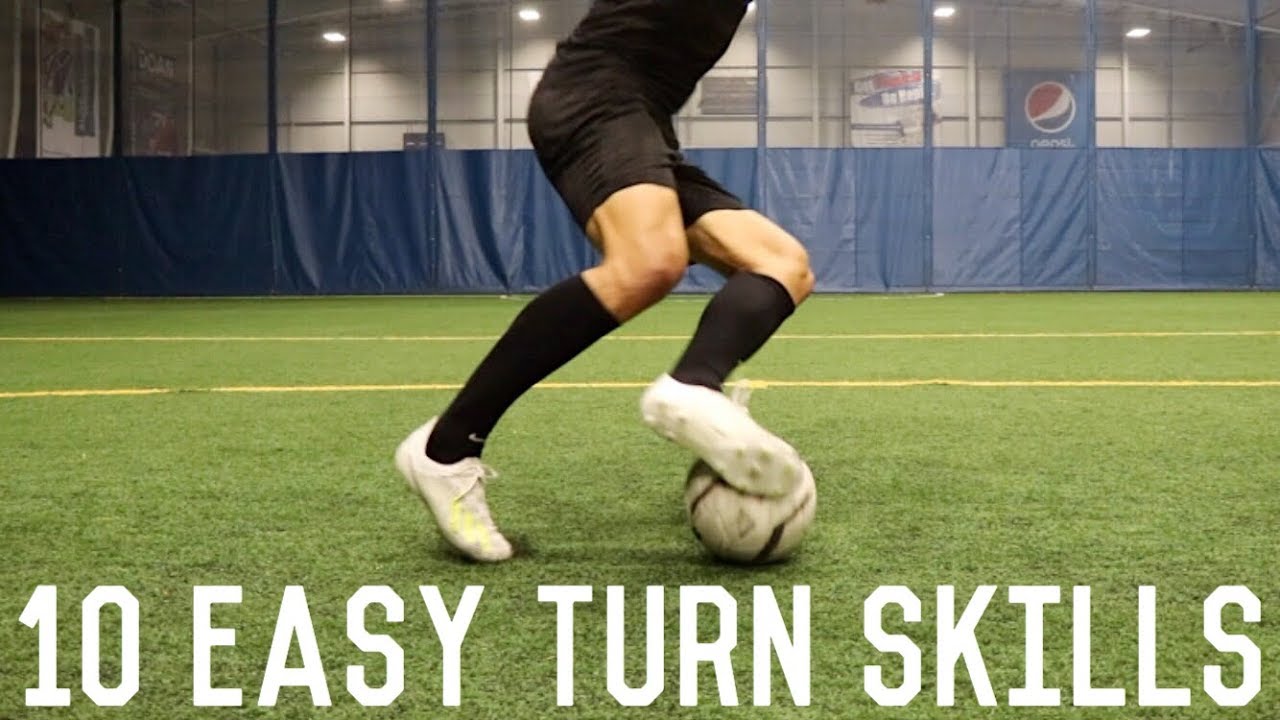 ▶ Watch on YouTube
10 Easy Skills To Turn Defenders | How To Skillfully Change Direction With The Ball — by 7mlc on YouTube.
, and
▶ Watch on YouTube
Master the Body Feint: Watch a 9-Year-Old's Skills Soar with This Proven Method — by PersianBall Drills on YouTube.
. The key coaching point: the second move in the chain is a response to how the defender reacts to the first. Cue: “Move one sets the trap. Move two is the real decision.” Advance when players can chain two moves with a clean exit acceleration against live pressure without telegraphing the second move.
Stage 5 — Dribbling in Numerical Context (U15–U16)
Run 2v2 and 3v3 small-sided games with a dribbling constraint: a goal only counts after a successful take-on. This teaches players when individual dribbling is tactically appropriate. The SS360 coaching manual uses a rotating 2v2v2 format for exactly this purpose. Advance when players consistently choose the dribble in the right moments (attacking third, space behind the defender) and pass or combine in the wrong ones (defensive third, no space on exit).
Stage 6 — Dribbling Under Physical Pressure and Traffic (U16+)
Introduce controlled contact: shielding under physical challenge, 1v1 with body contact allowed. Match players by physical maturity, not chronological age. Run
 ▶ Watch on YouTube
Soccer Drills for Kids to Teach Aggression (Intensity & Effort) — by Progressive Soccer on YouTube.
— a player receives under high pressure and must beat one or two opponents to exit a zone. Advance when players maintain ball control and execute their signature move under contact without instinctively retreating.
Stage 7 — Integrated Tactical Dribbling (U17–U18)
Dribbling decisions inside 11v11 game context. Introduce the
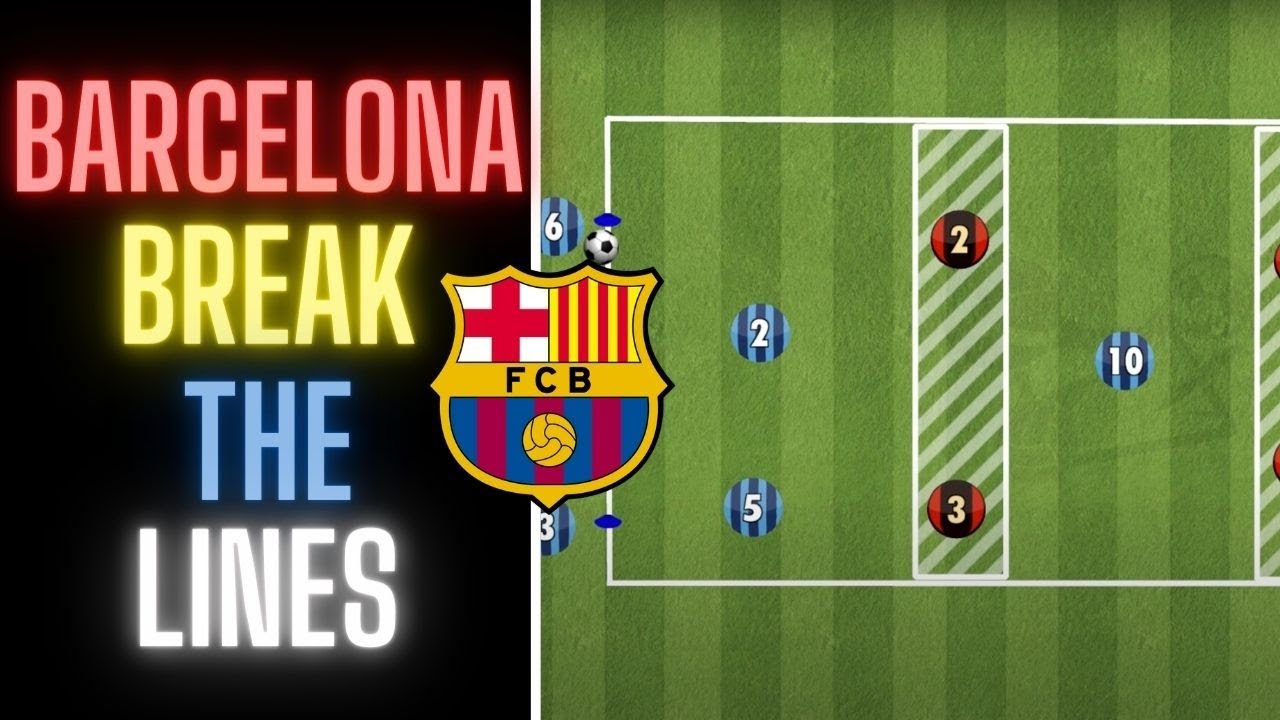 ▶ Watch on YouTube
Barcelona Football Drill | Break The Lines | Attacking Football 2021 — by KS Performance on YouTube.
— driving through a defensive line into the space behind it. Coach awareness: “Before you receive, scan. Where is the pressure? Where is the space?” The US Soccer framework describes this as “player ownership and self-reflection” — at this stage, the player should be diagnosing the situation, not waiting for a cue from the touchline.
Suggested program / schedule
This is a three-day-per-week structure that can slot into most club training schedules. Solo work is additional.
| Day | Focus | Content | Volume |
|---|---|---|---|
| Session A | Ball mastery + signature move | Coerver circuit (both feet equal); signature move reps in shadow then vs. passive defender | 8 min circuit; 15 min 1v1 |
| Session B | 1v1 under pressure + combination moves | Realistic 1v1 scenarios (both directions); chain 2 moves; constrained 2v2 | 20 min 1v1; 15 min 2v2 |
| Session C | Integrated / game-based | Constrained small-sided game (goal = take-on first); or full training game with dribbling awareness points coached post-game | 30–40 min |
| Daily solo | Ball mastery homework | Inside-outside toe-taps, sole rolls, tick-tocks, and one signature move drill at home or in the garden | 10–15 min |
Mistakes to avoid
Treating cone slaloms as the main dribbling training tool. Slaloms build foot-eye coordination but skip the perceptual-decision layer entirely. Research confirms performance doesn’t transfer to game scenarios without the gradual addition of a real defender.
Accepting one-footedness at 12+. Once coaches label it “positional,” it calcifies. Equal-volume non-dominant foot work must continue through this whole phase — adolescence is the last realistic window before position-specific habits lock in.
Teaching moves as trick sequences, not reads. If a player executes a step-over on a fixed count regardless of what the defender is doing, they’ll get stopped by any defender who doesn’t react on schedule. The move’s timing is determined by the defender’s weight, not a mental clock.
Letting players approach defenders at full speed. Full-speed approach eliminates the slow-fast-slow rhythm and cuts off the explosive exit. The result: running into the defender instead of past them.
Praising the move and ignoring the exit. The Coerver system’s Speed layer explicitly focuses on explosive acceleration with the ball after the move. A clean step-over that leads to a slow, flat exit has no real game value.
Skipping ball mastery warm-ups because “they’re past that.” Automaticity requires continued quality touch volume even at elite level. The opening minutes of training are the most valuable technical-volume window in the session.
Rewarding successful dribbles in all situations equally. A take-on that loses possession in the defensive third is not the same as one in the attacking third. Players need to build contextual judgment — that only happens if coaches treat context as part of the feedback.
Introducing contact-based 1v1 before players are ready. The US Soccer framework and safety guidelines are clear: physical contact scenarios should be introduced gradually, matched by physical maturity, and only after players have reliable execution under passive pressure. Rushing this raises injury risk and damages confidence.
When to advance
- Stage 1 → Stage 2: Player completes a full Coerver ball mastery circuit at pace with both feet equally, no hesitation, for 3 consecutive sessions.
- Stage 2 → Stage 3: Player executes their signature move against passive resistance, both directions, without needing a cue, for 4 out of 5 reps.
- Stage 3 → Stage 4: Player beats a live defender with their signature move at least 3 of 5 reps from each realistic starting position, both directions.
- Stage 4 → Stage 5: Player chains two moves with a clean acceleration on exit against live pressure, without telegraphing the second move.
- Stage 5 → Stage 6: Player demonstrates consistent contextual judgment — takes on defenders in the attacking third, combines or passes in the defensive third — across multiple small-sided game sessions.
- Stage 6 → Stage 7: Player maintains signature move execution and clean shielding technique under controlled physical contact, matched by maturity, with no breakdown in fundamentals.
A note on growth spurts: if a player regresses technically during a clear growth phase, do not hold them at a stage as a performance measure. Maintain their current stage’s work, reduce intensity demands temporarily, and reassess when coordination stabilizes.
If a player reports persistent knee, heel, or hip pain during dribbling drills, stop the drill and refer to a qualified sports medicine professional. Do not train through growth-related pain.
Further reading
- Coerver Pyramid Of Player Development
- Constraints Led Approach
- Peak Height Velocity And Coordination
- Escape The Press
- Bio Banding In Youth Soccer
Sources
- US Soccer Player Development Framework — Age Group Learning Plans (2023) — governing-body — https://bigwalnutsoccer.com/wp-content/uploads/2025/03/us-soccer-player-development-framework-age-group-learning-plans.pdf
- US Soccer Player Development Framework — U11–U12 Learning Plan (Foundation Phase III) — governing-body — https://utahavalanche.com/wp-content/uploads/2024/02/us-soccer-player-development-framework-age-u11-u12.pdf
- How to Use Ball Mastery Effectively with Young Soccer Players — practitioner (Saul Isaksson-Hurst, former Tottenham Hotspur & Chelsea FC Academy) — https://mypersonalfootballcoach.com/how-to-use-ball-mastery-effectively-with-young-soccer-players/
- Efficacy of using non-linear pedagogy to support attacking players’ individual learning objectives in elite-youth football: A randomised cross-over trial (Roberts SJ, Rudd JR, Reeves MJ) — peer-reviewed — https://pubmed.ncbi.nlm.nih.gov/31030644/
- The Effectiveness of Constraints-Led Training on Skill Development (Dribbling Accuracy) in Youth Football — peer-reviewed — https://pdfs.semanticscholar.org/08c1/c59a1fa6b0a4dd724e7e332e1e7d0f6bae20.pdf
- The Coerver Method — Pyramid of Player Development — practitioner — https://www.coervercteast.com/Default.aspx?tabid=1020203
- Player Development Program for the U13 Soccer Coach (SS360 / Freedom Option Soccer) — practitioner — https://www.freedomoptsoccer.com/wp-content/uploads/2017/06/SS360-U13-Coaching-Manual.pdf