
From Cones to Defenders: Building Real Dribbling Skills at Ages 10–12
At 10–12, your player is in one of the best windows they'll ever have for locking in dribbling technique — cognitively ready for complex moves, neurologically primed to build new patterns, and still young enough that bad habits haven't fully hardened. What you do with that window…
From Cones to Defenders: Building Real Dribbling Skills at Ages 10–12
At 10–12, your player is in one of the best windows they’ll ever have for locking in dribbling technique — cognitively ready for complex moves, neurologically primed to build new patterns, and still young enough that bad habits haven’t fully hardened. What you do with that window matters. A season of cone slaloms alone won’t cut it. Here’s how to build something that actually transfers to the game.
Why this matters at this age
The Long-Term Athletic Development (LTAD) framework — a structured model for matching training type to developmental stage — places ages 10–12 squarely in the “Learn to Train” stage. According to the “Learn to Train” U11/U12 Coaching Handbook from Ontario Soccer, this is the primary technical skill refinement window. That’s not a loose guideline; it’s the best time to build the touch habits, 1v1 instincts, and two-footed fluency that will underpin a player’s entire career.
Here’s what makes it urgent: motor pattern plasticity — the brain’s ability to rewire movement habits — is still high at this age but won’t stay that way. The US Soccer U11/U12 Learning Plan explicitly flags developing both feet equally as a stated priority at this age, noting that this window closes as dominant-foot habits entrench through puberty. If a player is still one-footed at 13 or 14, fixing it becomes genuinely hard.
Cognitively, 10–12 year-olds are ready for this work in a way younger players simply aren’t. They can process two-step instructions, understand what “read the defender’s weight” means, and plan and execute a move rather than just react. That cognitive capacity, combined with the motor plasticity, makes this the ideal moment to introduce signature dribbling moves — one or two go-to sequences a player can own at game speed.
Ignore this window, and players arrive at U13/U14 technically incomplete: dominant-foot dependent, unable to protect the ball under pressure, and executing moves in training that disappear the moment a real defender shows up.
Core concepts
*Ball Mastery* — The foundation of the Coerver Pyramid of Player Development: controlled, rhythmic manipulation of the ball with both feet, using the inside, outside, and sole. The Coerver Method defines it as one-player, one-ball repetition work designed to maximize individual touch volume. Without this base, every move built on top is shaky.
*Approach Speed* — Deliberately slowing down before a dribbling move to preserve body control and options, then exploding past the defender on the exit. The US Soccer U11/U12 Learning Plan frames attacking objectives around “change of speed to dribble past” — the deceleration is as important as the acceleration.
*Signature Move* — One or two dribbling moves a player can execute reliably at game speed under defensive pressure. The principle here is depth over breadth: players who own two moves outperform players who superficially know ten. For 10–12 year-olds, appropriate signature moves include the drag-back, inside cut, Cruyff turn, step-over, and V-turn.
*Constraints Led Approach* — A training methodology in which coaches manipulate task, environment, or rules (limiting touches, shrinking space, adding defenders) to force players to solve real problems rather than repeat fixed patterns. A peer-reviewed RCT published in PMC/National Library of Medicine found that a constraints-led group outperformed a traditional drill-based group on technical skills tests, with better retention at a five-week follow-up.
*Scanning* — Looking up and checking your environment before and while receiving the ball. The US Soccer U11/U12 Learning Plan places scanning and decision-making at the center of the attacking curriculum at this age. It’s a trainable habit, not a personality trait.
*Dribbling In Tight Vs Open Space* — Different contexts demand different technique. Open space: longer touches, head up, scanning ahead. Tight space: sole-of-foot control, body shielding, small protective touches. Players need reps in both contexts.
Progression
Stage 1 — Isolated Ball Mastery (8–10 min)
Start every technical session here. No defenders, no pressure — just touch volume.
What to do:
 ▶ Watch on YouTube
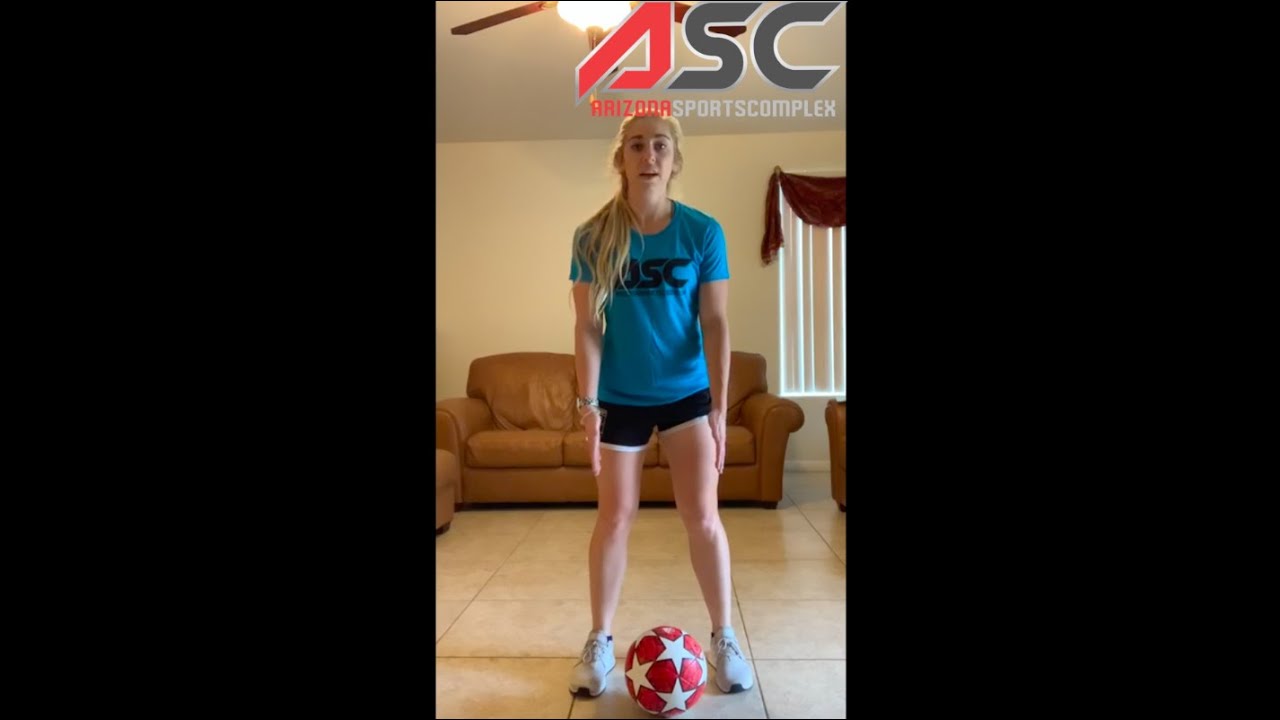
Soccer skills at home - Toe taps, Foundations, Sole rolls — by Arizona Sports Complex on YouTube.
,
 ▶ Watch on YouTube
How to JUGGLE a Soccer Ball for Beginners — by AllAttack on YouTube.
,
 ▶ Watch on YouTube
15 INSANE Skill Moves to DESTROY Defenders — by AllAttack on YouTube.
,
▶ Watch on YouTube
15 INSANE Skill Moves to DESTROY Defenders — by AllAttack on YouTube.
. Build from slow (precise form) to fast (foot speed). Equal reps on both feet — this is non-negotiable. Call it out explicitly: “Left foot only, same thing.”
Key cues: Soft touches, stay on your toes, eyes up as speed increases.
How long: 8–10 minutes as a warm-up block.
How to know you can advance: Player completes all movements at pace without looking down, using both feet without notable quality drop on the non-dominant side.
Stage 2 — Moves Against a Passive Obstacle (10 min)
Bridge from isolated touch to applied movement.
What to do: One cone or a passive defender (hands behind back, no pressure) positioned at the top of a small grid. Player approaches, executes one signature move —
 ▶ Watch on YouTube
6 Soccer Skills Kids Love | Soccer Skills from the MOJO App — by yougotmojo on YouTube.
,
 ▶ Watch on YouTube
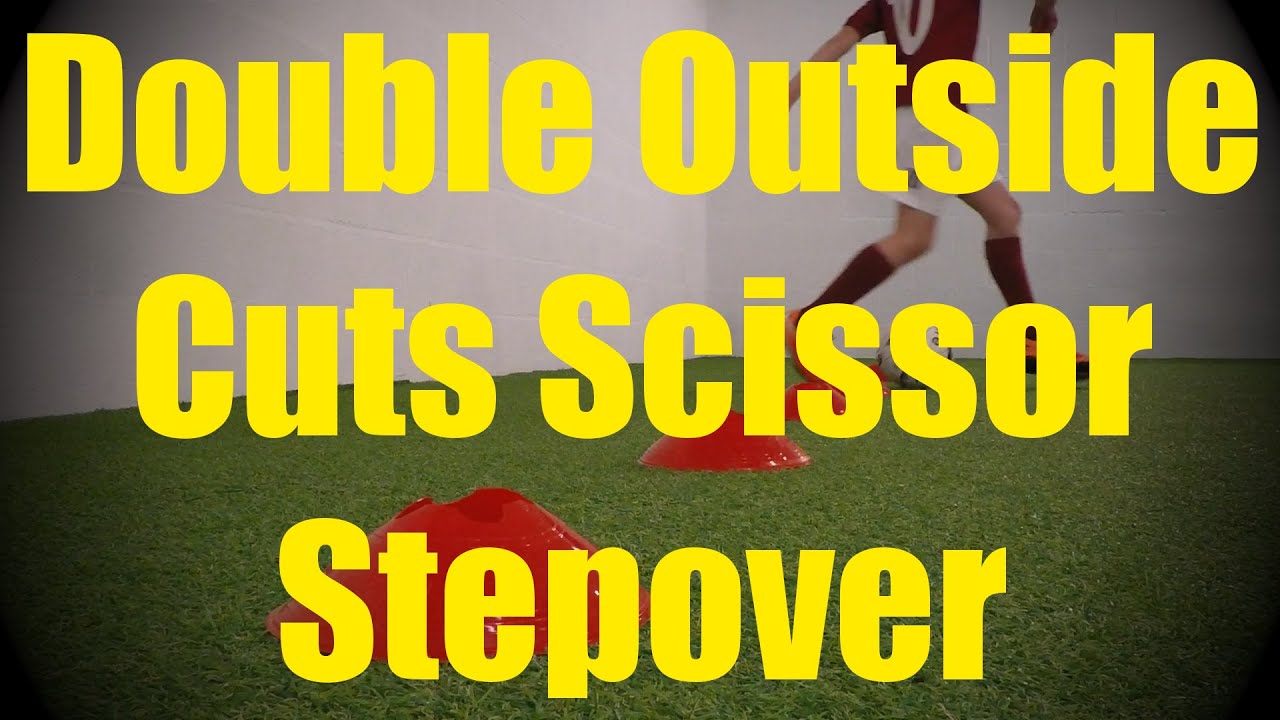
Double Outside Cuts Scissor Stepover - Cones Dribbling Drills - Ball Mastery Training (U10-U11) — by Ultimate Soccer Moves Collection on YouTube.
,
 ▶ Watch on YouTube
The Cruyff Turn | Tutorial — by AllAttack on YouTube.
— and drives into space. Repeat 6–8 times per move, both directions.
Key cues: Slow the approach before the move. The feint has to be fast enough to be believable. Explosive first step on the exit.
How long: 10 minutes.
How to know you can advance: Move is executed with deceptive timing 4 out of 5 reps against the passive obstacle.
Stage 3 — 1v1 Structured Activities (10–12 min)
Pressure goes up.
What to do:
 ▶ Watch on YouTube
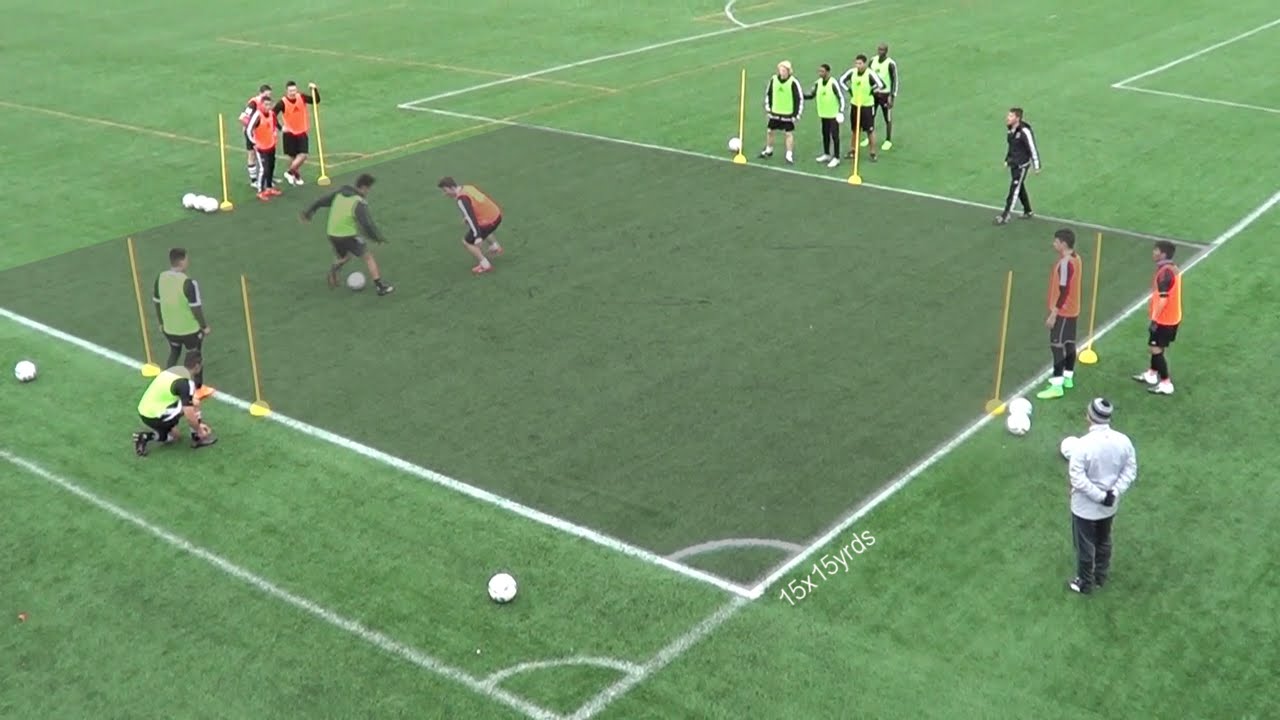
1vs1 Dribbling Soccer Drill | Attacking & Defending Exercises — by Professional Soccer Coaching on YouTube.
— attackers dribble past defenders inside a defined grid; the US Youth Soccer Skills School Manual recommends 4-minute rounds for U12, increasing competitive pressure gradually. Also effective:
▶ Watch on YouTube
1vs1 Dribbling Soccer Drill | Attacking & Defending Exercises — by Professional Soccer Coaching on YouTube.
— player dribbles through a series of small gates (pairs of cones) while a defender attempts to win the ball. Start with semi-active defending (defender can position and cut angles but no full tackles).
Key cues: Identify the defender’s weight and stance before the move. Attack a shoulder to commit them. Don’t slow down so much that you stall — it’s “control the approach,” not “stop.”
How long: 10–12 minutes.
How to know you can advance: Player attempts signature moves in context (not just patterns) and beats the semi-active defender at least half the time.
Stage 4 — 1v1 Competitive Games (10 min)
Full competitive pressure with individual feedback.
What to do: True 1v1s from varied starting positions — receiving a pass then immediately facing a live defender, starting side-on, starting back-to-goal. Both directions required. Add a scoring system (points for beating the defender and crossing a line; the defender scores for a turnover). Coach observes and gives individual targeted feedback after each rep.
Key cues: Don’t telegraph the move. If a player always steps over to the right, the defender learns it. Vary the timing.
How long: 10 minutes.
Stage 5 — Small-Sided Game with Dribbling Constraint (15–20 min)
Context-first: decision-making and technical application together.
What to do: 3v3 or 4v4 with a built-in dribbling incentive — a bonus point for beating a player before scoring, or a rule that the ball must be dribbled through a small gate before a shot is allowed. The US Soccer PDI mandates 9v9 for U11/U12 match play specifically to preserve individual ball contact opportunities; smaller scrimmage formats in training amplify this even further.
Key cues: Call out moments when scanning before receiving led to a good decision. “Head up before the ball arrived — that’s why you had space.”
Solo Practice (Outside of Team Sessions)
The Coerver Method and US Soccer grassroots materials both emphasize that touch volume simply cannot be accumulated in team sessions alone. Ten to fifteen minutes of daily ball mastery — sole taps, inside-outside rolls, chaining two moves together — is where signature-move ownership actually gets built. One ball per player is essential.
Suggested program / schedule
This assumes 2–3 team sessions per week, consistent with LTAD “Learn to Train” recommendations.
| Day | Session Type | Focus |
|---|---|---|
| Monday | Team session (60–75 min) | Ball mastery warm-up → Stage 2 signature moves → Stage 4 1v1 competitive |
| Tuesday | Solo (10–15 min) | Sole taps, inside-outside rolls, one signature move each foot |
| Wednesday | Team session (60–75 min) | Ball mastery warm-up → Stage 3 structured 1v1 → Stage 5 small-sided game |
| Thursday | Solo (10–15 min) | Combination moves: step-over into outside cut; drag-back into L-turn |
| Friday | Rest or light solo | Optional touch work only |
| Saturday | Match / small-sided game | 9v9 (PDI format) — apply what was trained |
| Sunday | Rest | Full recovery |
Mistakes to avoid
Letting players skip non-dominant foot reps. Players will default to their good foot every time unless the coach enforces equal reps. One-footed players are predictable and easily defended — the US Soccer U11/U12 Learning Plan flags this explicitly.
Charging into the defender at full speed. Players who sprint at defenders cut off their own options and lose body control. Teach approach speed as a named concept: “Slow in, fast out.”
Doing only cone slaloms. Cone drills build touch habits but can’t train the perceptual skill of reading a real defender. Research from the Effectiveness of Constraints-Led Training synthesis found that constraints-based game training produced significantly greater dribbling improvement than isolated drill repetition. Cones are a starting point, not a destination.
Introducing too many moves at once. A player who “knows” eight moves but owns none of them will hesitate under pressure. Keep the move repertoire to one or two per player and go deep.
Telegraphing the feint. A step-over done too slowly gives the defender all the time they need. The US Youth Soccer Skills School Manual distinguishes between fakes (body movements before touching the ball) and feints (deceptive ball movements) — both need deceptive timing and speed.
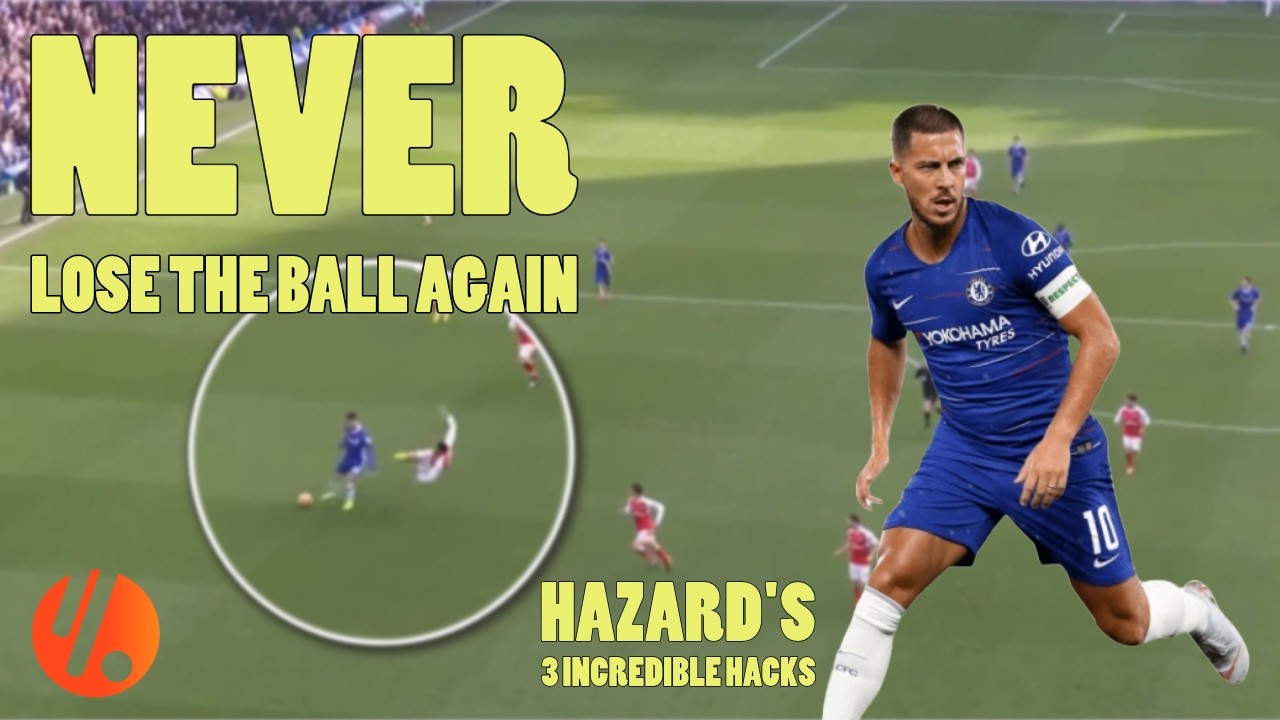
Neglecting shielding. A player who can dribble in open space but can’t protect the ball when pressed from behind is only half-trained. Add
 ▶ Watch on YouTube
How to Protect the Ball Under Pressure | 3 Shielding Moves for Footballers — by Dribble Dreams Academy on YouTube.
to your rotation.
Skipping game transfer. A drag-back executed perfectly in isolation but never applied in a 1v1 hasn’t really been learned. Every technique needs game-context reps in the same session it’s introduced.
Running full 11v11 scrimmages as primary game exposure. The US Soccer PDI mandates 9v9 for this age group for a reason: more individual decisions per player per game. Eleven-a-side dilutes those opportunities significantly.
When to advance
Move a player from Stage 2 to Stage 3 when they execute their signature move with believable timing against a passive obstacle 4 out of 5 reps consistently across two sessions.
Move from Stage 3 to Stage 4 when the player successfully applies a signature move (not just any touch) against a semi-active defender at least 50% of attempts without reverting to panicked kicks or stalls.
Move from Stage 4 to combination moves (chaining two moves) when the player beats a live defender in a true 1v1 setting — receiving a pass, then attacking — with consistent body control on the exit, across three or more sessions.
Move to introducing a second signature move when the first is reliable under full competitive pressure, not when it looks good against cones.
A note on maturation: Physical size at this age can mask technical gaps. The Ontario Soccer “Learn to Train” handbook explicitly cautions against confusing a large 12-year-old’s physical dominance with actual dribbling skill. Assess on technique, not outcomes against physically smaller opponents.
Further reading
- Coerver Pyramid Of Player Development
- Constraints Led Approach
- Long Term Athletic Development Learn To Train
- Dribble Attack Grid
- Non Dominant Foot Development
Sources
- US Soccer Player Development Framework — U11/U12 Learning Plan (9v9) — governing-body — https://www.alsoccer.org/wp-content/uploads/sites/282/2024/03/US-Soccer-Player-Development-Framework-U11-U12-Learning-Plan.pdf
- US Soccer Player Development Initiatives (PDI) — October 2017 — governing-body — https://static.ussdcc.com/users/148963/897090_eng-october2017pdi.pdf
- US Youth Soccer Skills School Manual (2017) — governing-body — https://www.usyouthsoccer.org/wp-content/uploads/sites/160/2023/09/2017-Skills-School-Manual.pdf
- The Coerver Method — Pyramid of Player Development — practitioner — https://www.coervercteast.com/Default.aspx?tabid=1020203
- Ecological-Dynamic Approach vs. Traditional Prescriptive Approach in Improving Technical Skills of Young Soccer Players — peer-reviewed — https://pmc.ncbi.nlm.nih.gov/articles/PMC11417948/
- The Effectiveness of Constraints-Led Training on Skill Development — peer-reviewed — https://pdfs.semanticscholar.org/08c1/c59a1fa6b0a4dd724e7e332e1e7d0f6bae20.pdf
- “Learn to Train” U11/U12 Coaching Handbook — Ontario Soccer / Grassroots Development — governing-body — https://www.tillsonburgsoccer.ca/assets/learntotrain-u11-u12.pdf