
Goalkeeping at 10–12: Building the Habits That Actually Stick
The U11/U12 window is short, and it matters more than most coaches realize. According to the US Youth Soccer Player Development Model, ages 9–12 fall squarely in the "Learning to Train" stage — the optimal period for locking in sport-specific movement patterns that will become…
Goalkeeping at 10–12: Building the Habits That Actually Stick
The U11/U12 window is short, and it matters more than most coaches realize. According to the US Youth Soccer Player Development Model, ages 9–12 fall squarely in the “Learning to Train” stage — the optimal period for locking in sport-specific movement patterns that will become instinctual. Get the basics right now, and a keeper carries them for a decade. Rush the wrong skills, or skip the foundations, and you spend the next four years undoing bad habits.
Why this matters at this age
The timing here is not arbitrary. The Official US Youth Soccer Coaching Manual notes that U12 players are developing markedly improved coordination and growing confidence with balls above the waist — which is exactly why U11/U12 is the right moment to introduce the W-grip, forward diving, and back-pass footwork. These aren’t concepts you’re cramming in early; they’re concepts the body is ready to absorb.
The goalkeeping position is uniquely exposed. Every mistake happens in public, in front of teammates and parents. The US Youth Soccer Player Development Model is explicit that through age 12, player development and self-confidence — not team results — are the primary objectives. Coaches who react visibly to goals conceded undermine the psychological safety a young keeper needs to try, fail, and learn. Behavior-specific positive feedback (“good set position on that one”) is the right tool.
Growth plates are open at this age — particularly at the distal radius and in the fingers — making landing mechanics a genuine safety concern, not a coaching preference. An outstretched arm absorbing a dive is the injury waiting to happen. Teaching the right way to fall is non-negotiable before you ever add height or power to a dive.
Finally, this is the age where rotation matters most. US Youth Soccer’s 55 technical directors are unified on this: U10, U12, and U14 players should not specialize in goalkeeper. Locking one kid in nets for an entire season denies them outfield development, increases burnout risk, and runs directly counter to governing-body guidance. More on that below.
Core concepts
Ready (set) stance Goalkeeper Ready Stance: the default position a keeper returns to between every action. Per the US Youth Soccer Skills School Manual, this means feet shoulder-width apart, weight on the balls of the feet (never the heels), knees bent, center of gravity lowered, a slight forward lean at the waist, arms extended at chest height with elbows bent, palms facing out, fingers relaxed and bent, eyes forward. If the weight is on the heels, reaction speed is already gone.
Set position Goalkeeper Set Position: the keeper must be balanced and stationary — or completing a small step — precisely at the moment the shot is struck. Moving during the shot degrades reaction speed. This is a timing habit, and it takes deliberate repetition to build.
W-grip W Grip: thumbs and index fingers form a W shape behind the ball for shots at chest height and above. Catch with fingertips, not palms, and absorb impact by bending the elbows deeply. Appropriate for U11/U12, but hand size matters — smaller-handed players may still be better served by the Diamond grip (thumbs and index fingers form a diamond shape), which is better suited to lower balls and smaller hands. Assess individually; there is no universal age threshold for this transition.
Angle-play Goalkeeper Angle Play: by stepping off the goal line toward the ball, a keeper physically narrows the amount of goal the shooter can see. This is a trainable concept at 10–12, even if the geometry takes time to internalize.
Safe landing mechanics: land on the side of the body — hip first, then ribcage — with the lower arm tucked. Never fall flat on the back or onto an outstretched wrist. This must be taught before any diving progression begins.
Progression
Stage 1 — Foundation (U9/U10; review at the start of U11)
Before building anything new, confirm these are solid: ready stance, Diamond grip, catching ground and waist-height balls cleanly, goal kicks, over-arm throws, patient 1v1 defending (spread the body, stay on feet, close the angle slowly), and calling “keeper!” when claiming.
How to know you can advance: keeper consistently returns to a correct ready stance unprompted, catches waist-height balls with fingertips and absorbs into chest without rebounds, and can hold a correct set position as a shot is struck.
Stage 2 — U11/U12 Introduction
W-grip for chest and head-height balls. Drill: partner or coach serves balls at chest/face height from 5–8 yards. Keeper catches, holds the W behind the ball, elbows give deeply. Start slow. If the ball is being palmed or slapped, slow down further.
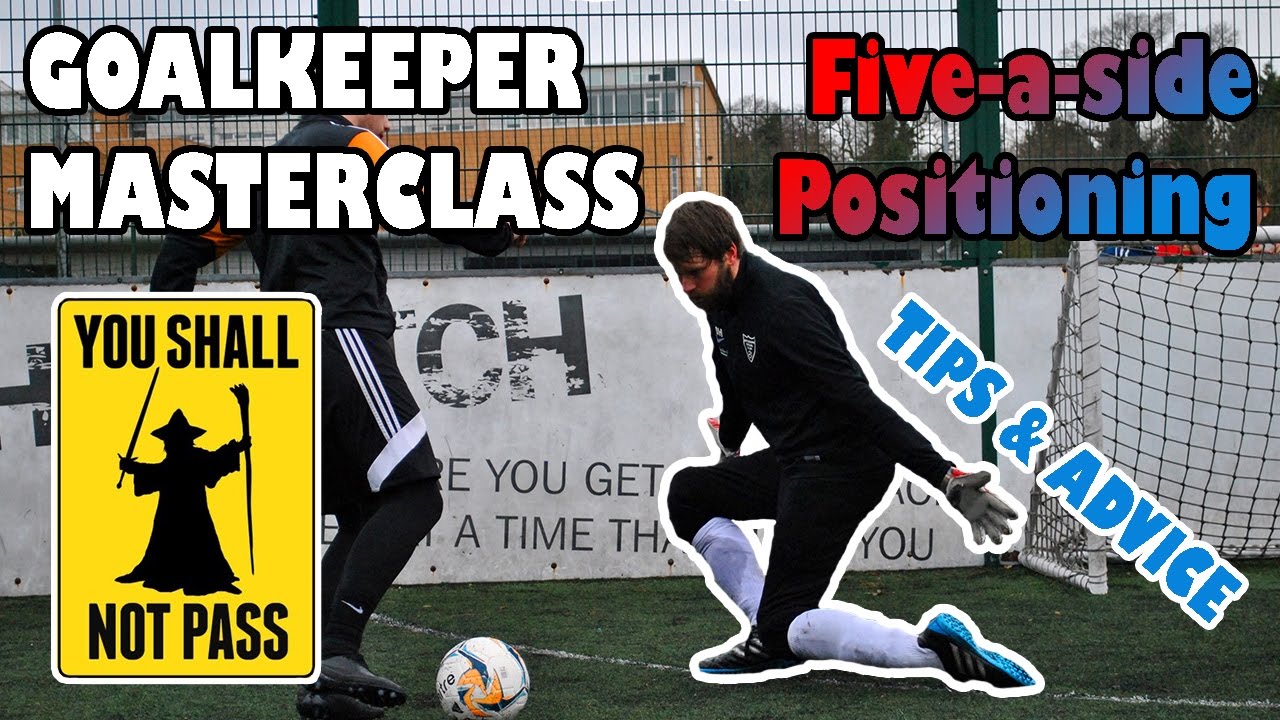
Safe landing, ground level first. On grass or gymnastics mats, no ball: keeper starts in ready stance, tips sideways, lands on hip then ribcage with lower arm tucked, lower leg slightly bent.
 ▶ Watch on YouTube
Goalkeeper Positioning Five-a-Side Tips & Advice - Easy Guide and Basic Technique Coaching — by David Haynes on YouTube.
Repeat 10–15 times each side before any ball is introduced to the dive.
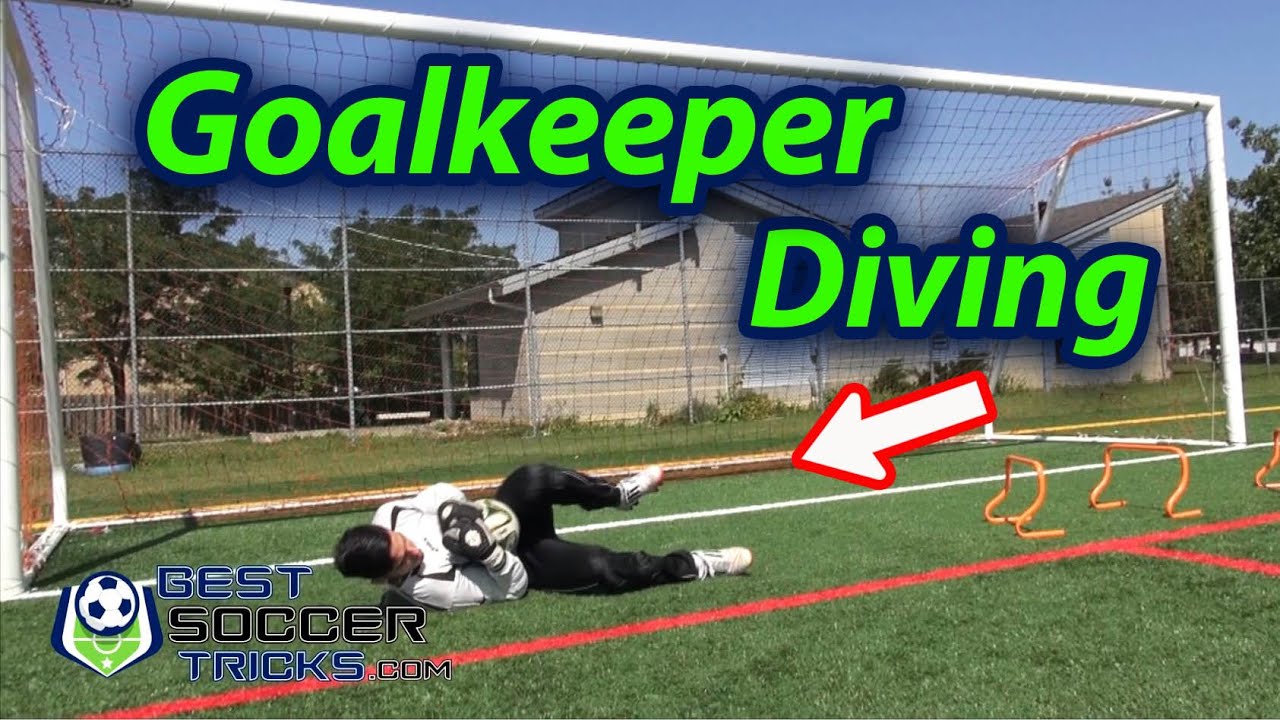
Forward dive and low lateral dive. Once the ground-level landing is clean, add a ball.
 ▶ Watch on YouTube
Lateral Dives for Soccer Goalkeepers — by Best Soccer Tricks on YouTube.
Coach places or rolls the ball to one side, 1–2 feet away. Keeper steps, extends, and lands safely. Soft ground only. Height and distance increase only when mechanics stay clean.
Bowling distribution. From a catch, keeper rolls the ball accurately to a wide teammate — never through the center of the field near the own goal. Keeping eyes up to read a teammate’s run is part of this skill.
Back-pass handling with feet. A modern essential. Begin with simple passes back to the keeper in a small-sided game. Comfort, not technical mastery, is the goal at this stage.
Basic angle positioning. Walk through it first: show the keeper the goal from the ball’s position, then have them step toward the ball and see how much goal disappears.
 ▶ Watch on YouTube
15 Fast Footwork Exercises | Increase Your Foot Speed With These Speed Ladder Drills — by 7mlc on YouTube.
Stage 3 — U11/U12 Consolidation
String skills together: footwork → set position → save → distribute. A simple sequence drill: coach serves a ground ball to the right, keeper shuffles and scoops (partner-roll drill — coach rolls alternating sides, keeper shuffles and scoops, always getting the body behind the ball), then immediately distributes wide to a target.
 ▶ Watch on YouTube
Learn to Dribble in Minutes: For Kids 3-5 years old! 🏀🥇 #howtodribble — by Hooper Hands Basketball on YouTube.
Introduce simple decision-making: throw or kick? Wide or short? Integrate the keeper into small-sided games where playing out from the back is rewarded.
Stage 4 — Bridge to U13/U14 (do not rush)
Medium lateral dives, dropkicks, boxing, and deflections are U14 skills per the US Youth Soccer Skills School Manual. Do not introduce these at U11/U12 unless Stages 2 and 3 are genuinely solid. The temptation to add the “cool” skills early is real — resist it.
Suggested program / schedule
This assumes two sessions per week where the keeper participates partly as keeper, partly as outfield player. Goalkeeper-specific repetitions should not dominate a youth training session.
| Day | Focus | Activities | Volume |
|---|---|---|---|
| Session 1 | Handling + stance | Ready stance reps, W-grip partner catches at varied heights, set-position timing drill | 10–15 min GK-specific, then join outfield |
| Session 1 | Footwork | Partner-roll drill (alternating sides, body behind the ball) | 3–4 min, 10–12 reps/side |
| Session 2 | Diving progression | Safe landing mechanics (ground level, no ball) → low lateral dive with ball on soft surface | 10 min GK-specific |
| Session 2 | Distribution + game integration | Bowling drill to wide targets, back-pass receiving in small-sided game | Embedded in team play |
| Matches | Rotation | Keeper role rotated across players; all players experience the position | Per US Youth Soccer PDM |
Mistakes to avoid
- Teaching the W-grip before hands are large enough. For smaller-handed U11 players, the Diamond grip may still be more appropriate — forcing W-grip on hands that can’t execute it correctly builds bad habits.
- Introducing diving on hard or artificial surfaces without a matted area. Hard ground and uncushioned turf multiply the risk to open growth plates. Grass or gymnastics mats first, always.
- Landing flat on the back or falling on an outstretched arm. This is the most common unsafe pattern and must be corrected immediately — it is how wrists and fingers get hurt.
- Keeper moving backward during a save attempt. The keeper should step toward the ball, not away from it. Backpedaling kills angle and reaction time.
- Standing flat-footed in the ready stance. Weight on the heels means the keeper is already half a step behind. Reinforce “balls of your feet” on every rep.
- Distributing through the center of the field near own goal. This is a dangerous habit to form at any age. Train keepers from the start to play wide.
- Locking one child into goal for the entire season. This contradicts US Youth Soccer development policy and is a burnout and dropout risk. Rotate.
- Over-loading goalkeeper technique drills. Isolating goalkeeper repetitions at the expense of outfield skill and small-sided game time runs counter to the development goals of this age group.
When to advance
Move from Stage 1 to Stage 2 when the keeper: - Returns to correct ready stance automatically between actions - Catches waist-height and ground balls cleanly with no rebounds, 4 out of 5 attempts
Move from Stage 2 to Stage 3 when the keeper: - Executes a safe side-landing (hip → ribcage, lower arm tucked) on 5 consecutive repetitions without cueing - Completes low lateral dives to both sides with clean landing mechanics on soft ground for at least 3 sessions - Demonstrates correct set position (stationary as the shot is struck) in at least half of small-sided game repetitions
Move from Stage 3 toward Stage 4 when: - The keeper strings footwork + set position + dive + distribution cleanly in a sequence drill for 3 consecutive sessions - Angle-play decisions (step out or hold?) are showing up without prompting in small-sided games - Note: Stage 4 skills (medium lateral dives, boxing, dropkicks) are listed as U14 skills and should not be rushed regardless of apparent readiness.
A note on an unresolved tension: US Youth Soccer policy calls for no goalkeeper specialization through U14, yet many club programs begin dedicated goalkeeper training at U11/U12. These positions are genuinely in tension. If your club offers GK-specific sessions at this age, participation is worthwhile — but it should complement, not replace, full-squad outfield training and position rotation.
Further reading
- Goalkeeper Ready Stance — A deep dive into body mechanics and common stance errors
- W Grip Vs Diamond Grip — When and how to transition between grip types
- Ltad Learning To Train Stage — The “Learning to Train” window explained for parents and coaches
- Goalkeeper Low Lateral Dive — Step-by-step progressions from ground fall to full dive
- Goalkeeper Angle Play — How to teach positioning geometry to young keepers
Sources
- US Youth Soccer Player Development Model — governing-body — https://addisonunitedvt.com/wp-content/uploads/2012/03/US_Youth_Soccer_Player_Development_Model.pdf
- How to Coach – Goalkeeping (Excerpt from US Youth Soccer Skills School Manual) — governing-body — https://www.arlingtonsoccerclub.org/how-to-coach-goalkeeping
- The Official US Youth Soccer Coaching Manual — governing-body — https://www.usyouthsoccer.org/wp-content/uploads/sites/160/2023/09/Official-US-Youth-Soccer-Coaching-Manual-1.pdf
- Youth Coach: Goalkeeper — practitioner — https://ussoccerplayers.com/soccer-training-tips/youth-coach-goalkeeper
- 7 Essential Skills for a Youth Soccer Goalkeeper — practitioner — https://barcaresidencyacademyusa.com/7-essential-skills-for-a-youth-soccer-goalkeeper