
Passing at 12+: Technique, Decisions, and Team Concepts for Growing Soccer Players
At 12 and up, the field gets bigger, the defenders get smarter, and the game starts demanding something beyond a clean kick — it demands a thinking passer. This is the age where technique, decision-making, and tactical awareness have to develop together, not in sequence. Get that…
Passing at 12+: Technique, Decisions, and Team Concepts for Growing Soccer Players
At 12 and up, the field gets bigger, the defenders get smarter, and the game starts demanding something beyond a clean kick — it demands a thinking passer. This is the age where technique, decision-making, and tactical awareness have to develop together, not in sequence. Get that combination right, and you’re building a player. Focus only on clean mechanics in a cone drill, and you’re building someone who looks good in warmup and goes to pieces in a game.
Why this matters at this age
The 12–14 window is one of the most consequential stretches in a soccer player’s development. The US Youth Soccer Coaching Manual identifies U-12 as the moment when players can “simultaneously run, strike, and think” — meaning this is precisely when coaches should be linking physical execution to tactical awareness, not treating them as separate subjects.
At the same time, puberty introduces real complications. Growth spurts temporarily disrupt coordination, and passing accuracy can actually dip before it improves. That’s not a failure — it’s biology. Knowing this helps coaches avoid over-correcting a player who is developing exactly on schedule.
The cognitive picture is changing too. Players around 12–14 can begin to think two passes ahead: what is my second pass? That’s a question worth asking out loud in training, and the Player Development Project’s material (featuring Tom Turner of the US Soccer National Coaching Committee) reinforces that questions, not constant instructions, are the right coaching tool at this stage.
According to the LTAD (Long-Term Athlete Development) framework, players in this band are transitioning from “Learning to Train” into “Training to Train.” Physical loading increases, but technical habit formation — passing off both feet, body shape, scanning — remains central. Fitness work should never crowd out passing volume.
Core concepts
Inside-foot push pass — the workhorse. Lock the ankle, plant your standing foot toward the target, and keep the follow-through low. Master it on both feet before adding anything else. Inside Foot Push Pass
Outside-foot pass — a quick-release redirection at shorter range. Defenders find it harder to read than the inside-foot pass, which makes it genuinely useful at 12+. It’s a complement, not a replacement. Outside Foot Pass
Driven ball (laces) — knee over the ball, contact through the center. This is the right tool for longer switches, through-balls, and combinations over distance. As field sizes grow, this becomes a primary skill rather than an advanced one. Driven Ball
Lofted ball — contact below the center of the ball. Used for switching play over the top or for crossing. The coaching focus should be on flight control and weight, not just getting it airborne.
First touch as the second pass — the receiving touch and the passing touch are one connected action, not two separate events. The first touch should cushion and redirect the ball into space away from pressure. A touch that stops the ball dead under your feet has already cost you. First Touch Redirection
Half-turn receiving — scanning the field before the ball arrives allows a player to receive already facing upfield, with their body open. This becomes critical at 12+ as pressure increases and the field widens. Half Turn Receiving
Weight of pass — match ball speed to your teammate’s situation: firm and direct when they’re under pressure, leading into stride when they’re running into space, soft and accurate when they’re stationary. Getting the technique right but the weight wrong is still the wrong pass.
Scanning — checking your shoulders repeatedly in the seconds before receiving so the decision is already forming when the ball arrives. This is a trainable skill. Coaches should develop it through questions: “What did you see before it came to you?” Visual Scanning
Pass selection and risk literacy — the ability to tell a safe ball (backward or sideways to keep possession) from a line-breaking forward pass worth the risk. Both have value. A player who only plays safe balls isn’t developing full passing intelligence.
Progression
Stage 1 — Technical consolidation (U12)
Focus on the inside-foot push pass on both feet in dynamic settings — not stationary lines. Run
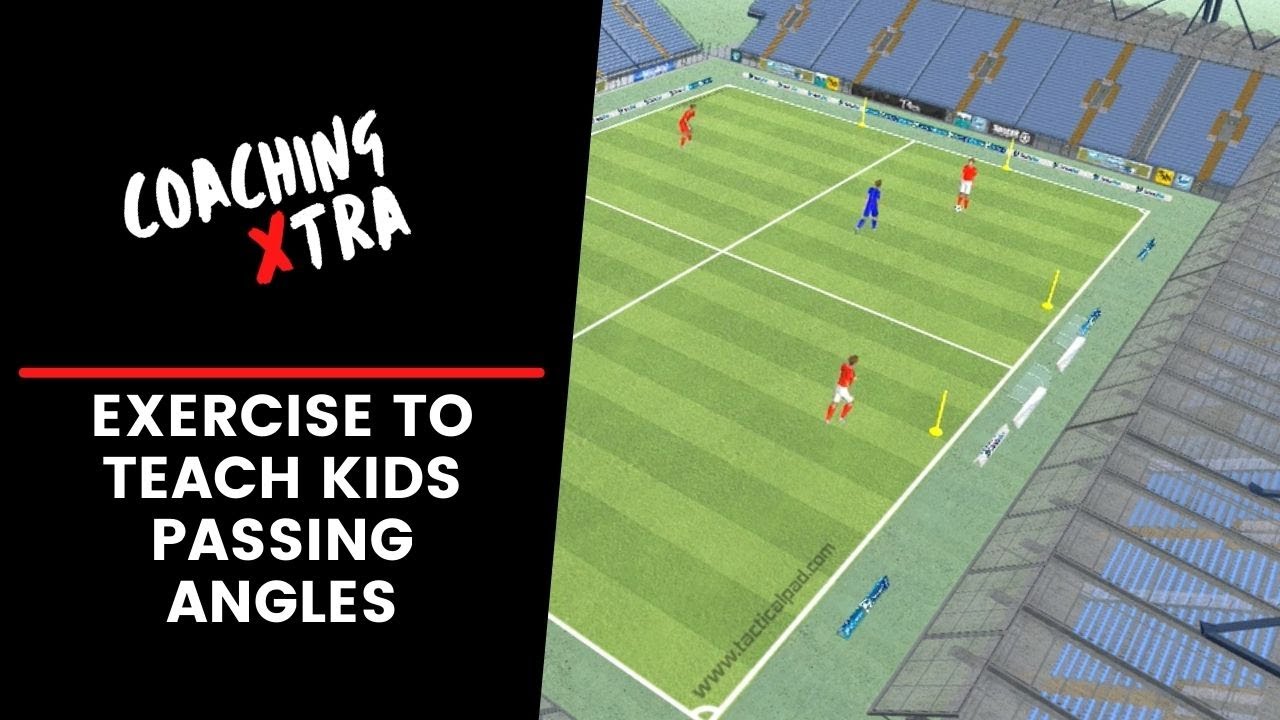 ▶ Watch on YouTube
Kids 3v1 Rondo With Mini Goals — by Coaching Xtra on YouTube.
and
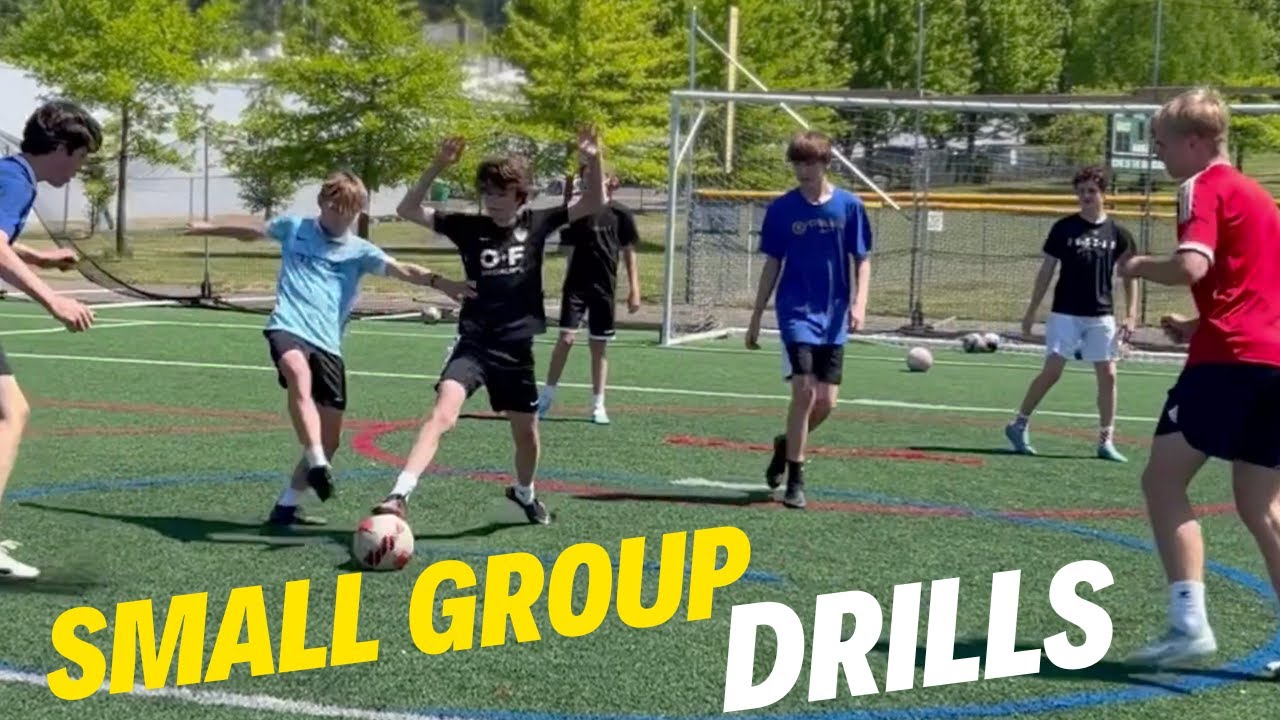 ▶ Watch on YouTube
Tight Space Decision Making | 4v1 Transitional Rondo Drill — by RAIN Soccer Training on YouTube.
with generous space to give players time to think while still working under light pressure. Introduce receiving on the half-turn as a coaching point. Use two-touch constraint games to encourage quicker decisions without removing the game context.
Advance when: Players can consistently pass off both feet in a 4v1 rondo without losing possession every few seconds, and they’re beginning to receive with an open body shape rather than chest-on to the passer.
Stage 2 — Pressure and range (U12–U13)
Tighten the rondo to
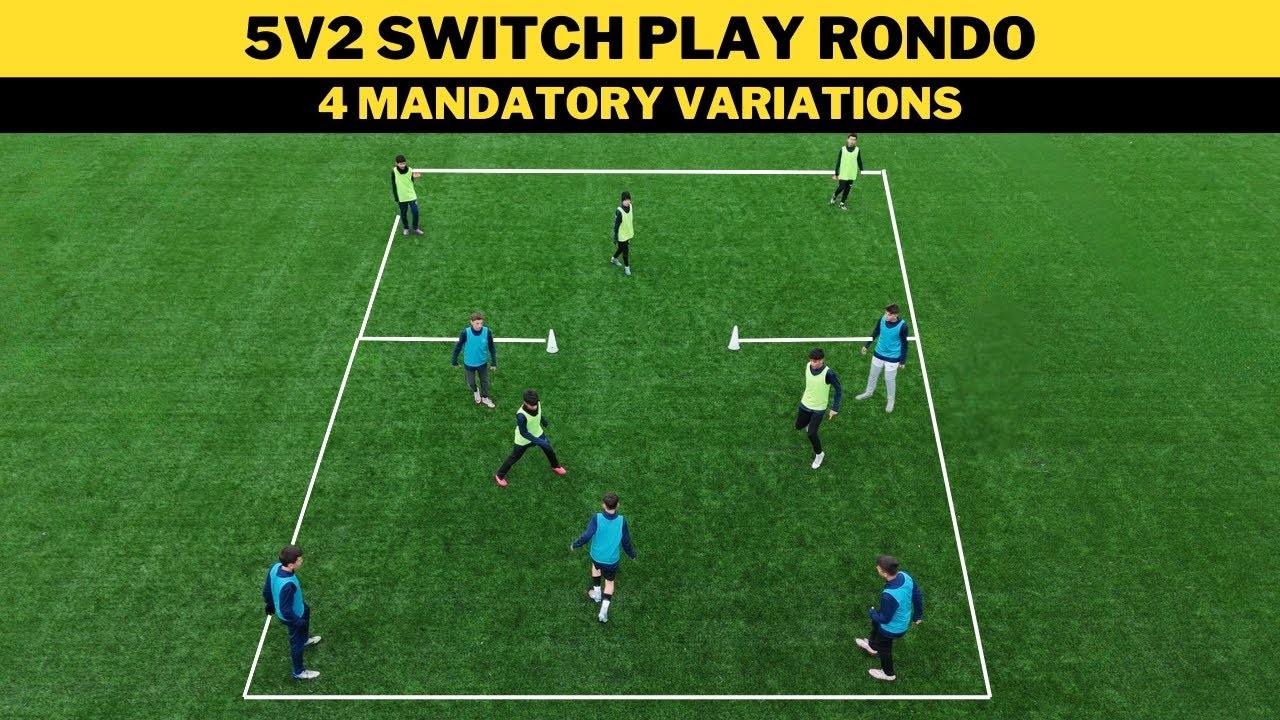 ▶ Watch on YouTube
5v2 Switch Play Rondo | 4 Mandatory Variations | Football/Soccer Training — by AD Football Training Videos on YouTube.
and
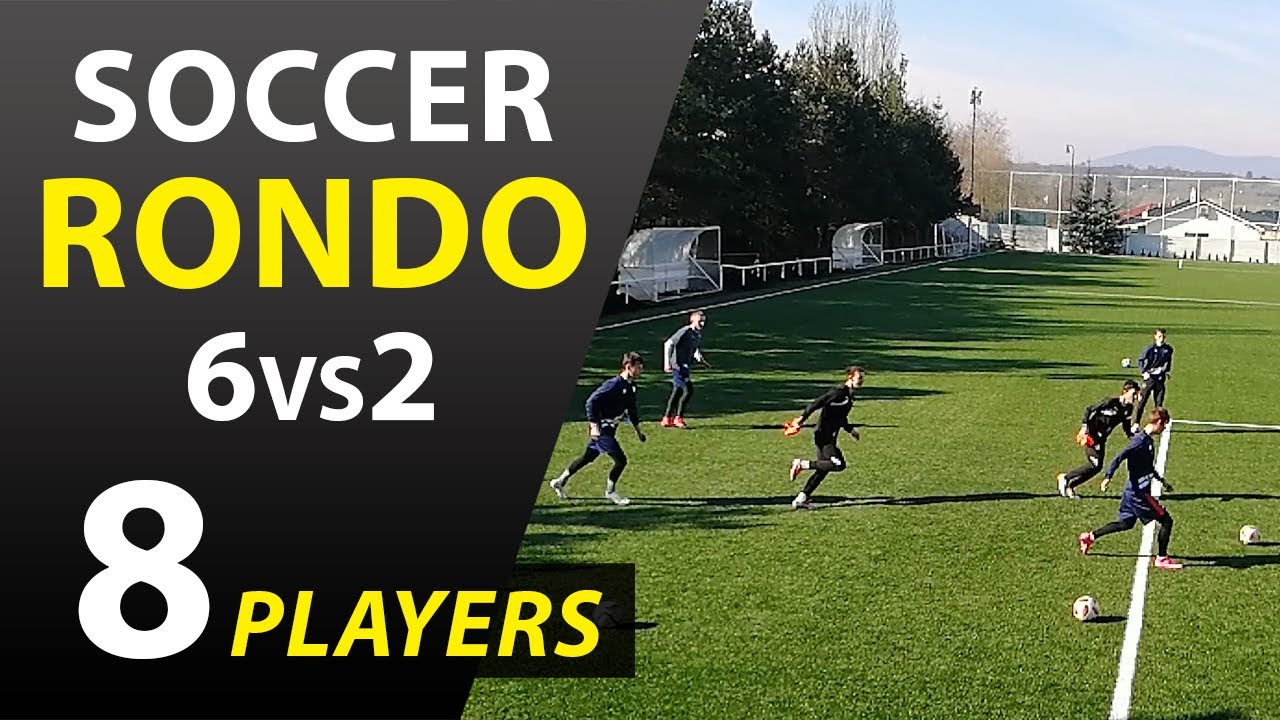 ▶ Watch on YouTube
RONDO DRILL 6V2 | SOCCER RONDO FOR 8 PLAYERS #6 — by PP Academy on YouTube.
. Less space means faster decisions and a harder scanning demand. Introduce the driven ball for passes over longer distances. Add the outside-foot pass as a situational option, coached in context rather than in isolation. Begin coaching weight of pass explicitly during possession games.
Advance when: Players can maintain possession in a 5v2 for multiple rotations, are scanning before receiving without being prompted, and can purposefully vary ball speed based on their teammate’s situation.
Stage 3 — Combination play (U13–U14)
Introduce combination sequences:
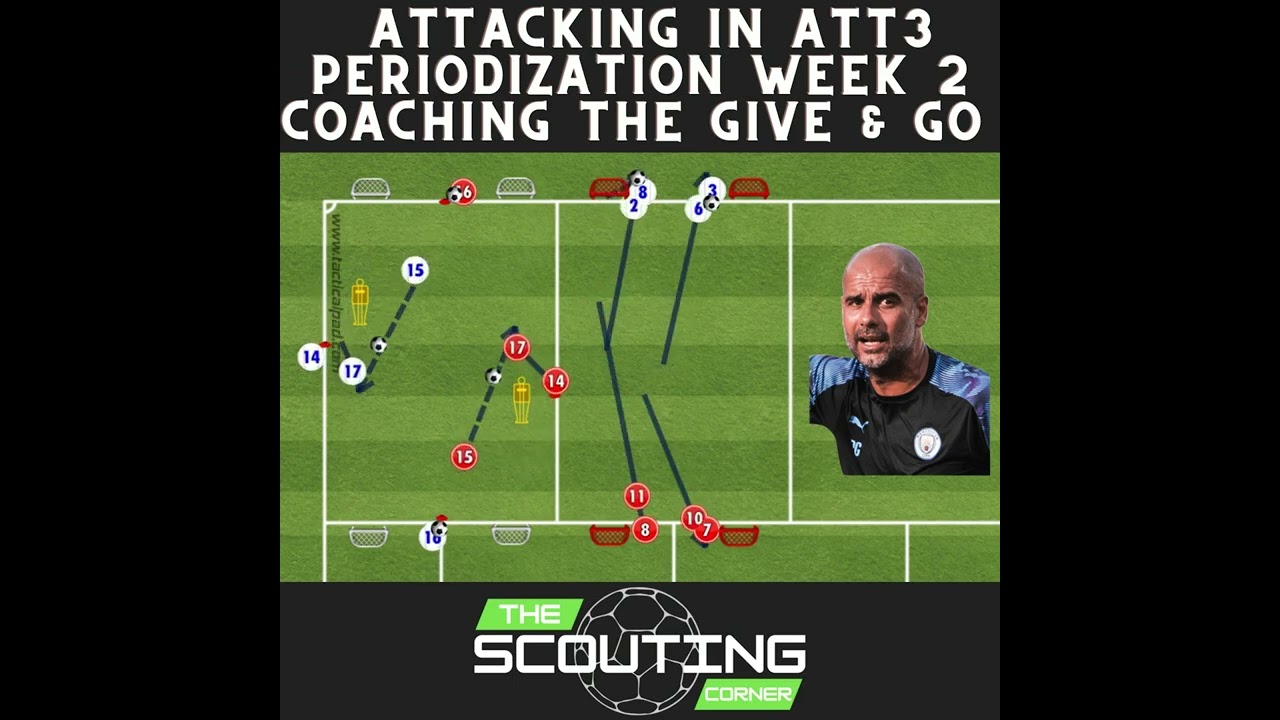 ▶ Watch on YouTube
Attacking Principles in Soccer give and Go one two wall pass TacticalPad Detailed coaching points — by The Scouting Corner Pro Scouting and Player Videos on YouTube.
, overlap runs, and
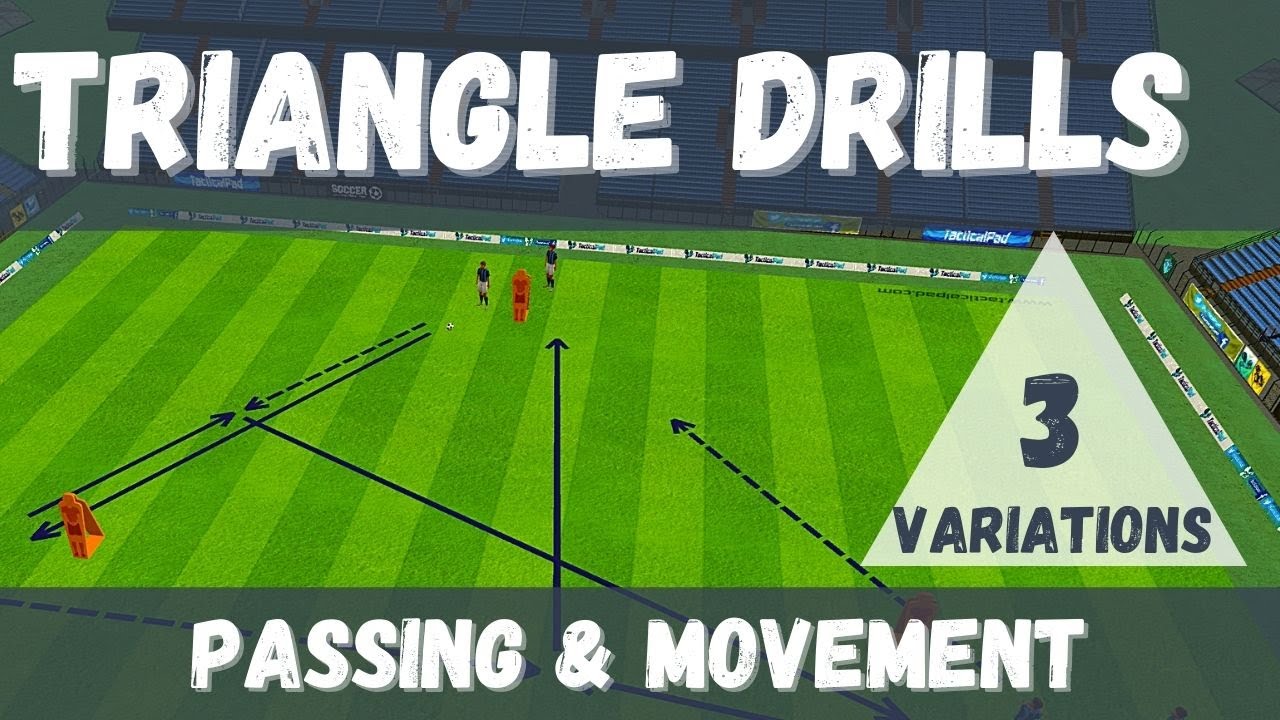 ▶ Watch on YouTube
Triangle Drills For Soccer/Football | Passing, Movement & Third Man Run | 2020 — by KS Performance on YouTube.
. Positional rondos with functional zones (one player in a wide role, one central) start to mirror real game structure. Add switching play using driven and lofted delivery. Introduce the pass-selection vocabulary — safe ball vs. risk ball — so players have language for what they’re choosing and why.
Advance when: Players can identify the third man before the ball moves and can execute a switch of play with a driven ball that arrives at pace, not floating at head height.
Stage 4 — Positional play integration (U14+)
Move into larger possession games: 6v6 with neutral players or target players, and positional play exercises where zones mirror actual game positions. Introduce press-resistance work at higher physical intensity. Add set-piece passing patterns. At this stage, players should be making full game-state decisions: when to slow possession, when to go forward, when to recycle.
Advance when: Players can read the press, move the ball in 1–2 touches under high pressure while maintaining shape, and articulate what their second pass will be before their first one leaves their foot.
Suggested program / schedule
The emphasis at this age should be on game-realistic contexts for most of the session. Isolated technical work is useful for brief refinement windows, not the session spine.
| Session Phase | Activity | Duration | Notes |
|---|---|---|---|
| Activation | Ball-mastery patterns, both feet | 8 min | No lines, players always in motion |
| Technical refinement | Inside/outside foot pass, driven ball — pairs or small groups | 10 min | Coach body shape and ankle lock |
| Core exercise | 4v1 → 5v2 rondo (progress within session) | 15–20 min | Questions on scanning; minimal stops |
| Combination play | Give-and-go patterns or third-man run sequences | 10–12 min | Functional, not robotic |
| Possession game | Touch-limited SSG (e.g., 2-touch, 4v4 or 5v5 with neutrals) | 15–18 min | Keep coach interruptions minimal |
| Cool-down / debrief | Questions: “What did you see?” “Why that pass?” | 5 min | Cognitive reflection, not a lecture |
Twice-weekly session rhythm is the baseline. Count total kicking volume across team training and games — and have conversations with parents about what players are doing outside of team sessions.
Mistakes to avoid
Running passing drills in stationary lines with no defender. You get players who look technically clean in warmup and fall apart under pressure. Every exercise needs a constraint or a defender.
Calling long-ball clearances “passing range.” A 40-yard punt trains the opposite of possession habits. It doesn’t develop the driven ball — it replaces learning with a shortcut.
Letting players default to their dominant foot. Structuring the exercise so the non-dominant foot is unavoidable — not just encouraged — is a non-negotiable coaching responsibility. Set up rondos and small-sided games where the geometry forces the weaker foot.
Over-coaching during rondos and small-sided games. The US Youth Soccer Coaching Manual is clear that coach interruptions during game activity should be minimal. Constant stops kill the decision-making practice that makes these exercises work in the first place.
Skipping body shape coaching. A player who receives chest-on to the passer has already wasted a touch. Open body shape should be addressed early, often, and patiently.
Praising pass completion without looking at pass selection. A player who only ever plays backward or sideways is protecting their completion rate, not developing full passing intelligence. Challenge the safe choice when the situation called for more.
Making the rondo your only passing exercise. Rondos are irreplaceable for building touch, decision-making, and body shape under pressure — a randomized trial published in 2025 (Bouzouraa et al.) showed large-effect-size improvements in problem-solving and creative thinking from structured rondo training with U-13 players. But rondos don’t cover switching play over distance or set-piece patterns. Round them out.
Ignoring the scanning habit. Not asking players what they saw before receiving the ball. Scanning is a coachable skill that degrades without deliberate attention. Make “What did you see?” a regular question, not an occasional one.
When and how to advance
Advancement between stages shouldn’t be based on age or how long a player has been in the stage — it should be based on what you actually see in practice.
- Out of Stage 1: Passes off both feet consistently in a 4v1 rondo; receiving on the half-turn at least some of the time without being reminded.
- Out of Stage 2: Holds possession in a 5v2 across multiple rotations; noticeably varying pass weight based on the receiver’s situation; scanning before receiving without a coaching prompt.
- Out of Stage 3: Anticipates the third-man option before the combination completes; switches play with a driven ball that arrives at appropriate pace; uses “safe ball vs. risk ball” language in debrief conversations.
- Into Stage 4 and beyond: Reads a press and moves the ball in 1–2 touches under high physical intensity while maintaining positional shape; can explain game-state decisions (when to hold possession, when to go forward) after a session.
One additional note: maturation varies widely at 12+. A single team will include players at very different physical and cognitive stages. Coaching that leans on physical dominance — defaulting to the long ball because it “works” for physically advanced players — masks the developmental gap and stalls everyone’s technical growth.
A note for parents
If your child’s coach is running a lot of rondos and small-sided games instead of shooting lines or 11v11 scrimmages, that’s deliberate. The US Youth Soccer philosophy emphasizes small-sided formats (7v7 to 9v9) at 12+ precisely because players get far more passing touches than in full-format games. The rondo — that circle passing drill where one or two players chase the ball in the middle — is doing more technical and cognitive work per minute than almost any other exercise in soccer coaching. It trains technique, decision-making, body shape, and scanning simultaneously. It’s also, according to peer-reviewed research, genuinely developing your child’s problem-solving skills. That’s not a bonus. That’s the point.
Further reading
- Rondo Progressions And Formats
- Visual Scanning And Shoulder Checks
- Half Turn Receiving
- Third Man Run Sequence
- Pass Selection Risk Literacy
Sources
- Official US Youth Soccer Coaching Manual — governing body — https://www.usyouthsoccer.org/wp-content/uploads/sites/160/2023/09/Official-US-Youth-Soccer-Coaching-Manual-1.pdf
- Enhancing problem-solving skills and creative thinking abilities in U-13 soccer players: the impact of rondo possession games’ training (Bouzouraa M, Dhahbi W, Ghouili H, et al., 2025) — peer-reviewed — https://pmc.ncbi.nlm.nih.gov/articles/PMC12244377/
- The Use of Rondos & Positional Training Games in Soccer (Philip Cauchi, UEFA A License & Elite Youth Coach) — practitioner — https://www.isspf.com/the-use-of-rondos-in-soccer/
- How to Coach U12 Soccer: Tips, Session Plans, and U12 Soccer Drills (Ajay Smith / Player Development Project, featuring Tom Turner, US Soccer National Instructor) — practitioner — https://playerdevelopmentproject.com/u12-soccer-drills/
- 5 Essential Rondo Training Drills That Transform Young Players — Absolute Football Training — practitioner — https://absolutefootballtraining.com/ultimate-game-changer-5-essential-rondo-training-drills-that-transform-young-players/