
Teaching the Beautiful Game: Age-by-Age Guide to Youth Soccer Practice Planning
Your 5-year-old races after the ball in a pack. Your 10-year-old is starting to look up before they receive. Your 13-year-old is ready to understand what "shape" means. The same sport, but completely different developmental worlds — and the practices that serve each of them look…
Teaching the Beautiful Game: Age-by-Age Guide to Youth Soccer Practice Planning
Your 5-year-old races after the ball in a pack. Your 10-year-old is starting to look up before they receive. Your 13-year-old is ready to understand what “shape” means. The same sport, but completely different developmental worlds — and the practices that serve each of them look nothing alike. Here’s what US Soccer’s own framework says, broken down by age, so you know exactly what a good session looks like and what to push back on when it isn’t.
Why this matters
Youth soccer in the US has a coaching problem that shows up at every level: adults design practices for adults, then hand them to kids. Lines of cones. Constant sideline shouting. Positions locked in at age eight. Tournament weekends for six-year-olds. These aren’t neutral choices — they actively shrink the number of ball contacts each child gets, remove decision-making from the players, and are associated with early dropout. US Soccer’s Player Development Initiatives and US Youth Soccer’s Player Development Model exist precisely to counter these habits with a framework grounded in developmental science. This guide makes that framework practical.
How the picture shifts with age
The youngest players — ages 4 through 6 — are not small versions of soccer players. They are children for whom egocentric play is developmentally normal. The concept of intentionally passing to a teammate is largely beyond their cognitive stage, and the US Youth Soccer Player Development Model acknowledges this explicitly. Their session is properly called “Me and My Ball.” The ball is the motivational vehicle; the actual training target is foundational movement — balance, coordination, spatial awareness.
By ages 7 through 9, cooperative play begins to emerge. Players in Piaget’s Concrete Operational stage (roughly 7–11 years) can start understanding intentional passing as a rewarding act — not because you told them to pass, but because the game design made it the obvious choice. This is the window for 4v4 formats, guided questions, and brief but purposeful coaching interactions.
Ages 10 through 12 are what LTAD (Long-Term Athletic Development, a framework for sequencing physical and skill development across a player’s career) researchers call the “skill-hungry” years — the window most sensitive to motor pattern development. Players can now sustain focus longer, understand teammate perspectives, and begin to grasp cause and effect in tactics. Basic team shape becomes appropriate. Abstract systems do not.
At 12 and above, adolescence introduces both new cognitive capacity and new volatility. Players can reason about formations, understand their role in a unit, and reflect on tactical decisions — but they also push back against authority and are highly sensitive to public embarrassment. The coach’s role shifts toward facilitator and, eventually, strategist.
Across every age, two things remain constant: every player needs a ball in their hands (or at their feet) as much as possible, and the game itself is the best teacher.
Age-specific guidance
Ages 4–6: Me and My Ball
The session, from start to finish
The US Youth Soccer Player Development Model for U6 recommends one combined session per week — not a separate practice plus a game, but one 45–60-minute event structured as: arrival free play → warm-up/soccernastics → game-like activities → 3v3 match. Every child has a ball for all of it. No waiting in lines. Ever.
- Arrival (5–10 min): Players arrive and explore freely with a ball. The coach watches and does not direct. This is not wasted time — it’s unstructured exploration that builds intrinsic love of the game.
- Warm-up/Soccernastics (10–15 min): Coach-led but child-paced challenges.
 ▶ Watch on YouTube
Soccer Drills for Kids to Teach Aggression (Intensity & Effort) — by Progressive Soccer on YouTube.
(dribble around a grid — freeze when the coach calls it), body-part challenges (“touch the ball with your knee!”), and movement-education tasks. Keep each task 2–3 minutes and move on. - Game-like activities (10–15 min): 1v1 dribbling challenges,
 ▶ Watch on YouTube
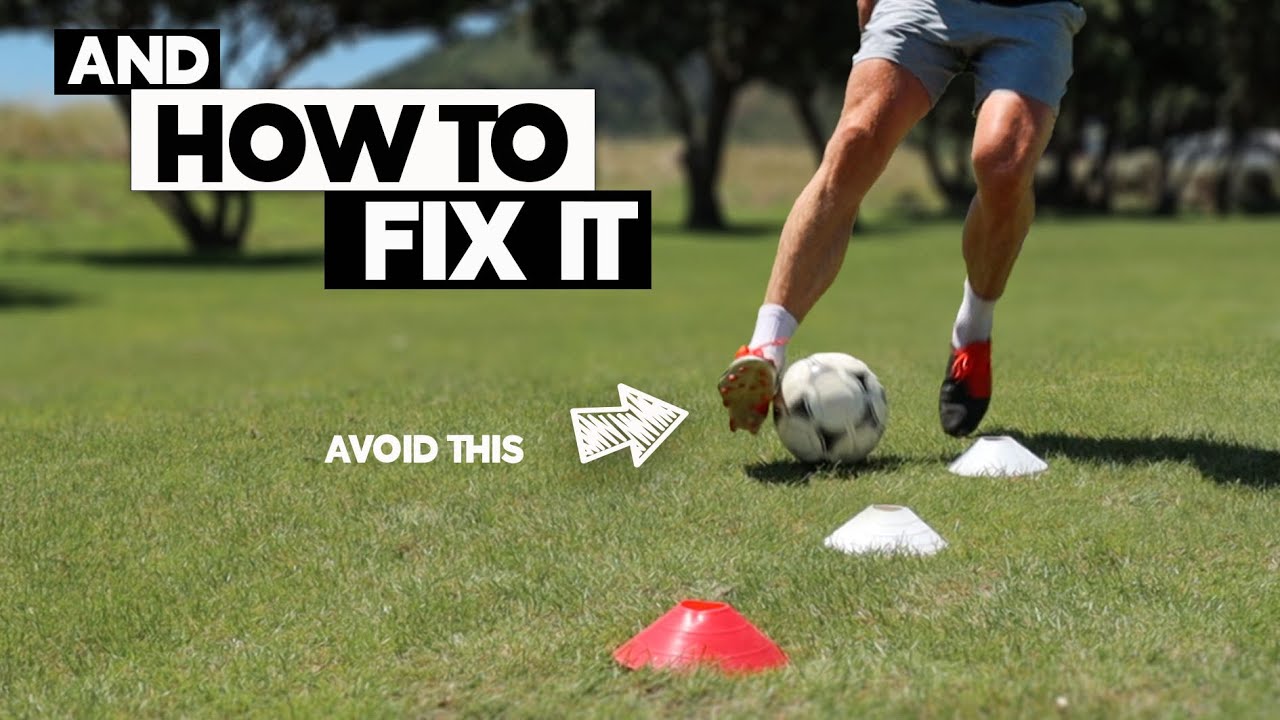
Why MOST Players Can’t Dribble around Cones — by The Football Folk on YouTube.
through cone gates, 2v1 keep-away. Short bouts, quick rotations, positive cues only. - 3v3 match (15 min): Two small goals, no goalkeeper, no referee needed. Let it run. Teach the rules informally as they come up (“that went out — your kick!”). Stay quiet on the sideline.
What the US Soccer PDI mandates - Size 3 ball (lighter, smaller — adult balls are a physical hazard for small feet and ankles) - Field approximately 25–35 yards × 15–25 yards - No standings, no scores recorded, no tournaments
The most important thing to know Children 4–6 cannot split attention between controlling a ball and listening to adult instructions simultaneously. When you talk, their play suffers. The US Youth Soccer Applied Summary for U6 frames sideline quiet not as a preference but as a developmental necessity.
Key mistakes to avoid at this age - Assigning a goalkeeper — prohibited by US Soccer PDI and developmentally inappropriate - Lining children up to take turns — destroys touch volume and kills engagement - Teaching passing as a deliberate tactical skill — cognitively premature; use constraints instead (e.g., a goal only counts if two players touched the ball) - Heading — strictly prohibited for all 11U and younger under the 2015 US Soccer Concussion Initiative; award an indirect free kick for any header at U6 - Entering tournaments or recording standings — explicitly discouraged by both US Soccer PDI and US Youth Soccer PDM
When to advance: When children reliably engage with 1v1 and 2v1 formats, show basic spatial awareness in a shared grid, and can follow simple two-step instructions — they’re ready for the U8 model.
Ages 7–9: The Beginning of Cooperation
The session structure
The US Soccer Player Development Framework describes a five-phase session for this age: arrival/free play → warm-up with a ball → small-sided activity → expanded small-sided game → match. Total time: 60–75 minutes maximum (45–60 min for U8; 60–75 min for U9).
| Phase | Time | Format | Coaching role |
|---|---|---|---|
| Arrival / free play | 5 min | 1 ball per player, self-directed | Observe only |
| Warm-up with a ball | 8–10 min | 1v1 tag games, skill challenges | Brief positive cues |
| Small-sided activity | 12–15 min | 1v1, 2v1, or 2v2 | Modify constraints |
| Expanded SSG | 12–15 min | 3v3 or 4v4 | Guided questions |
| Match | 10–15 min | 4v4 or 5v5, minimal coaching | Encourage and stay off the field |
Why 4v4? The Why Small-Sided Games for American Soccer? document from US Youth Soccer cites a comparison showing that 4v4 vs. 8v8 generated 135% more passes, 260% more shots, and 500% more goals per player. Five 4v4 fields fit inside one full-size field — 40 players active simultaneously instead of 22. Touch volume is the entire argument for small-sided formats at this age.
Technical focus First touch and receiving, dribbling to beat a defender in 1v1, shooting, and the beginning of intentional passing to a nearby teammate. Passing emerges here because you’ve designed games where it’s rewarding — not because you demanded it.
Key drill examples
 ▶ Watch on YouTube
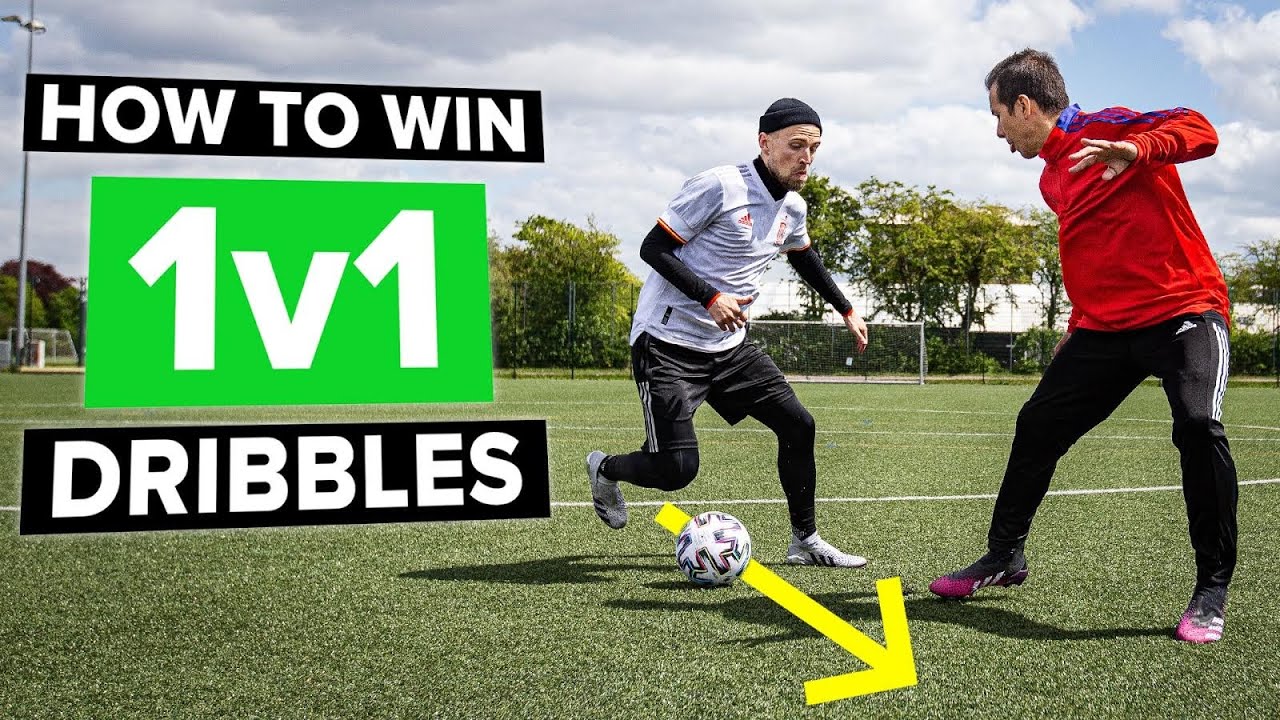
How to win 1v1 situations | dribble the defender — by Unisport on YouTube.
— Small goals at each end of a 10×15 yard grid; attacker tries to score, defender tries to clear the line. Rotate every 90 seconds.
 ▶ Watch on YouTube
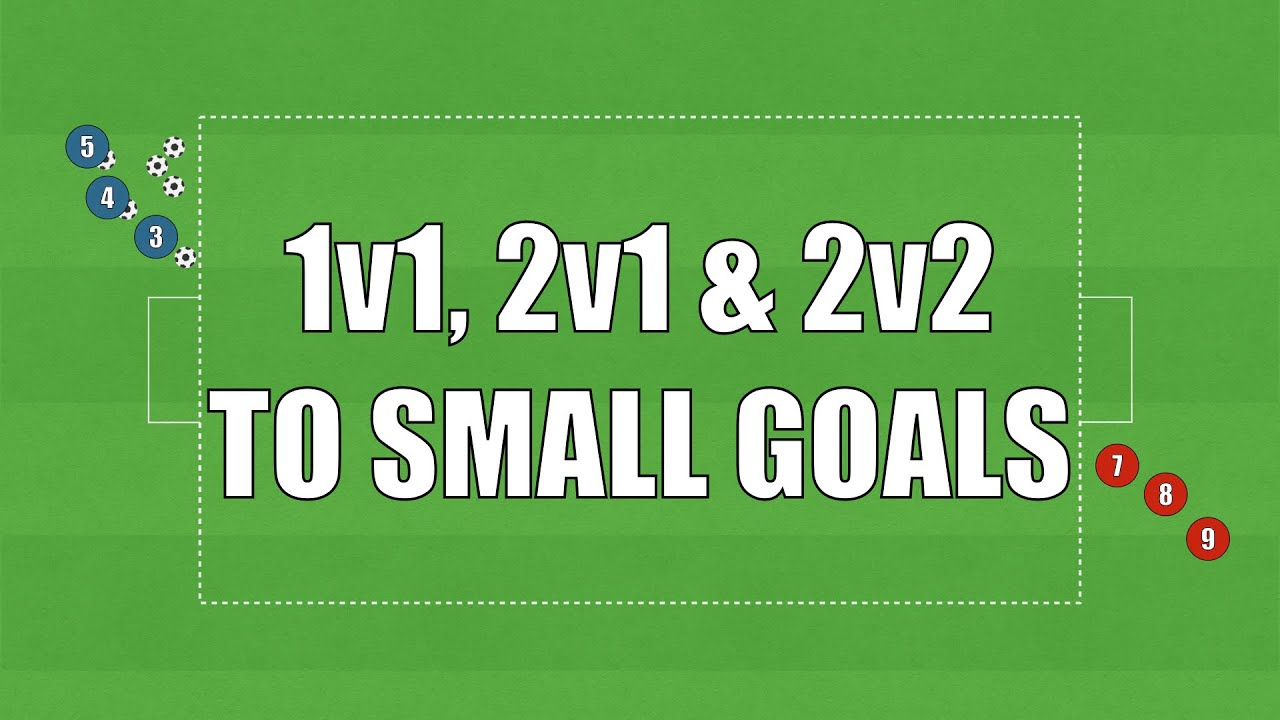
1v1, 2v1 & 2v2 To Small Goals Drills | Football/Soccer — by Onside - Training on YouTube.
— Attacker and support player vs. one defender; score by dribbling into an end zone. Defender tries to dispossess. Brief, competitive, high-repetition.
Key mistakes to avoid at this age - Joystick coaching — calling “pass it!”, “turn!”, “shoot!” in real time removes decision-making from players and defeats the purpose of the game - Running lines drills — if players are waiting, touches are disappearing - Permanent goalkeeper — rotate all players; no child should be locked in goal all season - Teaching formations or pressing systems — cognitively inaccessible at this stage - Exceeding 20 games per calendar year — per US Soccer PDI standards
When to advance: When players demonstrate basic spatial awareness in 4v4, begin voluntarily combining with a teammate (passing, not just dribbling), and sustain engagement through a 60-minute session — they’re ready for the U10 model.
Ages 10–12: The Skill-Hungry Years
The session structure (Play-Practice-Play)
The canonical US Soccer Grassroots framework here is Play-Practice-Play (PPP): arrival → ball-active warm-up → small-sided activity → expanded SSA → match. Session length: 60–75 minutes (two to three sessions per week maximum at the developmental level).
| Phase | Time | Format |
|---|---|---|
| Arrival / free play | ~8 min | 1 ball per player |
| Warm-up (ball-active) | ~12 min | Dribbling, rondos, movement challenges |
| Small-sided activity | ~15 min | 3v3–4v4, session theme |
| Expanded SSA | ~10 min | 5v5–6v6, theme in context |
| Match | ~15 min | 7v7 (U10) or 9v9 (U11/U12) |
The game format ladder US Soccer PDI specifies: U9/U10 play 7v7 on 55–65 × 35–45-yard fields with a size-4 ball; U11/U12 play 9v9 on 70–80 × 45–55-yard fields. Both formats have goalkeepers and offside. The Small-Sided Games Developmental Coaching Resource (summarizing Cologne/Abertay research) is direct: 11v11 and 7v7 on a full field are “totally inappropriate” for players under 12 because they reward kick-and-run over skill.
Introducing team concepts For U11/U12, the US Soccer Grassroots Player Development Framework introduces the Four Moments of the Game — attacking organization, defending organization, transition to attack, and transition to defense. Sessions should touch on all four across a week, not just attacking. Basic team-shape concepts (pressure-cover-balance in defense; width and depth in attack) are appropriate. Complex systems are not.
Key drill examples
 ▶ Watch on YouTube
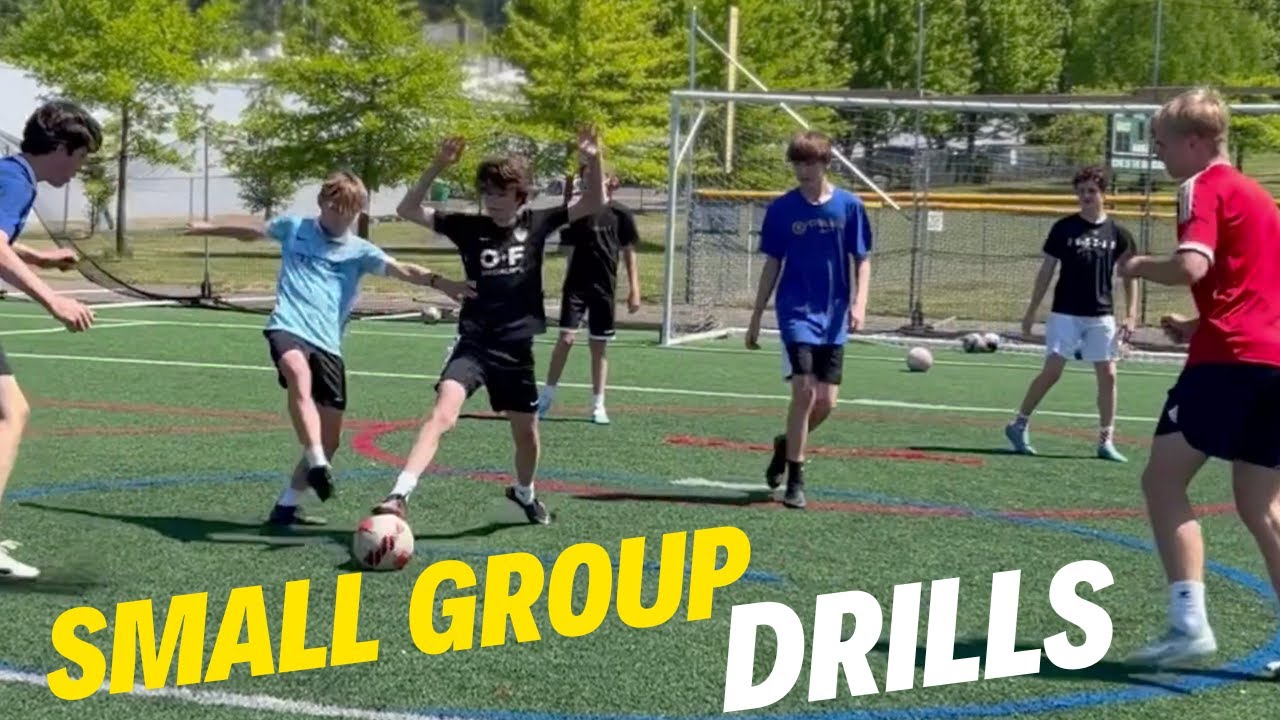
Tight Space Decision Making | 4v1 Transitional Rondo Drill — by RAIN Soccer Training on YouTube.
— Four attackers keep possession in a grid against one defender; attacker in the middle swaps with whoever loses the ball. Develops scanning, quick passing, and movement off the ball.
 ▶ Watch on YouTube
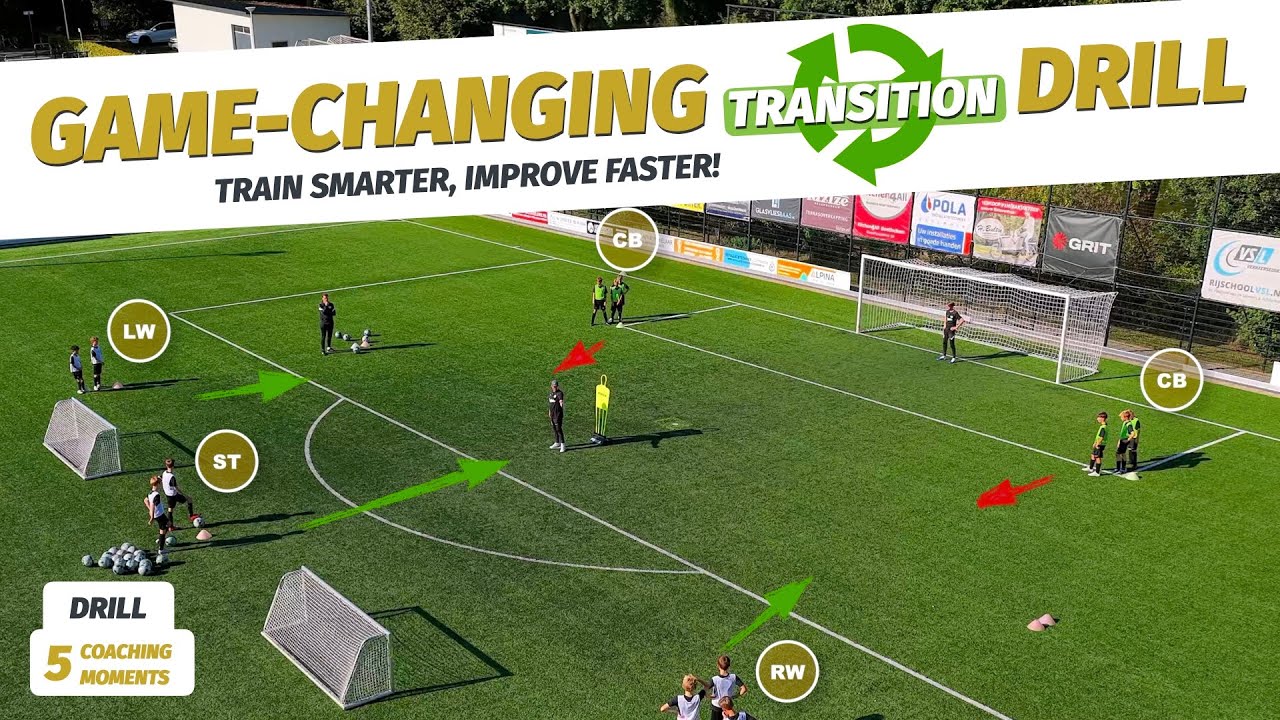
The Ultimate 3v2 Counter Attack Drill | From Finishing to Transition 🔄 — by Pelota Academy - Pro Footballer Skills on YouTube.
— Three attackers vs. two defenders with a goalkeeper; attackers work to create an overload and finish. Reward combination play; restart quickly.
Scanning skills The US Soccer Age Group Learning Plans explicitly list developing scanning habits — checking shoulders, reading the environment before receiving — as a priority for U11/U12. Build it into warm-up cues: “What do you see before it arrives?”
Key mistakes to avoid at this age - Locking players into positions — US Soccer recommends multi-position exposure through U12 - Repetitive cone-line drills — replace with competitive 1v1, rondos, or possession games - Delivering more than one coaching point at a time — overloads working memory; one clear point per activity is the standard - Introducing repetitive heading practice — US Soccer prohibits heading at U10 and below; for U11/U12, confirm your state association’s rules, which may be stricter than the national baseline - Scheduling 4–5 practices per week — exceeds evidence-based LTAD recommendations for this age and increases overuse injury risk
When to advance: When players maintain basic team shape during 7v7 or 9v9 without constant reminders, begin self-organizing using session concepts, and demonstrate reliable technical execution (passing, receiving, 1v1) under moderate pressure — they’re ready for the performance phase.
Ages 12+: Performance Phase and 11v11
The session structure
US Soccer Best Practices describes up to 75 minutes of structured, adult-guided soccer plus 15–30 minutes of free play and self-expression per session. Three sessions per week at 75–90 minutes is the US Youth Soccer PDM target for U14. The same five-phase structure continues: arrival → warm-up → SSA → expanded SSA → match — but every phase deepens.
| Phase | Time | Format |
|---|---|---|
| Arrival / intentional free play | 10–15 min | Self-directed with a ball |
| Technical warm-up | 12–15 min | Rondos, passing patterns, 1v1 |
| SSA (session theme) | 15–20 min | 4v4–7v7 |
| Expanded SSA | 15–20 min | 8v8–9v9 |
| Match / scrimmage | 15–20 min | 11v11 or near-full format |
Style of play and tactical structure The US Soccer 2023 Player Development Framework explicitly calls for introducing a “Style of Play” at the performance phase — a framework for decision-making involving formations, positional roles, and responsibilities. U13–U14 is the appropriate entry point for positional concepts (center back shape-holding, fullback overlaps, midfielder as connector) taught through game situations, not lecture. US Youth Soccer’s Aspiring Towards “Elite” resource describes a weekly periodization cycle that might look like: Monday recovery/technical, Tuesday tactical-defensive, Wednesday tactical-attacking, Thursday transitions and set pieces, Friday pre-match activation.
Constraints as a primary coaching tool Peer-reviewed research from González-Rodenas et al. (2021, IJERPH) confirms that pitch size and configuration in SSGs directly shapes tactical behavior and goal-scoring opportunity creation in youth players. Modify field shape, add touch limits, restrict dribbling in a zone, award bonus points for goals after a defined number of passes — the environment produces the behavior without constant verbal instruction.
Key drill examples
 ▶ Watch on YouTube
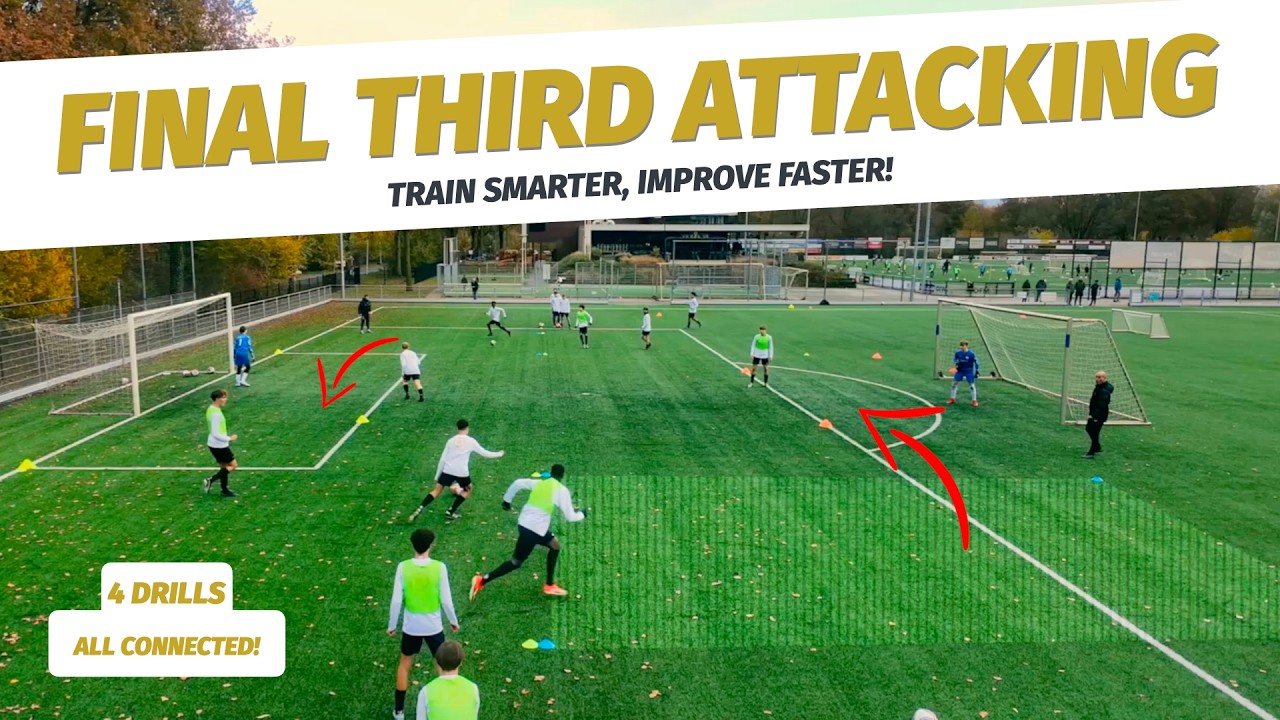
How to Train Final Third Attacking | Striker Movement- Creating Space & Finishing- Pro Coach Session — by Pelota Academy - Pro Footballer Skills on YouTube.
— After a goal, the scoring team immediately transitions to defend against a quick restart by the goalkeeper. Trains both defensive and offensive transition moments.
 ▶ Watch on YouTube
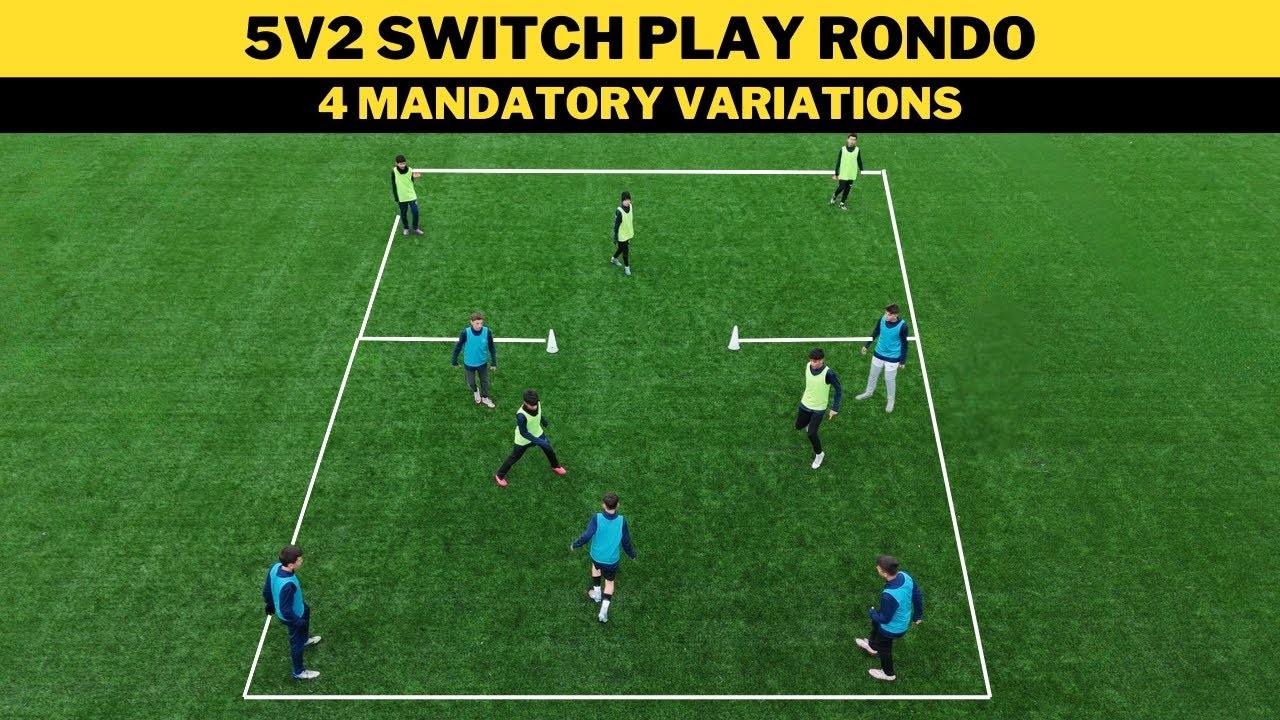
5v2 Switch Play Rondo | 4 Mandatory Variations | Football/Soccer Training — by AD Football Training Videos on YouTube.
— Begin with a 5v2 rondo to establish possession rhythm, then expand into a directional 5v5 using the same players. Connects the technical warm-up theme to the tactical game.
Heading The US Soccer PDI (2017) prohibits heading at 9v9 (U11/U12) and progressively reintroduces it at U13+. By U14+ standard heading is permitted under Laws of the Game, but should be taught with proper technique — forehead contact, appropriate approach angles — not drilled repetitively. Coaches working with U11–U13 should verify their state association’s specific rules, which may be more restrictive than the national baseline.
Key mistakes to avoid at this age - Locking players into a single position before U14 — limits overall development; maintain rotation in training - Treating all players as physically equivalent — early maturers can mask technical deficiencies with physicality; protect late maturers from being written off - Cutting the match phase short — the scrimmage is where learning consolidates; this is the most important part of the session, not an afterthought - Too many games, not enough training — the US Youth Soccer PDM targets 3:1 (training to games) for U14; tournament-heavy schedules frequently invert this ratio - Over-coaching set pieces at the expense of open play — introducing elaborate corner routines before players have sound open-play principles is a poor use of limited session time
When to advance: When players reliably apply session themes in 11v11 conditions without prompting, can articulate basic tactical decisions using the team’s style-of-play language, and demonstrate consistent technical execution under real match pressure — they’re ready for the increased positional specificity and periodization complexity of the later performance phase (U15–U16).
Core concepts that apply across ages
These principles appear throughout every age group’s guidance and are worth keeping as reference points regardless of the age you’re coaching.
*Game Centered Learning* — Teaching happens through play, not isolated drills. The game is the teacher; the coach designs conditions that make learning happen.
*Constraints Led Approach* — Modify field size, player numbers, rules, and scoring conditions to elicit desired behaviors. Change the environment; don’t narrate the player’s decisions.
*Small Sided Games* — Smaller formats (1v1 through 6v6) generate dramatically more ball contacts, decisions, and learning moments per player than full-sided play. This is the foundational argument behind every small-format mandate in US Soccer’s PDI.
*Ball To Player Ratio* — Every player should have a ball during warm-up and technical activities at every age. Waiting in lines is developmental waste.
*Four Moments Of The Game* — Attacking, defending, transition to attack, transition to defense. Sessions should address all four across a week. Exclusively running attacking drills is the most common structural omission in youth practice design.
*Long Term Athletic Development* — LTAD is a framework for sequencing physical and skill development from early childhood through adulthood. Youth soccer guidance from US Soccer and US Youth Soccer is built on its principles, including age-appropriate loads, multi-sport sampling, and avoiding early specialization.
*Joystick Coaching* — The practice of narrating or prescribing every decision from the sideline during game-like activities. Universally criticized across US Soccer, UEFA, and coaching science literature because it removes decision-making from players and defeats the purpose of game-based training.
Common mistakes (any age)
Waiting in lines. Every player waiting to take a turn is a player not developing. Replace any line-drill with a competitive small-sided format that keeps everyone active simultaneously.
Coaching out loud during the match. Calling “pass it!”, “shoot!”, or “get back!” during game play removes the cognitive challenge that makes games developmentally valuable. The match phase belongs to the players.
Introducing heading below U11. The 2015 US Soccer Concussion Initiative prohibits heading in practice and games for all players 11U and younger. This is non-negotiable. An indirect free kick is awarded for any deliberate header in a restricted age group game.
Permanent positions at U12 and below. US Soccer recommends multi-position experience through U12. Locking a child into “defender” at age 9 limits their technical and spatial development across the entire field.
Recording standings and scheduling tournaments too early. US Soccer PDI explicitly states results and standings should not be recorded at U6 through U8. The US Youth Soccer PDM specifically warns against “Tournamentitis” — too many competitive events at too young an age actively harms long-term participation.
Over-scheduling practice sessions. More sessions per week is not better at young ages. The evidence-based benchmarks from US Youth Soccer PDM: U8 — one session per week; U10 — two sessions per week; U14 — three sessions per week. Many competitive programs significantly exceed these, increasing overuse injury risk and the likelihood of early dropout.
Ignoring parent sideline behavior. The US Youth Soccer Applied U6 Summary is explicit: unsolicited adult shouting demonstrably harms on-field performance by forcing children to split attention between ball control and listening. At every age, coaches are responsible for setting quiet-sideline expectations before sessions begin.
Using a single oversized ball. Size 3 is mandated for U6–U8; size 4 for U9–U12. Adult-sized balls (size 5) are a physical hazard for developing feet, ankles, and technique at these ages.
When and how to advance
Advancing between age-band protocols should be based on observable behavior, not age alone or “they look ready.” Concrete markers:
- U6 → U8 model: Child reliably engages in 1v1 and 2v1 activities, demonstrates basic spatial awareness in a shared grid, and can track and follow two-step instructions.
- U8 → U10 model: Player begins voluntarily combining with a teammate (passing in context, not just dribbling), sustains engagement through a 60-minute session, and demonstrates basic first touch and 1v1 dribbling control.
- U10 → U12 model: Player maintains basic defensive shape (goal-side positioning) and provides simple supporting angles in attack without constant reminders; shows reliable passing and receiving under moderate pressure in 4v4 or 5v5.
- U12 → Performance phase (12+): Player reliably applies session themes in 9v9 or near-full-format play, begins self-organizing using the language of the team’s session concepts, and can articulate basic tactical reasoning when asked.
No child should be accelerated into a higher protocol based on physical size or early maturation. The Small-Sided Games Developmental Coaching Resource notes that early maturers may dominate physically while lagging technically — protecting those players from false advancement is part of the coach’s responsibility.
If any player shows signs of persistent joint pain, localized bone soreness, or injury at any stage, refer to a licensed sports medicine professional. Return-to-play decisions are medical determinations, not coaching ones.
Sources
- US Youth Soccer Player Development Model (2014) — governing-body — Link
- US Youth Soccer Player Development Model for U-6 (Applied Summary) — governing-body — Link
- US Soccer Player Development Initiatives (PDI) — October 2017 — governing-body — Link
- US Club Soccer — Head Injuries & Concussion Initiative — governing-body — Link
- Ecological-Dynamic Approach vs. Traditional Prescriptive Approach in Improving Technical Skills of Young Soccer Players (2024) — peer-reviewed — Link
- Constraints-Led Approach (CLA) Resources — The Perception & Action Podcast — academic — Link
- The Official US Youth Soccer Coaching Manual — governing-body — Link
- US Soccer Player Development Framework — Age Group Learning Plans (2023) — governing-body — Link
- Why Small-Sided Games for American Soccer? — governing-body — Link
- The Effect of Small-Sided Game Training on Passing Accuracy and Dribbling Ability in 10-Year-Old Junior Soccer Players — practitioner — Link
- Small-Sided Games — Developmental Coaching Resource (Cologne/Abertay Study Summary) — academic — Link
- Small Sided Games — US Youth Soccer Coaching Resource — academic — Link
- Small-Sided Games in Youth Football (Sustainability, MDPI, 2025) — peer-reviewed — Link
- How to Write a Training Session Plan — US Youth Soccer — governing-body — Link
- US Soccer Grassroots Player Development Framework — All Age Groups (2020) — governing-body — Link
- Best Practices for Coaching Soccer in the United States — US Soccer — governing-body — Link
- Different Pitch Configurations Constrain the Playing Tactics and the Creation of Goal Scoring Opportunities during Small Sided Games in Youth Soccer Players (IJERPH, 2021) — peer-reviewed — Link
- Aspiring Towards “Elite” — US Youth Soccer — practitioner — Link
- How to Coach U12 Soccer: Tips, Session Plans, and U12 Soccer Drills — Player Development Project — practitioner — Link
Further reading
- Stretch Shortening Cycle
- Play Practice Play Framework
- Tactical Periodization Youth
 ▶ Watch on YouTube
9 Best Rondos from FC Barcelona | Fun Youth Soccer Drills From the MOJO App — by yougotmojo on YouTube.
- Bio Banding In Youth Sport