
Teaching the Pass: A Youth Soccer Development Guide for Ages 4–12+
Youth soccer's most misunderstood skill isn't shooting or dribbling — it's passing. Parents want to see their kids threading the ball to teammates; coaches feel pressure to run "passing drills" from the first practice. But what actually builds great passers by age 12 is almost the…
Teaching the Pass: A Youth Soccer Development Guide for Ages 4–12+
Youth soccer’s most misunderstood skill isn’t shooting or dribbling — it’s passing. Parents want to see their kids threading the ball to teammates; coaches feel pressure to run “passing drills” from the first practice. But what actually builds great passers by age 12 is almost the opposite of what most rec-league sessions look like. This guide maps what your child’s brain and body can actually do at each age — and what you should be coaching, practicing, and celebrating at every stage.
Why This Matters
Passing is the primary mechanism of team play in soccer. But passing development is not a single skill switched on at one age — it’s a decade-long layering of physical coordination, decision-making, and tactical awareness. Rush it and you create players who can execute a push pass in a drill but fall apart in a game. Build it patiently and in the right order, and passing becomes intuitive.
The US Soccer Player Development Framework makes the sequence clear: movement exploration first, ball comfort second, short passing formally third, team concepts fourth. Each layer depends on the one below it. Skip a layer and the whole structure is shaky.
How the Picture Shifts with Age
Ages 4–6 aren’t developmentally ready for passing as a coaching objective. Their nervous systems are learning what a foot does to a ball. Their social development means they naturally play alongside teammates, not with them in a coordinated sense. Passing emerges through play — it cannot be drilled in.
Ages 7–9 enter the critical window for forming foundational motor patterns. The brain at this stage encodes movement blueprints through varied, repetitive practice. This is the moment to establish the inside-foot contact surface, the pass-and-move habit, and both-feet discipline. Get these right now; undoing one-footed habits later is genuinely hard.
Ages 10–12 gain something new: the ability to see teammates as tactical options, not just nearby people. Cognitive development allows players to start thinking about what a pass accomplishes, not just whether it reaches someone. This is when scanning, body shape, and weight of pass become teachable — and when the rondo (a possession exercise involving passing under defensive pressure) becomes the right training tool.
Ages 12+ bring expanding field formats, defensive pressure, and enough cognitive capacity for multi-pass thinking. Players can begin to internalize pass selection — knowing when to play safe and when to risk a forward ball. Puberty adds a wrinkle: growth spurts can temporarily disrupt coordination, so a skill plateau at 13 is usually not a ceiling but a growth-related blip.
Age-Specific Guidance
Ages 4–6: Play First, Pass Later
The developmental truth most parents don’t know: at U5–U6, dribbling is the official priority. The US Soccer Player Development Framework designates U5 as “Movement Exploration and Ball Discovery” and U6 as “Dribbling and Shooting.” Short passing as a named objective doesn’t appear in the framework until U7–U8. That’s not an oversight — it’s the science.
What to do instead of passing drills:
Keep every child active with a ball at all times. Small-sided 3v3 or 4v4 games (no goalkeepers, no set positions, size 3 ball) create far more natural touches — and natural passing moments — than any organized drill. The England Football Learning guide for this age describes the coach’s role as creating “a rich play environment,” not instructing technique.
Activities that build passing readiness through play:
- Pass through the gate: Two cones 2–3 yards apart, a partner on the far side. Kick the ball between the cones to your partner. One cue only: “use the side of your foot.” Celebrate any intentional kick toward a teammate.
- Marbles: Each child has a ball; they kick theirs into a larger stationary ball. Seeds directional passing without calling it that.
- Partner storytelling kicks: “Can you kick the ball to the lost dog’s owner?” Narrative scaffolding motivates the kick far better than technical correction at this age.
- Incentivized 3v3: “If you pass to a teammate before scoring, it counts double.” The rule creates passing without the lecture.
The inside-foot push pass, if introduced at all, gets one cue per activity: “use the side of your foot.” Approach angle, plant foot position, ankle lock, and follow-through are all real mechanics — but not for a 5-year-old in one session.
Key mistakes to avoid at 4–6:
- Running line drills where children stand waiting for a turn. Low engagement, no game context, developmentally wrong.
- Demanding passes during games. Children this age should dribble. Shaming a 5-year-old for not passing contradicts both developmental norms and governing-body guidance.
- Using a size 4 or 5 ball. Size 3 only for U6 and below — a larger ball creates poor mechanics and joint stress at small growth plates.
- Introducing positioning concepts (“stay wide,” “don’t bunch up”). Swarming the ball is developmental, not a discipline problem.
- Stopping the game to correct where a child “should have passed.” The England Football Learning approach at this age: let them play; ask questions after.
When to advance: A child consistently makes intentional kicks toward a partner (not just any direction) and shows emerging awareness that someone is on the other side of the cones.
Ages 7–9: Building the Motor Blueprint
This is the most important passing window you’ll ever have with a player, and the US Youth Soccer Player Development Model makes clear why: the nervous system at ages 7–9 is forming the foundational movement blueprints for kicking and receiving. Patterns built here are the ones players carry for life.
Core technique — the inside-foot push pass: - Approach the ball at a slight angle - Plant foot alongside the ball, toes pointing at the target - Kicking ankle locked firm (not floppy) - Contact ball with the flat inside surface of the foot - Follow through low toward the target
One cue per activity. “Show me the inside of your foot before you kick” is a complete coaching intervention.
Both feet from day one. The US Youth Soccer Small-Sided Games data is unambiguous: if coaches don’t explicitly require the non-dominant foot, players will always default to the dominant one. Build it into the exercise rules, not as an afterthought.
Receiving is half of passing. The first touch is already setting up the next action. Begin coaching that the ball should be controlled out of the player’s feet and into space — not trapped and sat on. A simple cue: “can you see the whole field when you get the ball?”
Pass-and-move. After releasing the ball, the passer moves. Watching your own pass sail to a teammate is the single most universal bad habit to break at this age. “Pass and MOVE” becomes the constant refrain.
Progressions:
- Stationary partner push pass at 5–8 yards — one technical cue, both feet required
 ▶ Watch on YouTube
Soccer Player Training - Partner Drills - Passing and First Touch - Weak Foot Skills — by Soccer Wizdom - Pierce Hugh Campbell on YouTube.
- Moving target passing — passer stationary, receiver walks toward the ball; focus on weight of pass reaching the receiver’s feet
 ▶ Watch on YouTube
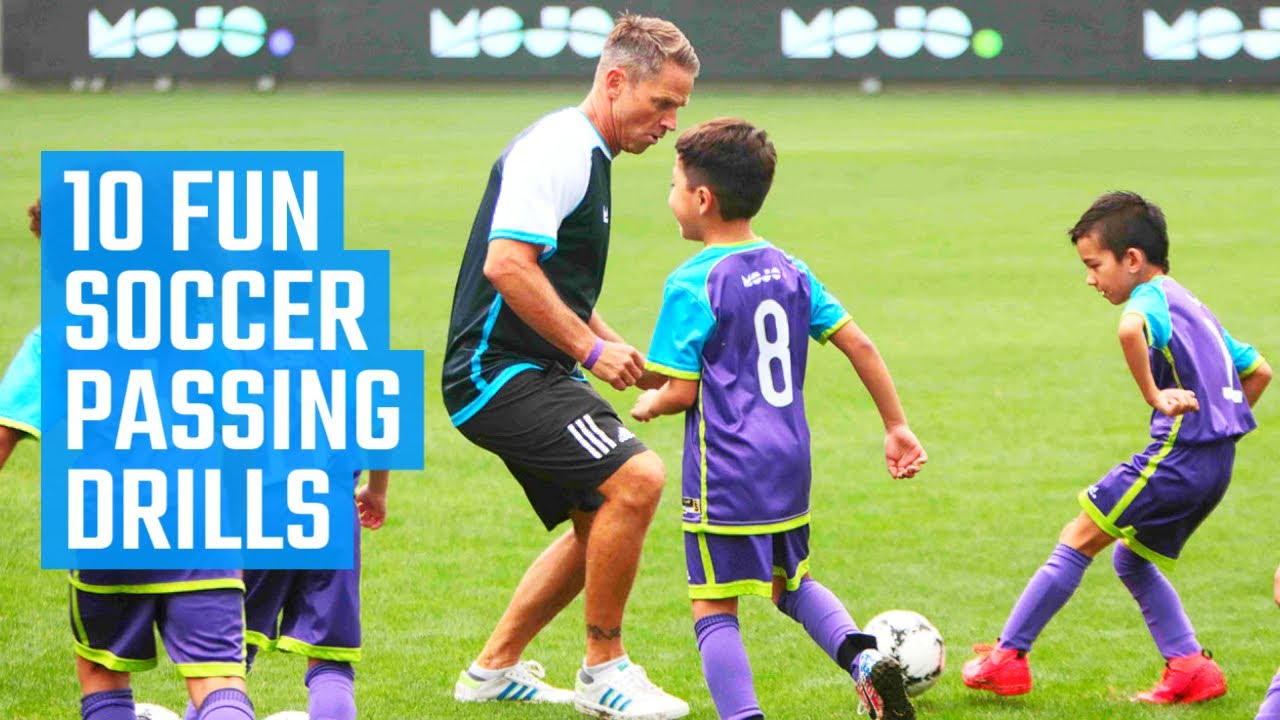
10 Best Soccer Passing Drills for U8, U10 and U12 | Fun Soccer Drills by MOJO — by yougotmojo on YouTube.
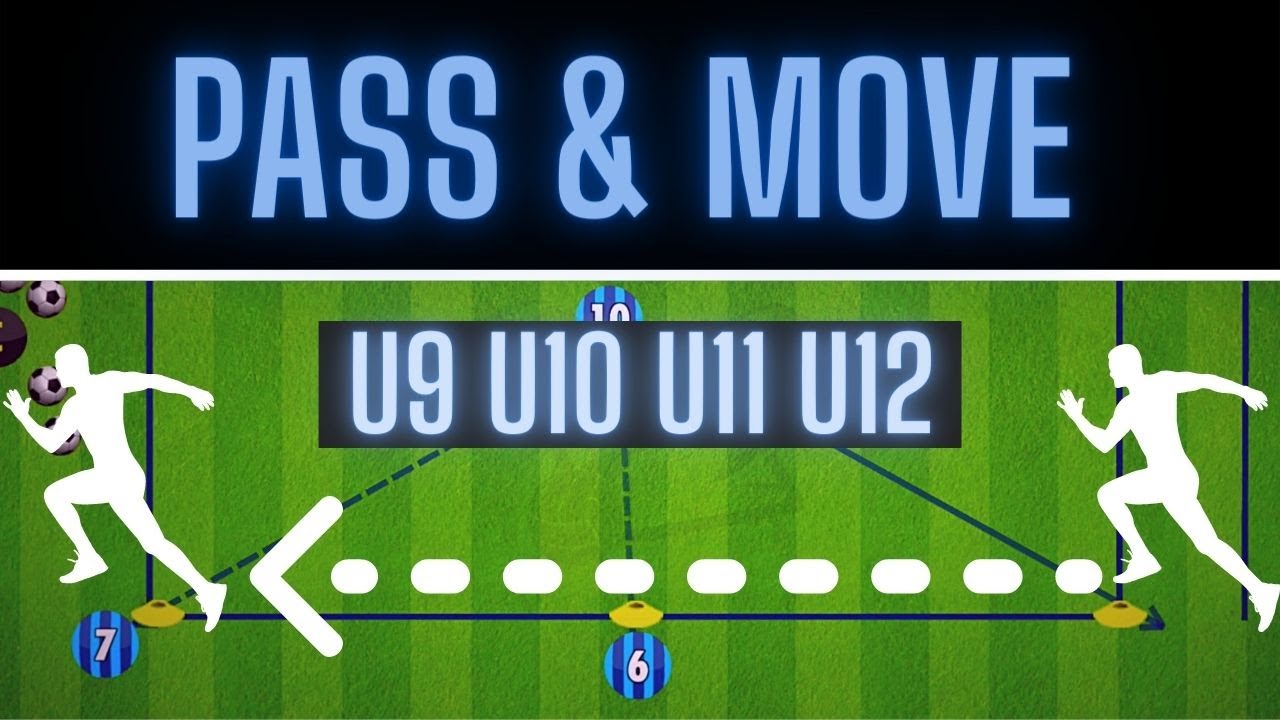
- Pass-and-move triangle — 3 players, 3 cones; passer moves to a new cone after every pass
 ▶ Watch on YouTube
Pass & Move Drill | U9 U10 U11 U12 | Soccer/Football Passing Combination — by KS Performance on YouTube.
- Gate passing games — multiple cone-pair gates in a grid; score by passing through a gate to a teammate; accuracy, direction, and off-ball movement all built in by the game
 ▶ Watch on YouTube
Game: 'Through the gates' › Pairs | Soccer skills in PE (grades K-6) — by Prime Coaching Sport on YouTube.
- Two-touch patterns — 3+ players, explicit “receive then pass” rule; plants the habit that the first touch is the second pass
- Incentivized 4v4 — bonus goals for 3 consecutive passes before shooting
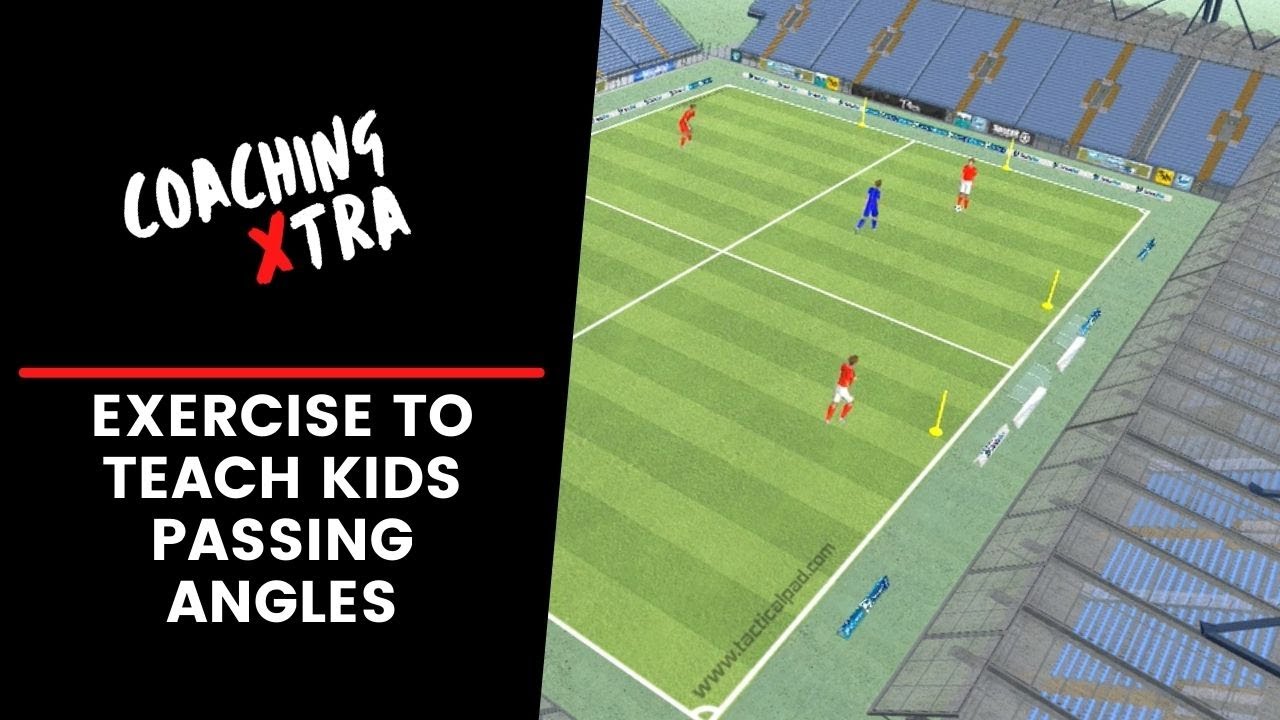
- 3v1 rondo — 3 attackers, 1 defender, ~8×8-yard grid; first exposure to passing under mild pressure, body shape, and reading two teammates simultaneously
 ▶ Watch on YouTube
Kids 3v1 Rondo With Mini Goals — by Coaching Xtra on YouTube.
Do not advance to: 4v2 rondos, driven passes, lofted balls, switching play, or any named positional concept. Those are for ages 10+.
Common mistakes at 7–9:
- Toe-punt as default — caused by rushing or habit; slow the activity, make foot surface visible
- Passing directly into a marked teammate instead of to open space or a moving target
- Only correcting the passer, never coaching the receiver’s body shape
- Drilling in lines — replace with every-player-active formats; US Youth Soccer data shows that in larger-group formats, some players get fewer than 0.5 ball touches per minute
- Ignoring pass weight — coaching only direction while never addressing whether the pace matched the situation
When to advance: Player completes the pass-and-move triangle for three sessions with clean mechanics, moves after every pass without being prompted, and can demonstrate an inside-foot pass with the non-dominant foot at 5 yards.
Ages 10–12: Tactical Awareness Arrives
The Official US Youth Soccer Coaching Manual calls U11–U12 “the dawning of tactical awareness.” Players at this age can genuinely start to see teammates as options — not just nearby people — and to make decisions about why they’re passing, not just whether they can.
New techniques to introduce:
- Outside-foot pass Outside Foot Pass: quick-release redirection; harder for defenders to read; complement to the inside-foot pass, not a replacement
- Driven ball (instep/laces): knee over ball; for medium-to-longer passes as field formats expand at U11–U12
- Lofted/chip pass: contact below the ball’s midline; accuracy of weighted ground passes comes first
Body shape on receiving is the most-neglected coaching point at this age and the one with the biggest payoff. The US Youth Soccer Skills School Manual describes it clearly: hips angled to the field, not facing the passer. The cue “back foot receive” — controlling the ball with the foot away from the passer — opens the player to the whole field in one touch.
Scanning before the ball arrives. This is a trainable habit. Coaches can introduce it with a simple visual cue: hold up a colored cone or number of fingers while the ball is in transit; the receiver must call out what they saw. The goal is making a shoulder-check automatic before each reception.
Rondos become the cornerstone of training:
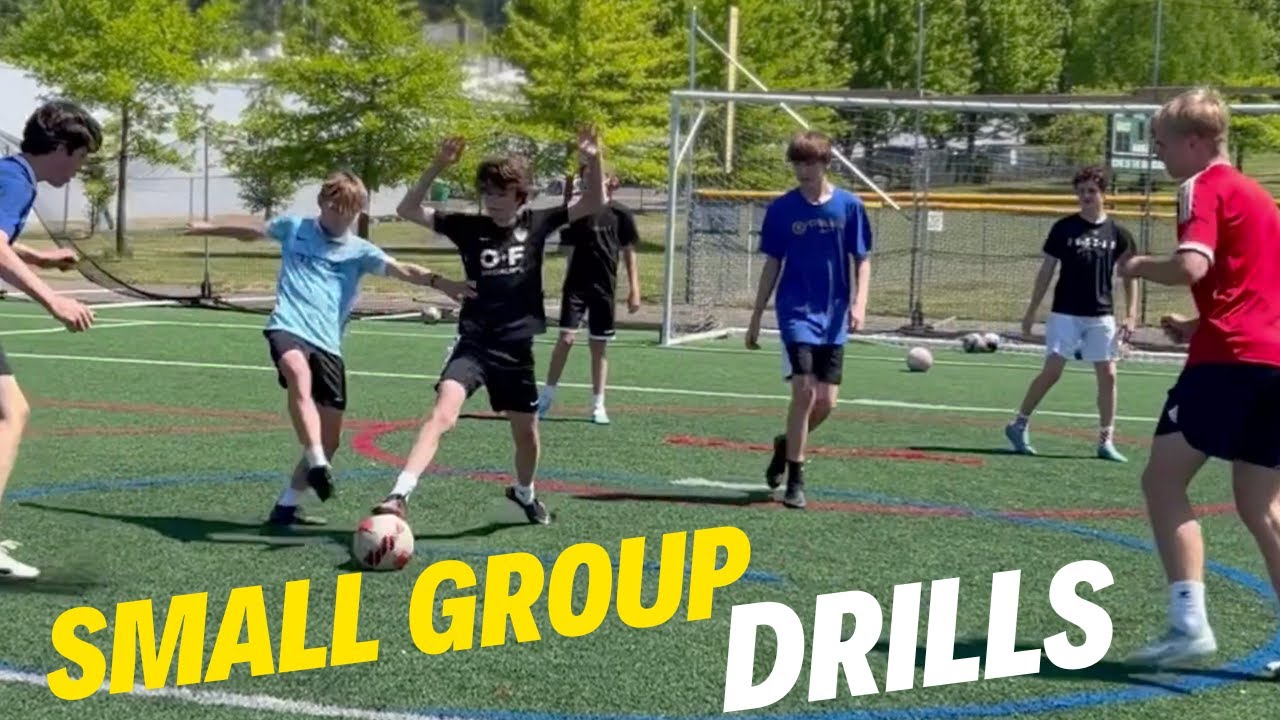
- 4v1 entry rondo: generous space; focus on support angles and quick first touch
 ▶ Watch on YouTube
Tight Space Decision Making | 4v1 Transitional Rondo Drill — by RAIN Soccer Training on YouTube.
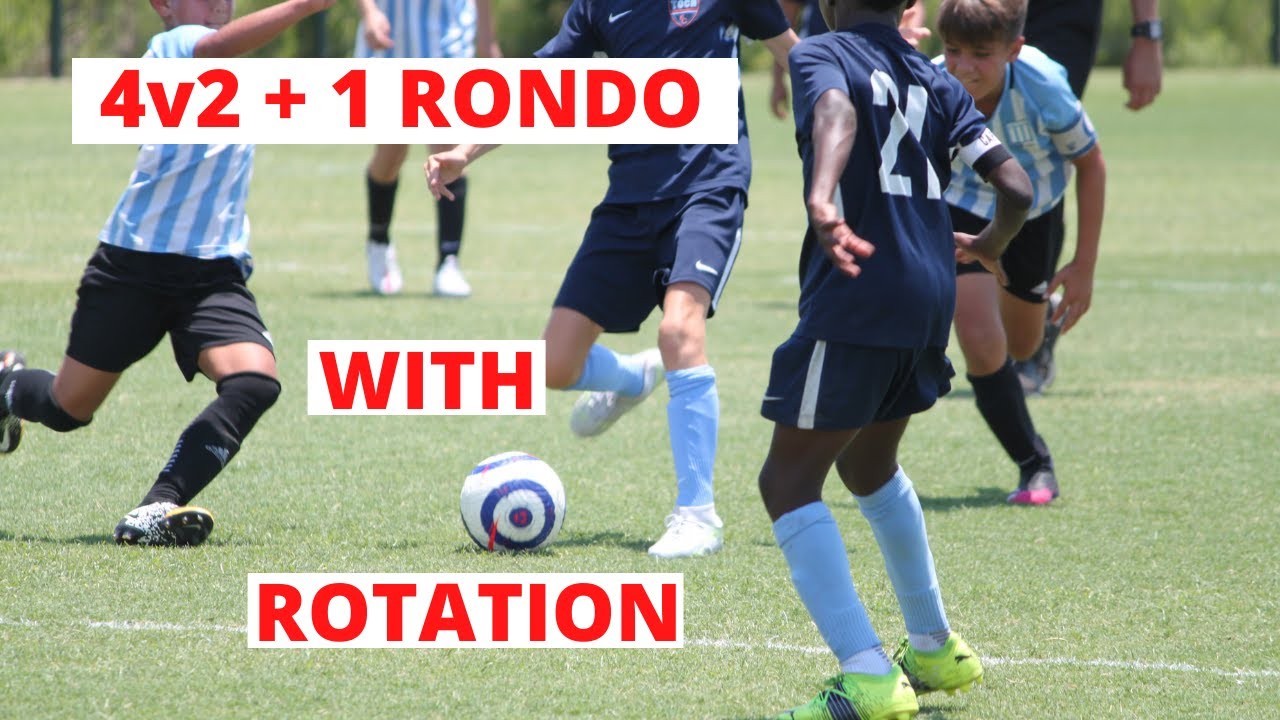
- 4v2 progression: genuine defensive pressure; add a 3-touch maximum as players succeed
 ▶ Watch on YouTube
Soccer Coaching Drills | 4v2 + 1 Rondo with Rotation | Toca FC 2010 MLS — by Purpose Driven Futbol on YouTube.
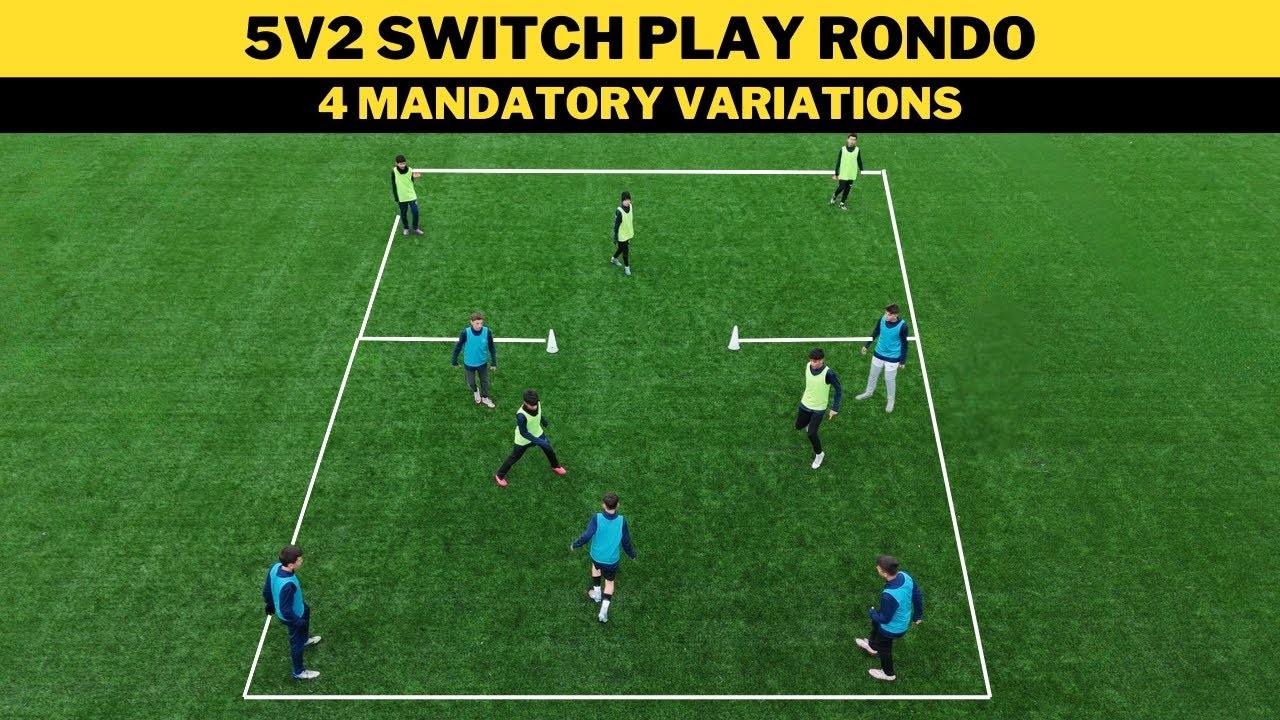
- 5v2: find the player furthest from pressure; introduces the “switch” concept
 ▶ Watch on YouTube
5v2 Switch Play Rondo | 4 Mandatory Variations | Football/Soccer Training — by AD Football Training Videos on YouTube.
The 360Player guide on rondo variations notes that grid size is the primary difficulty dial: bigger grids for earlier stages, smaller as decision speed improves. Touch restrictions (3-touch → 2-touch) escalate difficulty without changing the format.
Third-man runs — where the player not involved in a two-person exchange becomes the forward target — are introduced at the upper end of this bracket (U12), coached through occasional freeze-and-highlight during possession games rather than tactical diagrams.
Common mistakes at 10–12:
- Passing to a stationary marked teammate instead of leading them into space
- Body facing the passer on reception — the most widespread technical flaw at U11–U12
- “Pass and admire” — the player watches their pass and stands still, breaking the possession triangle
- Dominant-foot only — coaches must structurally require the non-dominant foot, not just suggest it
- Over-coaching during small-sided games — US Soccer guidance emphasizes minimal interventions during game-form activities; too many stoppages erase the decision-making repetitions that make these exercises valuable
- Teaching possession for its own sake — the ball is meant to progress toward goal; square passes without purpose are as much a problem as random long balls
When to advance: Player consistently receives with an open body shape without a cue, moves after every pass, uses the non-dominant foot without resistance in a 4v2 rondo, and can verbally identify a third-man option when asked during a possession game freeze.
Ages 12+: Decision, Purpose, and Range
By 12+, the foundational motor patterns are set and the brain is ready for genuine tactical complexity. The three layers of passing now need to work simultaneously: technique (how the body moves), decision (what the player sees before the ball arrives), and purpose (what the pass accomplishes for the team).
Expanded technique repertoire:
All techniques from younger ages continue to be refined — inside-foot, outside-foot, driven ball, lofted pass. At 12+, disguised passes (no-look, backheel) are introduced situationally, as tools for the right moment, not party tricks. The prerequisite is mastery of simpler options.
Scanning becomes a deliberate training focus. The research on elite adult players — cited in coaching education literature, though the primary source requires verification — describes checking shoulders multiple times in the seconds before receiving as a trainable habit that separates advanced from average players. At 12+, coaches can coach this directly: “What did you see before the ball came?”
A 2025 randomized controlled trial published in PMC (Bouzouraa et al.) found that an 8-week rondo training program for U-13 players produced large improvements in problem-solving confidence and creative thinking — confirming that passing-focused rondo training at this age is simultaneously technical and cognitive development.
Rondo progressions at 12+:
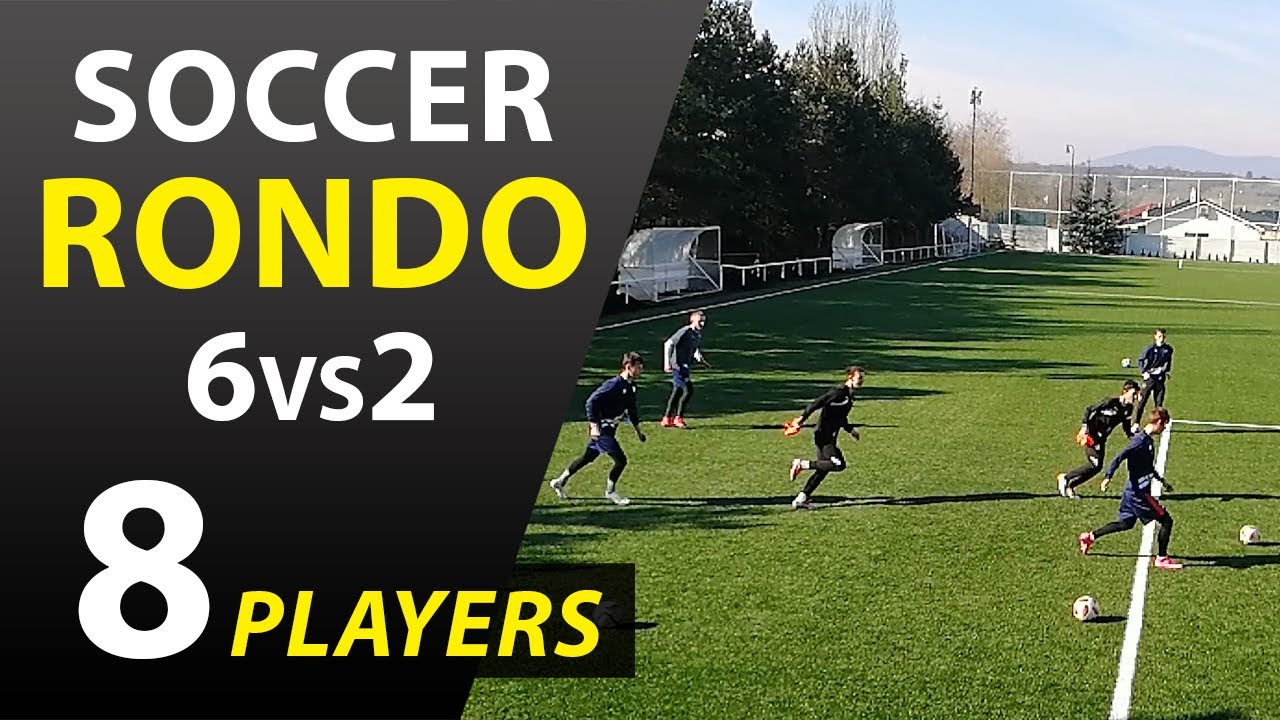
- 5v2 and 6v2 in tighter spaces — genuine pressure, faster decisions
 ▶ Watch on YouTube
RONDO DRILL 6V2 | SOCCER RONDO FOR 8 PLAYERS #6 — by PP Academy on YouTube.
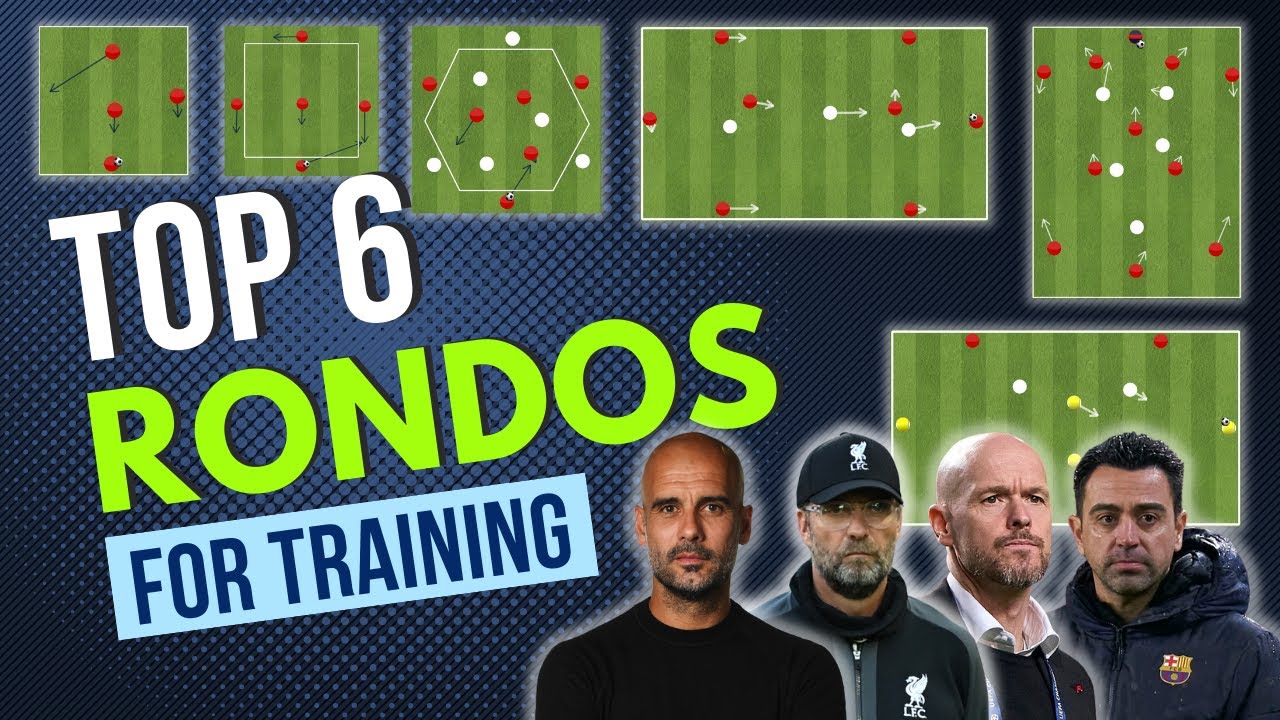
- Positional rondos with functional zones replicating game positions (wide player, central midfielder)
 ▶ Watch on YouTube
6 Best Soccer Rondo Drills to IMPROVE Your Team! — by Paul Spacey on YouTube.
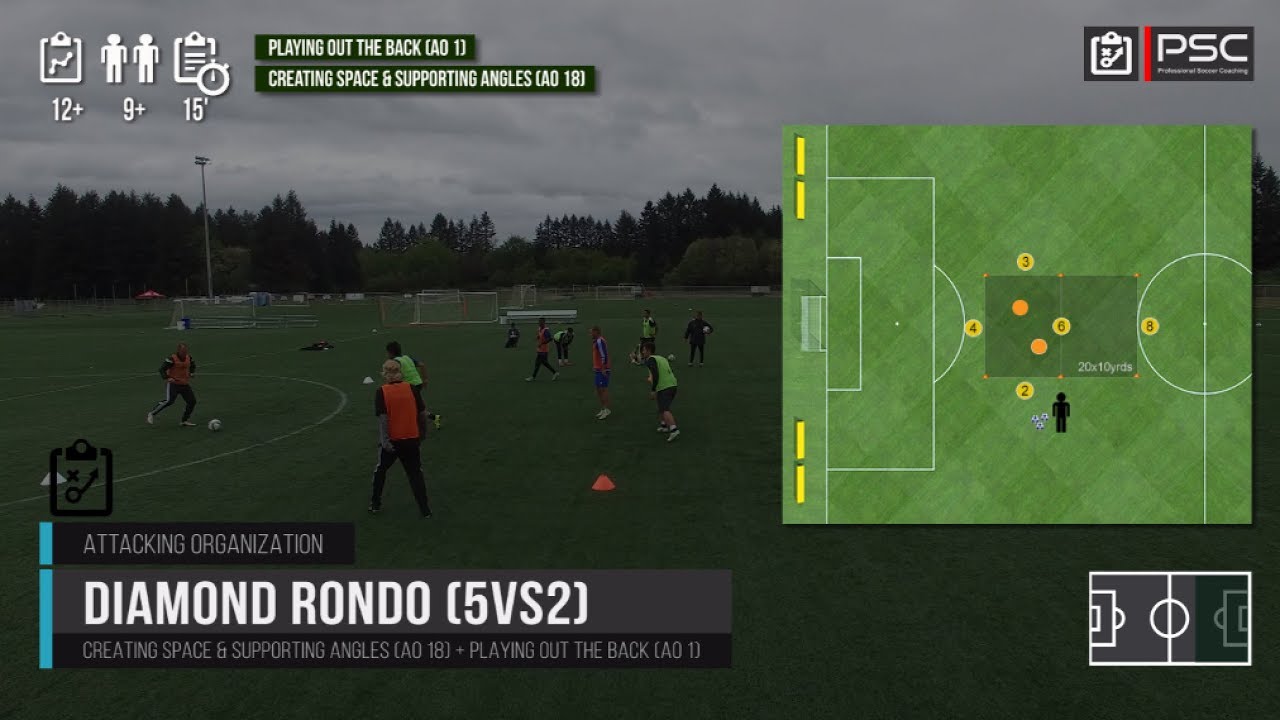
- Diamond rondos (5v2 in diamond shape) for advanced U12+
 ▶ Watch on YouTube
Diamond Rondo Soccer Drill (5vs2) — by Professional Soccer Coaching on YouTube.
Switching play — long diagonal passes to change the point of attack from congested to open zones — is introduced here as field formats expand. A well-weighted driven pass to an open teammate on the far side is good passing; coaches who only reward short combinations can inadvertently train players away from appropriate range.
Pass selection literacy: players learn to distinguish a smart reset (backward or lateral to maintain possession) from a line-breaking forward pass. The Player Development Project notes that teaching players to read game state — rather than defaulting to one pattern — is the goal. Praising pass-completion rate without considering pass selection misses half the picture.
Common mistakes at 12+:
- Coaching perfect stationary push passes in lines with no defender — produces players who can’t pass under pressure
- Allowing dominant-foot default in rondos and possession games — structure the exercise so the non-dominant foot is unavoidable
- Freezing play too often during rondos — the decision-making repetitions are the point; too many stoppages eliminate the exercise’s value
- Skipping body shape coaching — players who receive facing the passer have already lost a touch
- Ignoring the cognitive layer — not asking players what they saw before receiving; the ISSPF guide (UEFA A License) explicitly states that scanning atrophies without deliberate coaching attention
When to advance: Player passes off both feet in dynamic game settings across multiple surfaces; independently shoulder-checks before receiving; uses pass-and-move without prompting; can identify and execute a third-man run option; demonstrates appropriate pass selection (safe vs. forward) when asked during a possession game freeze.
Core Concepts That Apply Across Ages
Inside Foot Push Pass — The foundational passing technique at every developmental level; ankle locked, planted foot beside and pointing at target, contact with the flat inside surface.
Weight Of Pass — Pass pace matched to the receiver’s situation; the critical refinement that separates adequate from excellent passing at every age.
Pass And Move — After releasing the ball, the passer immediately finds a new support position; the habit that sustains possession.
Open Body Shape — Receiving with hips angled toward the field rather than the passer; allows the first touch to become the setup for the next action.
Scanning — Checking shoulders before the ball arrives to build a mental picture of the field; a trainable habit, not a talent.
Rondo — A possession exercise (attackers keeping ball from defenders in a defined space) that simultaneously trains technique, body shape, decision-making, and pressure resistance.
Triangular Support — Every ball carrier should have at least two passing options at different angles; the structural basis of possession play.
Stretch Shortening Cycle — Not directly applicable to passing, but relevant to overall athletic development at these ages.
Common Mistakes (Any Age)
- Running line drills. Children waiting in parallel lines for a turn get almost no touches, no game context, and no decision-making practice. Replace with every-player-active formats at every age.
- One-foot default. If the exercise doesn’t structurally require the non-dominant foot, players will never use it. Build it into the rules.
- Over-coaching during game activity. Constant stoppages to lecture eliminate the decision-making repetitions that make rondos and small-sided games valuable. US Soccer guidance is explicit: minimize coaching interventions during game forms.
- Demanding passes from players who aren’t ready. Shaming a 5-year-old for dribbling or a 9-year-old for a weak-foot toe-punt undermines confidence and contradicts developmental norms.
- Wrong ball size. Size 3 for U6 and below; size 4 for U9–U12. Larger balls at younger ages create poor mechanics and stress small growth plates.
- Treating receiving as a separate skill. The first touch is already the setup for the next pass. Receiving and passing must be coached together from age 7 onward.
- Coaching direction and ignoring weight. A pass that arrives too hard or too soft fails even if it reaches the right person. Weight of pass must be coached explicitly, with distance-variable activities that make it visible.
- Praising pass completion without considering pass selection. A player who only plays safe balls never develops the full passing repertoire. Pass purpose — not just pass success — is the coaching standard.
When and How to Advance
Age-band transitions are not automatic; they’re earned by demonstrated competency:
- Into the 7–9 program: Child intentionally kicks toward a partner in game settings; has comfortable ball contact with the inside of the foot on the dominant side.
- Into the 10–12 program: Player completes the 3v1 rondo with clean mechanics across 3 sessions; moves after every pass without a prompt; uses non-dominant foot in activities without resistance.
- Into the 12+ program: Player receives consistently with open body shape; independently scans before receiving; demonstrates appropriate pass selection in small-sided games; executes inside-foot pass off both feet in dynamic (moving, opposed) settings.
Puberty introduces a legitimate complication at 12–14: growth spurts can cause temporary coordination regression. A skill plateau during this window is not a ceiling — it typically resolves as physical maturation catches up. Avoid over-correcting during these periods.
Sources
- US Soccer Player Development Framework: Age Group Learning Plans (2023/2024 Edition) — governing-body — bigwalnutsoccer.com
- How to Coach 4 to 6 Year Olds — England Football Learning (The FA), Play Phase — governing-body — learn.englandfootball.com
- Training for 4 to 6 Year Olds — Coaching Resource (BASA) — practitioner — BASA/Cloudfront
- How to Coach Passing in the Modern Game — England Football Learning Webinar — governing-body — YouTube
- Soccer Skills for Kids by Age: Development Guide — practitioner — teachme.to
- US Youth Soccer Player Development Model (PDM) — governing-body — US Youth Soccer
- Best Practices for Coaching Soccer in the United States — governing-body — US Soccer Federation
- Small-Sided Games — US Youth Soccer — governing-body — usyouthsoccer.org
- Soccer Coaching 101: Fundamental Lessons for Beginner Coaches — practitioner — Player Development Project
- Foundational Rondos | Passing Drills 9–11yrs — practitioner — Professional Soccer Coaching
- US Youth Soccer Skills School Manual — governing-body — usyouthsoccer.org
- 7v7 Weekly Training Sessions (US Soccer PDI-aligned) — practitioner — Farmington CT Recreation
- The Official US Youth Soccer Coaching Manual — governing-body — usyouthsoccer.org
- US Youth Soccer U12 Practice Activities — governing-body — US Youth Soccer
- The Definitive Guide to Soccer Rondos (With 7 Proven Drill Variations) — practitioner — 360Player
- Beginner Rondos & Youth Soccer Passing Drills for Foundational Possession Soccer — practitioner — YouTube
- Soccer Passing Drills That Build Accuracy, Speed, and Team Play for Real Football Situations — practitioner — Alicante Football Academy
- Enhancing problem-solving skills and creative thinking abilities in U-13 soccer players: the impact of rondo possession games’ training — peer-reviewed — PMC/PubMed
- The Use of Rondos & Positional Training Games in Soccer — practitioner — ISSPF
- How to Coach U12 Soccer: Tips, Session Plans, and U12 Soccer Drills — practitioner — Player Development Project
- 5 Essential Rondo Training Drills That Transform Young Players — practitioner — Absolute Football Training
Further Reading
- Inside Foot Push Pass — Detailed technique breakdown with mechanics and common error diagnosis
- Rondo — What rondos are, how to run them by age, and how to progress the format
- Weight Of Pass — How to teach pass pace: activities, cues, and coaching points
- Open Body Shape — The back-foot receive and half-turn: a coach’s guide to the most-neglected habit in youth passing
- Gate Passing Game — Full session plan for gate passing games across age groups
- 3V1 Rondo — Step-by-step setup, coaching cues, and progressions for the entry rondo
- Scanning — Teaching shoulder-checking as a trainable pre-receive habit at ages 10–14