
Youth Soccer Dribbling: A Complete Age-by-Age Guide for Parents and Coaches
Every time a young player stands in a line waiting for a turn to dribble through cones, that's a minute they could have spent actually touching a ball. Multiply that across a season and you start to understand why so many kids plateau, lose interest, or show up to U12 tryouts still…
Youth Soccer Dribbling: A Complete Age-by-Age Guide for Parents and Coaches
Every time a young player stands in a line waiting for a turn to dribble through cones, that’s a minute they could have spent actually touching a ball. Multiply that across a season and you start to understand why so many kids plateau, lose interest, or show up to U12 tryouts still unable to use their left foot. The good news: the research and the governing bodies largely agree on what works at each age. Here’s how to get it right from the first kick at age four through the performance phase at sixteen and beyond.
Why This Matters
Dribbling is not a trick. It is the foundational skill that determines whether a player can keep possession under pressure, create a 1v1 opportunity, or simply survive when the ball arrives at their feet with a defender closing in. The US Youth Soccer Player Development Model describes the years between four and nine as a period where “technical development is mostly random and exploratory — volume and variety are more important than perfection.” That framing matters. The window for building touch, two-foot competency, and body awareness is real and time-limited — and the habits formed in these years, good or bad, are remarkably sticky.
How the Picture Shifts with Age
Between ages four and six, children are still wiring the basic motor patterns — balance, coordination, stopping, starting. The ball is almost incidental at this stage; the goal is building the body-control foundation that ball skills will eventually sit on.
From seven to nine, fundamental movement skills start consolidating into sport-specific ones. Players can now follow multi-step instruction, begin to understand cause and effect, and — critically — they are ready for the repetition that ball mastery requires. This is when touch volume matters most.
At ten to twelve, players enter what the Ontario Soccer Association’s Learn-to-Train handbook describes as “the primary technical skill refinement window.” They can read a defender’s posture, plan a move, and execute it — but only if the foundation from ages seven to nine was actually built. This is also the last serious window to lock in non-dominant foot competency before puberty hardens dominant-foot habits.
After twelve, the adolescent growth spurt temporarily disrupts proprioception (the body’s sense of its own position in space) — meaning some players will appear to “lose their touch” mid-season even as they physically grow. Dribbling development doesn’t stop here; it shifts toward decisions, combination moves, and positional context. But it can’t be faked: players who skipped ball mastery earlier will hit a ceiling around fourteen or fifteen that no amount of tactical coaching can fix.
Age-Specific Guidance
Ages 4–6: Body First, Ball Second
What matters at this age
The US Youth Soccer Model for U-6 is unambiguous: “body control precedes ball control.” Balance, coordination, and agility are prerequisites for ball skills. Every session should give every child a ball — there are no exceptions to the one-ball-per-player rule — but the primary job of the coach is to create play environments, not deliver technical instruction.
Sessions must be capped at 45 minutes. The ICA Coaching Manual structures activity windows at roughly five minutes each, and that’s the right instinct: four-to-six-year-olds lose focus fast, and standing in lines is developmentally catastrophic at this age.
The right progressions
The ICA’s eight-week program structure provides a useful model:
- Body exploration (no ball): Jumping, hopping, skipping, stopping, changing direction. This is not filler — it is the literal foundation.
- Ball familiarization (stationary): Sole-of-foot tapping with alternating feet (“pet the dog with BOTH feet”), rolling the ball with hands, exploring all three foot surfaces. The Parker Recreation Drill Guide’s imaginative “pet the dog” cue — asking kids to pat the ball with the sole the way you’d stroke a puppy — works because kids at this age learn through imaginative framing, not anatomical instruction.
- Walking dribble: Move with the ball at a walk, no speed pressure, inside the grid.
- Simple direction change: The Red Light/Green Light dribble drill — players move freely until “red light,” then stop the ball with the sole. No formal drag-back move yet. Just stop and go.
- Dribble in a crowd: All players with a ball in a 20×20 grid, navigating each other without collisions. Develops peripheral vision and touch simultaneously. No defenders — just traffic.
- Soft tag games: “Shark and Minnows” and the Transformer game (knock opponents’ balls out of the grid while protecting your own) introduce protective dribbling instinctively. This is the only “pressure” appropriate at this age — soft tag, ball-based, no physical contact.
- 3v3/4v4 free play: The game itself is the culminating learning environment. Do not over-coach it.
Mistakes to avoid
- Lines at cones. If children are standing still, they are not learning.
- Technical language mid-activity. “Lock your ankle” means nothing to a five-year-old. Use visual demos and imaginative cues.
- Formal dribbling moves. Step-overs, Cruyff turns, and scissors are not developmentally appropriate at ages four to six.
- Formal 1v1 defending drills. Too physically risky and cognitively overwhelming. Tag games achieve the same goal safely.
- Skipping both-feet work. Cueing the non-dominant foot should be built in from the very first session — “pet the dog with BOTH feet.”
- Large fields and full-size goals. Scale everything to the child’s body. US Soccer recommends a Size 3 ball for U-8 and below.
- Sessions over 45 minutes. Cognitive and physical fatigue cause regression in skill and behavior, full stop.
When to advance
When a child can dribble through a 20×20 grid of other children at walking pace without repeated collisions, and can stop the ball with the sole on command, they have the foundation for Stage 7 and 8 activities.
Ages 7–9: Build the Touch Bank
What matters at this age
This is where ball mastery — defined as close control with the inside foot, outside foot, and sole using both feet equally — becomes the central training objective. The Coerver Coaching approach structures this as a pyramid: ball familiarity first, then dribbling moves, then feints and fakes, then 1v1 attacking. Each layer requires the one below it.
The US Youth Soccer Skills School Manual is explicit that at U8, players should be running two-minute game rounds in activities like Dribble Attack (attackers dribble past defenders in a grid). The Anytime Soccer Training development milestones put a concrete benchmark on it: by age eight, a player should be able to perform five-plus ball mastery moves comfortably (toe taps, sole rolls, inside-outside touches, pull-backs) and dribble through cones at speed with both feet.
The cognitive shift here is real. TeachMe.To’s soccer development guide notes that at seven to eight, players can dribble while looking up occasionally; by eight to nine, they can receive and redirect intentionally. Design drills that match — and slightly stretch — that range.
The right progressions
- Stage 1 — Foot Familiarity: Both feet, all surfaces. Toe-taps, sole rolls, inside-outside sequence. One ball per player, every session. Tag games running alongside.
- Stage 2 — Directional Control: Cone slalom with specified surfaces (“inside foot only on right cones, outside foot only on left”). V-turns and U-turns at low speed. Drag-back stop to change direction. No time pressure yet.
- Stage 3 — Change of Direction with Purpose: L-turn and inside cut added. The “Beat the Cone” drill — dribble toward a cone and execute a specific move to change direction — starts building the muscle memory for defender-facing situations.
- Stage 4 — First Feints: Simple scissors/step-over introduced as a body feint. Shoulder drop/look-away fake. Coach introduces the concept of “selling it” — the idea that the move is meant to deceive, not just to move the ball.
- Stage 5 — 1v1 vs. Passive Defender: “Beat the Cone” graduates to a stationary player, then a slow-moving one. Emphasize reading the defender’s weight before committing.
- Stage 6 — Game Context: 1v1 and 2v2 small-sided games with a dribbling constraint (must dribble past halfway before shooting). The “coach holds up a number, player calls it while dribbling” challenge trains eyes-up habits without breaking the flow of the game.
Mistakes to avoid
- Allowing dominant-foot-only completion. Passive permission is not enough — design activities that force weaker-foot use.
- Only using straight-line cone slaloms. These build touch habits but create no decision-making. Without a decision-making component, the US Youth Soccer Coaching Manual and practitioner sources agree: cone drills don’t transfer.
- Introducing too many moves at once. Depth on one or two reliable moves is more valuable at this age than a catalogue of half-learned tricks.
- Dribbling at full speed into a defender. From the first 1v1 activity, teach approach pace: slower on approach, explosive on exit.
- Prioritizing winning over skill. If your best player beats everyone with raw speed, they aren’t learning to dribble. Constrain the activity — award bonus points for executing a named move.
- Skipping the game wrapper. Tag games, 1v1 tournaments, and Sharks and Minnows variants serve the same technical purpose as drills, with far better engagement.
When to advance
A player is ready for Stage 5 and 6 when they can perform the pull-back, V-turn, inside cut, and inside-outside sequence with both feet at low speed without stopping to reset. The next age band is appropriate when they can beat a passive defender using at least one reliable move, with both feet able to initiate it.
Ages 10–12: Lock In the Foundation Before Puberty Changes Everything
What matters at this age
The US Soccer Player Development Framework’s U11/U12 Learning Plan states it plainly: “Focus on the development of both feet.” This isn’t a throwaway coaching cue — it’s an acknowledgment that ten to twelve is likely the last major window before dominant-foot habits fully entrench. A player who reaches thirteen with no reliable left-foot move will spend the rest of their career as a predictable 1v1 threat.
The other critical shift at this age: isolated ball mastery must now be paired with pressure. Cone slaloms and solo footwork circuits still belong in the warm-up — they build touch volume that can’t be replicated in games alone — but they are not sufficient. A 2024 peer-reviewed study (published via PMC/National Library of Medicine) on players around age twelve found that an ecological-dynamic training group, which manipulated constraints like space, touches, and defender numbers rather than running fixed drills, outperformed a traditional drill group on technical skill tests and showed better retention at a five-week follow-up.
US Soccer mandates 9v9 (not 11v11) for U11/U12 specifically to preserve individual decision-making and ball-contact volume per player.
The right progressions
- Stage 1 — Isolated Ball Mastery (warm-up, 8–10 min): Sole taps, inside-outside rolls, V-turns, drag-backs at pace. Both feet, equal reps. Build from slow (form) to fast (speed). No defender yet.
- Stage 2 — Moves Against a Passive Obstacle (10 min): Practice one to two signature moves against a stationary cone or passive (hands-behind-back) defender. Key moves for this age: drag-back, inside cut, step-over, Cruyff turn. Focus: approach speed, weight shift/feint, execution, acceleration out.
- Stage 3 — 1v1 Structured Activities (10–12 min): Dribble Attack grid game with passive-to-semi-active defenders. Defender pressure gradually increases. The goal is applying moves in context, not pattern repetition.
- Stage 4 — 1v1 Competitive Games (10 min): True 1v1s from realistic starting positions — receiving a pass and turning, receiving with a tight defender. Score-keeping adds pressure. Coach gives targeted individual feedback.
- Stage 5 — Small-Sided Game with Dribbling Constraint (15–20 min): 3v3 or 4v4 with a rule that rewards dribbling — bonus point for beating a player before scoring, or must dribble through a gate before shooting.
The Constraints-Led Approach (CLA) — a training method based on manipulating task, environment, and performer constraints rather than prescribing fixed techniques — is supported by the peer-reviewed synthesis on dribbling accuracy, which found CLA participants (averaging age twelve) showed a significant improvement over a traditional cognitive group, including fewer execution errors under variable conditions.
Mistakes to avoid
- Over-reliance on dominant foot. Equal-time left/right must be enforced by the coach, not left to player preference.
- Running into the defender at full speed. The “approach speed” principle — slow on approach, explosive on exit — must be explicitly taught.
- Telegraphing the move. Step-overs performed too slowly give defenders time to read them. The timing and deception of the move matter as much as the mechanics.
- Looking down. Train the scanning habit through “heads-up” games — calling out a color bib, identifying a number held up by the coach.
- Cone slaloms as the primary diet. They build touch habits but cannot train the perceptual-decision layer. Live opponents are non-negotiable.
- Too many moves. A player with two moves they own at game speed beats a player who “knows” ten moves but can execute none under pressure.
- No shielding work. A player who can dribble in open space but loses the ball under rear pressure is technically incomplete.
When to advance
A player is ready for the 12+ phase when they can execute one to two signature moves against a semi-active defender at game speed, dribble with both feet through a constraint-based small-sided game without defaulting to their dominant foot, and demonstrate basic scanning habits (eyes up at least occasionally while in possession).
Ages 12+: Pressure, Decisions, and Owning the Move
What matters at this age
At twelve and above, the US Soccer Player Development Framework frames dribbling in explicitly tactical terms: “driving,” “protecting,” and “controlling” are player actions embedded in team principles, not isolated technical exercises. A winger breaking a defensive line in the attacking third has a different risk/reward calculation than a central midfielder dribbling under a press. That context is now teachable.
But here’s the coaching trap: many coaches at this level abandon ball mastery work because players “aren’t beginners.” Saul Isaksson-Hurst, a former Tottenham Hotspur and Chelsea FC Academy coach, argues directly against this — unopposed ball mastery work “demonstrably improves player confidence and sharpness in game situations across all levels.” The Coerver system agrees: the base of the pyramid never stops being the base.
The adolescent growth spurt — typically ages thirteen to sixteen for boys, twelve to fifteen for girls — temporarily disrupts proprioception and coordination. Coaches should expect technique regressions during peak height velocity and not over-correct them. A player who “lost their touch” at thirteen is often just physiologically catching up to a body that grew four inches in eight months.
The right progressions
- Stage 1 (U13) — Refresh Fundamentals: Coerver ball mastery circuit (inside-outside toe-taps, sole rolls, tick-tocks) at the opening of every session, five to eight minutes, both feet.
- Stage 2 (U13–U14) — Signature Move Acquisition Under Low Pressure: Choose one to two moves per player (step-over, Cruyff turn, elastico, V-turn). Paired shadow format — defender allows the move, gradually adds passive resistance.
- Stage 3 (U14–U15) — Signature Moves Under Live Pressure: 1v1 from realistic positions — receiving a pass with a tight defender, wide 1v1 on the flank, both directions required each rep.
- Stage 4 (U14–U16) — Combination Moves: Chain two moves (step-over into outside cut; drag-back into acceleration). “Read the defender” coaching: the move that attacks the open shoulder is the right move, regardless of which one you practiced last.
- Stage 5 (U15–U16) — Dribbling in Numerical Context: 1v1 within a 2v2 or 3v3 with dribbling constraints. Players start learning when individual dribbling is tactically appropriate versus counterproductive.
- Stage 6 (U16+) — Dribbling Under Physical Pressure: 1v1 with contact allowed; 2v2 tight grids; “escape the press” drills where a player must beat one to two opponents to exit a zone.
- Stage 7 (U17–U18) — Integrated Tactical Dribbling: Line-breaking dribbles within 11v11 game context; positional decision-making with the ball; understanding when a successful dribble creates a numerical overload for the team.
Mistakes to avoid
- Abandoning ball mastery warm-ups. Automaticity requires repeated quality touches even at elite level.
- Teaching moves as trick sequences. Timing the move when the defender’s weight is on the wrong foot is the actual skill. “Execute on a predetermined count” teaches the wrong thing.
- Neglecting the exit. The move has no value without an explosive first touch or acceleration into the created space. Praise the move and coach the follow-through.
- Rewarding dribbles in all contexts equally. Losing the ball in the defensive third is not the same risk as the same attempt in the attacking third. Build contextual judgment.
- Introducing contact 1v1 before the player is ready. Rushing this undermines confidence and increases injury risk if moves aren’t yet reliable under passive pressure.
- Accepting one-footedness as “positional.” This limits 1v1 options in both directions regardless of position.
When to advance through stages
A player is ready to move from Stage 2 to Stage 3 when they can execute their signature move against a passive defender consistently — meaning not just the footwork, but the approach speed, the feint, and the explosive exit. They’re ready for Stage 4 when that move holds up against a semi-active defender in both directions. Stage 6 contact work belongs only when a player can regularly execute their primary move under full semi-active defending without losing composure.
Core Concepts That Apply Across Ages
- Ball Mastery Pyramid — The Coerver framework for sequencing technical skill development from touch familiarity to game-speed attacking moves.
- One Ball Per Player — The non-negotiable practice structure principle; every minute of technical training requires every player to have a ball.
- Constraints Led Approach — A training design method that improves skill transfer by manipulating task, environment, and performer variables rather than prescribing fixed technique sequences.
- Non Dominant Foot Development — The principle of equal-volume left/right training, and why specific age windows matter for building functional symmetry.
- Approach Speed Principle — Slow on approach to the defender, explosive on the exit; the foundation of effective 1v1 attacking across all ages.
- Long Term Athletic Development — The LTAD framework (Active Start → FUNdamentals → Learn to Train → Train to Compete) that structures the physical and technical priorities at each age band.
Common Mistakes (Any Age)
- Putting players in lines. If a child is standing still, they are not developing ball mastery. Design every activity so every player is moving with a ball.
- Using the dominant foot as the default. Coaches who don’t actively enforce both-feet work are passively building one-dimensional players.
- Treating cone slaloms as complete dribbling development. Cone drills build foot-eye habits but cannot develop the perceptual-decision layer. Live opponents are required.
- Introducing too many moves at once. Owning two moves reliably at game speed is more valuable than superficially “knowing” ten.
- Coaching volume over coaching quality. Correcting every rep shuts down learning at younger ages and demoralizes adolescents. Be selective and specific.
- Skipping game context. A move that a player can execute in isolation but never in a 1v1 has not been learned in any usable sense.
- Misreading the growth spurt as a skill regression. Technique disruptions during peak height velocity are physiological, not motivational. Reduce pressure, maintain volume.
- Scaling the environment to adults, not children. Full-size goals, large fields, and Size 5 balls are developmentally inappropriate below U12. US Soccer recommends Size 3 for U-8 and below; 9v9 (not 11v11) for U11/U12.
When and How to Advance
Age bands in governing-body frameworks are guidelines, not gates. The concrete signals that a player is ready to move to the next phase of training:
- From 4–6 to 7–9 work: Can stop the ball on command with the sole, dribble in a crowd without repeated collisions, and complete a walking dribble with both feet without stopping to adjust.
- From 7–9 to 10–12 work: Can perform five-plus ball mastery moves (toe taps, sole rolls, inside-outside, pull-back, V-turn) with both feet; can beat a passive defender using at least one reliable move; shows occasional eyes-up awareness while dribbling.
- From 10–12 to 12+ work: Executes one to two signature moves at game speed against a semi-active defender in both directions; demonstrates scanning habits; can complete a small-sided game with a dribbling constraint without consistently defaulting to the dominant foot.
- Within the 12+ phase: Each stage advances when the move holds under the next level of pressure — from passive, to semi-active, to live contact, to multi-defender scenarios. Rushing this progression increases injury risk and undermines confidence.
If a player at any age cannot meet the “previous” stage criteria, address the gap — regardless of chronological age.
Sources
- US Youth Soccer Model for U-6 — The Fundamental Stage — governing-body — https://www.msjsl.com/Default.aspx?tabid=1182086
- US Youth Soccer Skills School Manual (2017) — governing-body — https://www.usyouthsoccer.org/wp-content/uploads/sites/160/2023/09/2017-Skills-School-Manual.pdf
- Training for 4 to 6 Year Olds — ICA Coaching Manual — practitioner — https://dt5602vnjxv0c.cloudfront.net/portals/80647/docs/coaches%20corner/training%20for%204%20to%206%20year%20olds.pdf
- Soccer Coaching 3 to 5 Year Olds — Parker Recreation Drill Guide — practitioner — http://parkerrec.com/DocumentCenter/View/10742/Drills-for-3_5yr
- Getting an Active Start: Assessing the Impact of a Physical Literacy-Based Intervention on Preschool-Aged Children’s Fundamental Movement Skills — peer-reviewed — https://pubmed.ncbi.nlm.nih.gov/41464494/
- Improving Preschool Fundamental Motor Skills Through Interventions Targeting 24-Hour Movement Behaviors — peer-reviewed meta-analysis — https://pubmed.ncbi.nlm.nih.gov/40675559/
- The Official US Youth Soccer Coaching Manual — governing-body — https://www.usyouthsoccer.org/wp-content/uploads/sites/160/2023/09/Official-US-Youth-Soccer-Coaching-Manual-1.pdf
- US Youth Soccer Player Development Model — governing-body — https://cdn2.sportngin.com/attachments/document/0090/7006/US_Youth_Soccer_Player_Development_Model.pdf
- Soccer Ball Mastery — Coerver Coaching — practitioner — https://www.coerver.com/blog/soccer-ball-mastery/
- Soccer Skills for Kids by Age: Development Guide — TeachMe.To — practitioner — https://teachme.to/blog/soccer-skills-for-kids-by-age-development-guide
- Soccer Development Milestones by Age — Anytime Soccer Training — practitioner — https://anytime-soccer.com/soccer-development-milestones-by-age-what-your-child-should-know-at-every-stage/
- US Soccer Player Development Framework — U11/U12 Learning Plan (9v9) — governing-body — https://www.alsoccer.org/wp-content/uploads/sites/282/2024/03/US-Soccer-Player-Development-Framework-U11-U12-Learning-Plan.pdf
- US Soccer Player Development Initiatives (PDI) — October 2017 — governing-body — https://static.ussdcc.com/users/148963/897090_eng-october2017pdi.pdf
- The Coerver Method — Pyramid of Player Development — practitioner — https://www.coervercteast.com/Default.aspx?tabid=1020203
- Ecological-Dynamic Approach vs. Traditional Prescriptive Approach in Improving Technical Skills of Young Soccer Players — peer-reviewed — https://pmc.ncbi.nlm.nih.gov/articles/PMC11417948/
- The Effectiveness of Constraints-Led Training on Skill Development — peer-reviewed synthesis — https://pdfs.semanticscholar.org/08c1/c59a1fa6b0a4dd724e7e332e1e7d0f6bae20.pdf
- Learn to Train U11/U12 Coaching Handbook — Ontario Soccer Association — governing-body — https://www.tillsonburgsoccer.ca/assets/learntotrain-u11-u12.pdf
- US Soccer Player Development Framework — Age Group Learning Plans (2023) — governing-body — https://bigwalnutsoccer.com/wp-content/uploads/2025/03/us-soccer-player-development-framework-age-group-learning-plans.pdf
- How to Use Ball Mastery Effectively with Young Soccer Players — Saul Isaksson-Hurst — practitioner — https://mypersonalfootballcoach.com/how-to-use-ball-mastery-effectively-with-young-soccer-players/
- Efficacy of using non-linear pedagogy to support attacking players’ individual learning objectives in elite-youth football — peer-reviewed — https://pubmed.ncbi.nlm.nih.gov/31030644/
- Player Development Program for the U13 Soccer Coach — SS360/Freedom Option Soccer — practitioner — https://www.freedomoptsoccer.com/wp-content/uploads/2017/06/SS360-U13-Coaching-Manual.pdf
Further Reading
- Ball Mastery Pyramid
- Constraints Led Approach
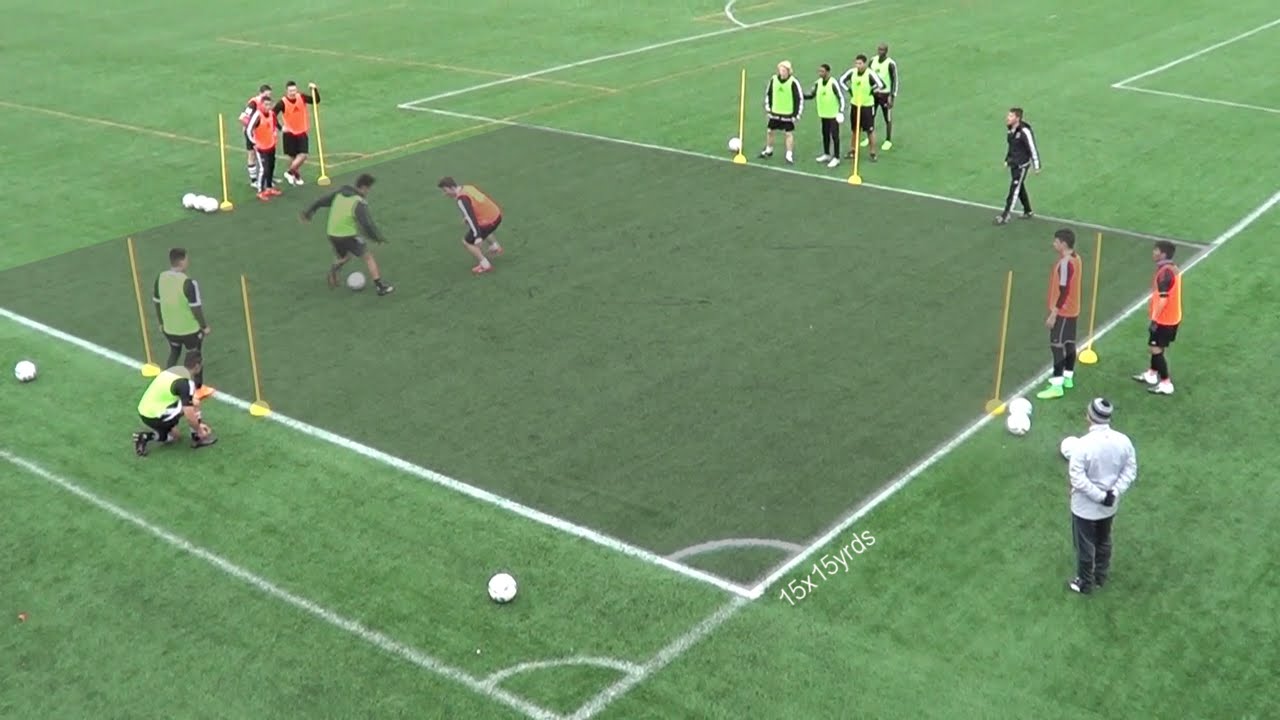 ▶ Watch on YouTube
1vs1 Dribbling Soccer Drill | Attacking & Defending Exercises — by Professional Soccer Coaching on YouTube.
 ▶ Watch on YouTube
1 ON 1 SOCCER MASTERCLASS - 1v1 Soccer Skill Moves, Drills, and Tips on How To Beat A Defender 1v1 — by Progressive Soccer on YouTube.
- Non Dominant Foot Development