
Youth Soccer Skill Development: A Complete Age-by-Age Guide for Parents and Coaches
Your 5-year-old and a 13-year-old are not playing the same game — and they shouldn't be trained like they are. US Soccer's Player Development Framework maps a deliberate progression from pure play at ages 4–6 all the way to 11v11 team shape at 13+. This guide walks through every phase:…
Youth Soccer Skill Development: A Complete Age-by-Age Guide for Parents and Coaches
Your 5-year-old and a 13-year-old are not playing the same game — and they shouldn’t be trained like they are. US Soccer’s Player Development Framework maps a deliberate progression from pure play at ages 4–6 all the way to 11v11 team shape at 13+. This guide walks through every phase: what the research and governing-body standards say, what to actually do at each age, and the mistakes that quietly derail players before they ever reach their potential.
Why this matters
Youth soccer in the United States has a well-documented problem: too many kids get too few touches, too much tactical instruction, and too little fun. The Player Development Initiatives (PDI) — US Soccer’s binding national standards — were built to fix that. They mandate smaller teams, smaller fields, smaller balls, and developmentally sequenced skill targets at every age. But knowing the standards exist and knowing how to apply them are different things. The gap between what the framework recommends and what actually happens on rec fields and club training pitches is wide. This guide is about closing that gap.
How the picture shifts with age
Early childhood (ages 4–6) is about movement and exploration, not soccer. Children this age are pre-operational thinkers — concrete, present-focused, unable to process abstract instruction. Their job is to fall in love with a ball. The coach’s job is to set up a fun environment and get out of the way.
The early school years (ages 7–9) are a sensitive period for motor pattern acquisition. The brain is highly plastic for skill learning right now, and habits established — both good and bad — are sticky. Ball mastery, both-feet development, and dribbling in 1v1 situations are the investment; tactics are not.
Pre-adolescence (ages 10–12) brings more sophisticated cognition and a longer attention span, but puberty is either approaching or beginning, and physical maturation varies wildly within any birth year. The skill window is still wide open. Technical quality — not physical dominance — is the right coaching lens.
Early adolescence (ages 12+) introduces the full 11v11 game, positional identity, and genuine tactical frameworks. But here’s the thing: everything tactical only works if the technical foundation underneath it is solid. Players who weren’t allowed to dribble, receive, and shoot with both feet for the previous eight years don’t suddenly develop those habits now. The U13–U14 phase consolidates what was built earlier and adds the complexity of team shape and transitions.
Age-specific guidance
Ages 4–6: Discovery, Movement, and Ball Exploration
The developmental reality. The US Soccer Player Development Framework divides U6 into two sub-phases. Discovery Phase I (roughly ages 4–5) is about fundamental movement — running, jumping, hopping, rolling, changing direction — and general ball play with hands and feet. Discovery Phase II (roughly age 6) introduces dribbling and shooting as the first soccer-specific skills. Neither phase is about tactics. Neither phase involves a goalkeeper.
What to do. The US Soccer PDI mandates 4v4 on a 25–35 yd × 15–25 yd field with no goalkeeper and a size 3 ball for U6. Four-on-four “beehive” games — small enough that every player is constantly involved — are the primary vehicle. Between and around those games, the coaching environment looks like this:
- Ball rolling and stopping: Let kids explore rolling a ball with their feet in any direction, then stopping it with the sole. No defined technique — the goal is foot-to-ball contact and curiosity.
- Dribble-and-freeze: Set up a 10 × 10 yd grid. Each player has a ball. On a signal, freeze. Build the start-stop habit through play, not drill.
- Kick-to-a-big-goal free shooting: Open goal, close range, no goalkeeper. Just encourage kids to shoot from whatever foot and angle they want.
- Tag games with a ball at the feet: Keep it moving, keep everyone involved, limit any single activity to 2–5 minutes before switching.
The US Soccer Player Development Framework is explicit that children at this age play at full speed with no internal sense of fatigue. Coaches must build rest into activity structure — not wait for kids to slow down on their own.
What the coach does — and doesn’t do. Short instructions only. Show, don’t explain. Positive, specific praise (“Nice! You stopped it with your foot!”). No tactical talk, no position assignments, no scorekeeping. The US Youth Soccer Small-Sided Games: A New Reality document lists the developmental psychology targets for this age as sharing, fair play, parental involvement, and emotional management — not tactical awareness.
Mistakes to avoid at this age: - Drill lines with kids waiting — dramatically reduces ball contact time and attention. - Assigning positions (“you’re the defender today”) — developmentally counterproductive and contrary to PDI standards. - Using a size 4 or 5 ball — too large, too heavy, impairs control and can reinforce poor mechanics. - Sessions longer than 45 minutes — attention and physical stamina don’t support it. - Any heading — US Soccer banned heading in training and matches for all players 10U and under in 2015. At ages 4–6, this is an absolute.
When to advance. When a child can dribble a ball through a space and stop it consistently, enjoys kicking toward a goal, and engages cooperatively in simple small games — they’re ready for the U7/U8 phase. That’s it. No tactical benchmark required.
Ages 7–9: Ball Mastery and the 1v1 Foundation
The developmental reality. This is the most valuable technical window in soccer development. Pre-pubertal brains are highly plastic for motor pattern acquisition — the US Soccer Creating a Pathway of Development document describes ages 8–12 as the ideal window for developing technique and coordination. What gets wired in now has high long-term transfer value. What gets skipped is genuinely hard to recover later.
US Soccer PDI standards: 4v4 (no goalkeeper) for U7–U8 with a size 3 ball; 7v7 (with goalkeeper) for U9 with a size 4 ball. No offside rule at 4v4; introduced at U9.
What to do. Every session should maximize individual ball contact. The skill targets from the US Soccer framework are:
- Sole rolls and toe taps — ball mastery warm-up, both feet, 2–3 minutes at the start of every session. Cues: “light touches, keep the ball close, switch feet.”
- Inside/outside foot dribbling with direction changes — set up cones 5–8 yards apart. Dribble to a cone, use an inside-foot cut to change direction. Progress to changing direction off either foot.
- 1v1 to mini-goals — one attacker, one defender, a 10 × 15 yd grid with two small goals. Three-minute rounds. This is the core competitive unit at this age.
- Inside-foot push pass introduction (U8–U9) — pass to a partner 5–8 yards away, rolling ball, inside of foot. Cue: “lock your ankle, follow through to your target.” Only introduce this after individual dribbling is solid.
- Instep drive shooting (U9) — instep (laces) contact on a stationary or slow-rolling ball from 8–10 yards. Cue: “toes down, hit through the center.”
Defending at this age is simple: one-on-one pressure, stay on your feet, slow the attacker down. No team defensive shape. The US Soccer framework explicitly reserves pressure-cover-balance for later.
Coaching approach. The research base for this age range supports varied, exploratory practice over repetitive blocked drills — a 2026 study in Biology of Sport (Hamaidi et al.) found that variable, exploratory practice within small-sided game contexts outperforms repetitive drills for skill acquisition. Practically: run 1v1 games, 2v2 games, and 3v3 games with different rules, not the same drill repeated twenty times.
Mistakes to avoid at this age: - Playing 11v11 or 9v9 — eliminates touches and decision-making; directly contradicts PDI standards. - Dominant-foot-only training — asymmetry developed by age 7 is hard to reverse after age 12. - Winning-oriented coaching at U7–U8 — standings and championships shift focus to physical dominance and risk excluding late developers. - Early goalkeeper specialization — a child permanently stationed in goal at U7–U9 misses hundreds of ball-contact repetitions during a critical window. - Constant sideline coaching during game flow — interrupts the problem-solving that small-sided games are designed to generate.
When to advance. A U9-ready player can dribble with both feet under light pressure, stop and redirect a rolling ball consistently with the inside of the foot, and complete a simple give-and-go pass with a teammate. They engage with the idea of “keeping the ball” rather than just kicking it away.
Ages 10–12: Technique Refinement and Contextual Decision-Making
The developmental reality. The skill window is still wide open — US Youth Soccer’s Small-Sided Games: A New Reality explicitly cites ages 8–12 as the ideal phase for developing technique and coordination. But two new variables are entering the picture: puberty and maturation variance. A 2024 scoping review in Human Movement found that early-maturing players cover significantly more distance in small-sided games, which means coaches who evaluate players by physical output are systematically confusing physical maturity with soccer skill. Assess technique, not outcomes.
US Soccer PDI standards: 7v7 for U10, 9v9 for U11–U12, both with a size 4 ball. Field size for 9v9 is 70–80 yd × 45–55 yd. Heading is prohibited for players 10U and below; for players 11–12, heading in training is limited to 30 minutes per week with a maximum of 20 headers per week.
What to do. The skill targets expand substantially:
- Ball mastery daily habit — sole rolls, inside/outside rolls, L-turns, step-overs with both feet. This stays in every warm-up even at this age.
- 1v1 attacking with feints — introduce the cruyff, scissors, and step-over in isolation first, then in a 1v1 to a mini-goal. Cue: “sell the move with your hips, not just your feet.” Progress: passive defender → active defender → conditioned small-sided game.
- Receiving on the half-turn — player receives a pass and opens their body to face forward rather than square or backward. Cue: “check your shoulder before the ball arrives, set your foot so your first touch goes forward.” Practice in pairs, then in 3v2 small games.
- Passing with timing — inside-foot pass and outside-foot pass at U11; driven passes over 15–20 yards at U12. The new demand is timing: the pass releases as the teammate moves, not after they stop.
- 9v9 with introductory shape — pressure-cover-balance for defending is developmentally appropriate at this level. One player closes the ball, the next provides cover, the third maintains balance. Teach this through freeze-and-discuss moments in 9v9 games, not through diagrams.
A 2025 study in Scientific Reports (Rahmoune et al.) found that small-sided game training produced broader physical and technical adaptation than isolated dribbling circuits alone — supporting the PDI philosophy of teaching through game play rather than drill-only approaches.
Mistakes to avoid at this age: - Using adult size 5 balls — still common in recreational leagues despite PDI requiring size 4. - Running fitness without the ball — aerobic work at this age should be ball-integrated. - Sideline coaching that removes decision-making — constant “pass it!” and “get back!” interrupts the game-sense development that is the primary cognitive-tactical goal. - Rewarding early maturers as “more talented” — cutting late-maturing players at U12 is one of the most well-documented talent identification errors in youth sport. - Locking a child into goalkeeper at U11–U12 — they’re forfeiting outfield development during a high-value motor learning window.
When to advance. A player ready for the U13 phase can receive a moving ball on the half-turn with a purposeful first touch, execute a give-and-go pass in a small-sided game without prompting, apply 1v1 defending by closing space and staying on their feet, and shoot with the instep from a realistic game distance.
Ages 12+: The 11v11 Game and Tactical Frameworks
The developmental reality. US Soccer’s framework moves players to 11v11 at U13+, with full-sized fields, a size 5 ball, and two 35–40 minute halves. Tactical frameworks — positional shape, transitions, pressing — are now developmentally appropriate because the cognitive capacity to understand them has arrived. But here’s the critical point from the US Soccer U13–U14 Learning Plan: individual technique still underpins everything. A player who can’t reliably receive under pressure won’t execute a wall pass in a positional structure, no matter how clearly you’ve drawn it on a whiteboard.
Puberty adds a major variable. Boys in a U14 group can differ in biological maturity by as much as 5–6 years relative to their chronological age, according to a 2024 Delphi study (van der Sluis et al.). Girls enter puberty earlier, roughly ages 11–13, and with it comes a meaningful increase in ACL injury risk — data from the National ACL Injury Coalition shows that serious knee injuries among teen athletes grew 26% from 2007 to 2022, with 57.5% of girls’ ACL injuries occurring without contact.
What to do. The US Soccer U13–U14 framework centers on:
- Scanning before receiving — a core cue for every receiving action. “Check over both shoulders before the ball arrives.” Build it as a habit in pair exercises before contextualizing in 11v11.
- Pressure–cover–balance as a defensive unit — the nearest player closes, the next provides cover at a diagonal, the third balances. Practice in 5v5 channels before running it in full-field scrimmage.
- Attacking and defending transitions — the US Soccer game model emphasizes counter-pressing: when possession is lost, react immediately with maximum intensity. Small-sided game condition: “your team must press for 6 seconds after losing the ball.” This trains the habit faster than any lecture.
- Combination play in positional context — wall passes and overlaps are no longer abstract; they happen within a positional structure. For example, a winger-fullback overlap drilled in a wide 3v2 before being introduced in 9v9 or 11v11.
- Player-led warm-ups — the US Soccer framework explicitly builds player-led warm-up routines and self-reflection into U13–U14 coaching. It develops ownership and self-efficacy. Let players run it, then debrief.
- FIFA 11+ warm-up protocol — this structured neuromuscular warm-up program has demonstrated 50–80% injury risk reduction in studies and should be introduced at U13+ given the ACL risk profile at this age.
Heading at 12+. Columbia University research cited in a 2026 analysis found that repetitive heading can damage the gray-white matter junction in the frontal lobe. Following the 2015 US Soccer heading ban, epidemiological data spanning 2012–2023 showed a 25.6% reduction in soccer concussions. For the 12+ group, heading is no longer prohibited by the U10 ban, but it should be introduced gradually, with proper neck-muscle development and limited training repetitions. Coaches should be current on their state association’s implementation of US Soccer heading guidelines.
Mistakes to avoid at this age: - Overloading tactical concepts before individual technique is stable — complex formations built on shaky technical foundations collapse in games. - Treating all players the same physically — a player at peak height velocity may have temporarily regressed in agility and ball mastery; that’s normal, not a sign to increase drilling volume. - Year-round single-sport soccer without a rest period — US Soccer’s PDI warns against this, and the overuse injury literature fully supports the concern. - Neglecting both feet — as positional play becomes the emphasis, coaches often allow dominant-foot defaults. This is the last window to insist on two-footed development before patterns calcify. - Constant sideline instruction — the PDI is explicit: coaches at this level should ask questions and facilitate reflection, not shout instructions throughout games.
When to advance. A player ready for the next developmental phase can scan reliably before receiving, apply pressure-cover-balance with their defensive unit without prompting, execute a combination pass in a game context, and self-correct in a player-led debrief.
Core concepts that apply across ages
*Fundamental Movement Skills* — The locomotor and object-manipulation foundation (running, jumping, kicking, catching) that must precede soccer-specific technique. US Soccer’s framework explicitly sequences these before any tactical content.
*Skill Before Tactics* — The overarching developmental philosophy running through all US Soccer PDI documents: technical competence enables tactical understanding, not the other way around.
*Small Sided Games* — Reduced-player formats (4v4, 7v7, 9v9) that increase individual ball contact, decisions-per-minute, and game realism. The research base consistently supports SSG training as the primary vehicle for youth technical and tactical development.
*Relative Age Effect* — The systematic over-selection of players born early in the registration year (January–March under US Soccer’s January 1 cutoff) due to developmental advantages that look like talent. Coaches at every age should guard against confusing relative age maturity with actual skill.
*Long Term Athlete Development* — The framework principle that youth sport decisions should be made for the athlete they will become at 18–22, not for the team they’re on at 9. Multi-sport participation, both-feet development, and positional rotation all flow from this principle.
*Multi Sport Participation* — US Soccer’s PDI explicitly recommends multi-sport involvement through at least age 12 to support broad motor development and reduce overuse injury risk.
Common mistakes (any age)
- Running adult training structures with kids — drill lines, long waits, and lecture-style technical instruction dramatically reduce ball contact time at every age, but the younger the player, the more damaging the effect.
- Assigning fixed positions before age 13 — positional rotation is both a safety principle (avoiding repetitive movement-pattern overuse) and a development principle through U12.
- Using the wrong ball size — size 5 with U12 players, size 4 with U8 players, any oversized ball at any age reinforces poor mechanics and can be physically hazardous.
- Introducing or continuing heading without following US Soccer policy — banned entirely for 10U and below; limited to 30 minutes / 20 headers per week in training for ages 11–13. Coaches who are unaware of these limits expose developing brains to unnecessary risk.
- Prioritizing team tactics over individual technique before the U13 phase — tactical frameworks built on weak technical foundations produce players who can recite a shape but can’t execute the touches required to run it.
- Coaching constantly during game flow — interrupts the problem-solving that small-sided games are specifically designed to generate; applies from U6 through U14.
- Early goalkeeper specialization — locking one child into the goalkeeper role at any age below U13 costs them outfield development during critical motor learning windows.
- Year-round single-sport play without an off-season — US Soccer’s PDI warns against this; the overuse injury and burnout literature fully supports recommending at least one substantial sport-specific rest period per year.
When and how to advance
The right signal to move a player into the next age band’s training approach is not birthday or team assignment — it’s demonstrated readiness in the criteria below.
| From phase | Core readiness markers |
|---|---|
| U6 → U7/U8 | Can dribble with purpose and stop the ball; engages cooperatively in simple 4v4 games; enjoying the activity |
| U7/U8 → U9 | Dribbles under light pressure with both feet; controls a rolling ball with inside of foot; beginning to pass intentionally to a teammate |
| U9/U10 → U11/U12 | Receives on the half-turn with a purposeful first touch; executes a give-and-go without prompting; applies 1v1 defending by closing space and staying on feet |
| U12 → U13/U14 | Consistently scans before receiving; applies instep drive and inside-foot placement shots in game contexts; engages with basic defensive shape concepts without constant prompting |
If a player is chronologically in the next age group but isn’t demonstrating readiness, continue the current phase’s work. The framework is developmental, not strictly age-gated.
Sources
- Player Development Initiatives (PDI) — US Soccer Federation (2017) — governing-body — https://static.ussdcc.com/users/148963/897090_eng-october2017pdi.pdf
- Small-Sided Games: A New Reality — US Youth Soccer — governing-body — https://www.usyouthsoccer.org/wp-content/uploads/sites/160/2023/09/Small-Sided-Games-A-New-Reality.pdf
- US Soccer Player Development Framework — Age Group Learning Plans (2024, via BASA) — governing-body — https://dt5602vnjxv0c.cloudfront.net/portals/768/docs/basa%20player%20development%20framework%202024.pdf
- Creating a Pathway of Development — US Youth Soccer — governing-body — https://www.usyouthsoccer.org/wp-content/uploads/sites/160/2023/09/Creating-a-Pathway-of-Development.pdf
- Small Sided Games — Coaching American Soccer — practitioner — https://coachingamericansoccer.com/tactics-and-teamwork/soccer-small-sided-games/
- US Soccer Player Development Framework — Age Group Learning Plans (2023, via Big Walnut Soccer) — governing-body — https://bigwalnutsoccer.com/wp-content/uploads/2025/03/us-soccer-player-development-framework-age-group-learning-plans.pdf
- Player Development Initiatives 2017 — US Youth Soccer Implementation Guide — governing-body — https://www.usyouthsoccer.org/wp-content/uploads/sites/160/2023/09/Player-Development-Initiatives-2017.pdf
- Effects of small-sided games and dribbling circuit training on physical and technical skills in youth soccer players — Rahmoune et al. (2025) — peer-reviewed — https://pubmed.ncbi.nlm.nih.gov/41381777/
- The effectiveness of differential learning in small-sided soccer games — Hamaidi et al. (2026) — peer-reviewed — https://pubmed.ncbi.nlm.nih.gov/41668942/
- US Youth Soccer Small-Sided Games Manual — governing-body — https://cdn3.sportngin.com/attachments/document/0024/5432/US_Youth_Soccer_Small_Sided_Games_Manual.pdf
- Role of Maturation on Small-Sided Games in Youth Soccer: A Scoping Review — Human Movement (2024) — peer-reviewed — https://hummov.awf.wroc.pl/Role-of-maturation-on-small-sided-games-in-youth-soccer-a-scoping-review,205321,0,2.html
- Effects of Pitch Size on Soccer Players’ Responses During Small-Sided Games: A Meta-Analytical Comparison (2023) — peer-reviewed — https://pmc.ncbi.nlm.nih.gov/articles/PMC9806761/
- Small-Sided Games in Youth Football: Advancing Technical–Tactical Performance and Social Inclusion — Sustainability / MDPI (2025) — peer-reviewed — https://www.mdpi.com/2071-1050/17/21/9563
- U13–U14 Learning Plan: 11v11 — US Soccer Player Development Framework (2023) — governing-body — https://cdn3.sportngin.com/attachments/document/2b24-3193718/9-us-soccer-player-development-framework-game-model-and-learning-plan-u13__2_.pdf
- US Soccer Grassroots Player Development Framework: 11v11 (Ages 13+) — governing-body — https://static.ussdcc.com/users/227808/458431/us-soccer-grassroots-11v11-player-development-framework.pdf
- Consensus on maturity-related injury risks and prevention in youth soccer: A Delphi study — van der Sluis et al. (2024) — peer-reviewed — https://pmc.ncbi.nlm.nih.gov/articles/PMC11556685/
- Analysis: Serious Knee Injury Among Teen Athletes Grows 26% — Project Play / Aspen Institute (2023) — academic — https://projectplay.org/news/2023/11/22/analysis-serious-knee-injury-among-teen-athletes-grows-26
- Heading Toward a Change: Shifts in Youth Soccer Safety Rules — Flagler College Gargoyle (2026) — other — https://gargoyle.flagler.edu/heading-toward-a-change-shifts-in-youth-soccer-safety-rules/
- Five Things to Know About US Soccer Player Development Initiatives — US Soccer (2017) — governing-body — https://ussoccer.com/stories/2017/08/five-things-to-know-about-us-soccer-player-development-initiatives
Further reading
- Fundamental Movement Skills — Deep dive into locomotor and object-manipulation development in early childhood
- Small Sided Games — Research review of SSG formats, player numbers, and pitch sizes across age groups
- Long Term Athlete Development — The LTAD framework and how US Soccer’s PDI fits within it
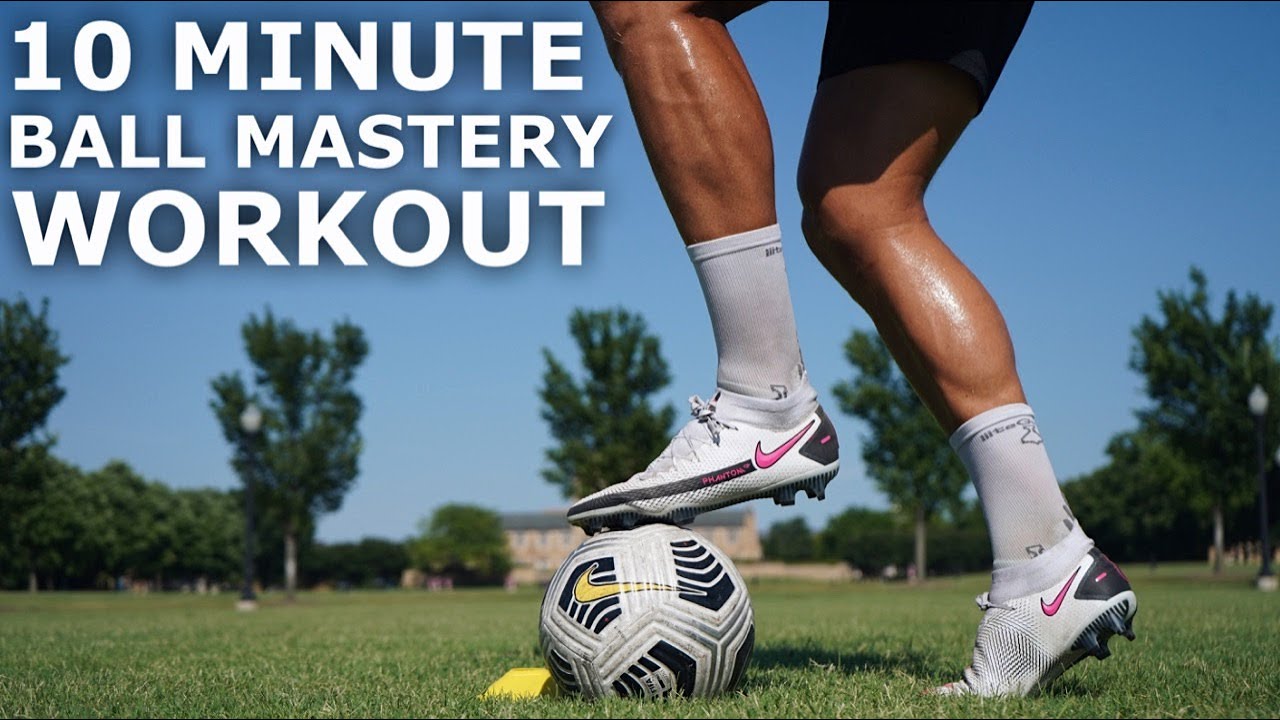 ▶ Watch on YouTube
Easy 10 Minute Ball Mastery Workout | Simple Ball Mastery Exercises For Footballers — by 7mlc on YouTube.
— Sole rolls, toe taps, L-turns, and step-overs with both-feet emphasis by age group - Acl Injury Prevention Youth — FIFA 11+ warm-up protocol and neuromuscular training for adolescent athletes